Spot Welding Parts Glossary: 25 Terms Every Buyer Should Know

Sourcing spot welding parts means reading quotes, drawings, and supplier conversations packed with terms that everyone assumes everyone else already knows. A buyer who confidently orders “Class 2 caps” without knowing what RWMA class means, or who nods along to “the pin is shunting” without picturing what is happening, is one misunderstanding away from a wrong order — and wrong orders in this category tend to be discovered weeks later, on the line, at the worst possible moment. This glossary defines the 25 spot welding terms that actually come up when you are buying parts — not an academic dictionary, but the working vocabulary of a purchasing conversation, written so a non-welder can follow it.
We have grouped the terms by what they describe: the process, the electrodes and consumables, the materials, the failure modes, and the purchasing language. Where a term connects to a deeper article we have written, the link is there if you want to go further. None of these definitions assume prior welding knowledge — if you are a purchasing professional who inherited a spot welding parts category and is learning it on the job, this is written for you as much as for the engineer who already lives in this vocabulary.
Spot Welding Process Terms
These are the foundational spot welding terms that describe how the joint is actually made.
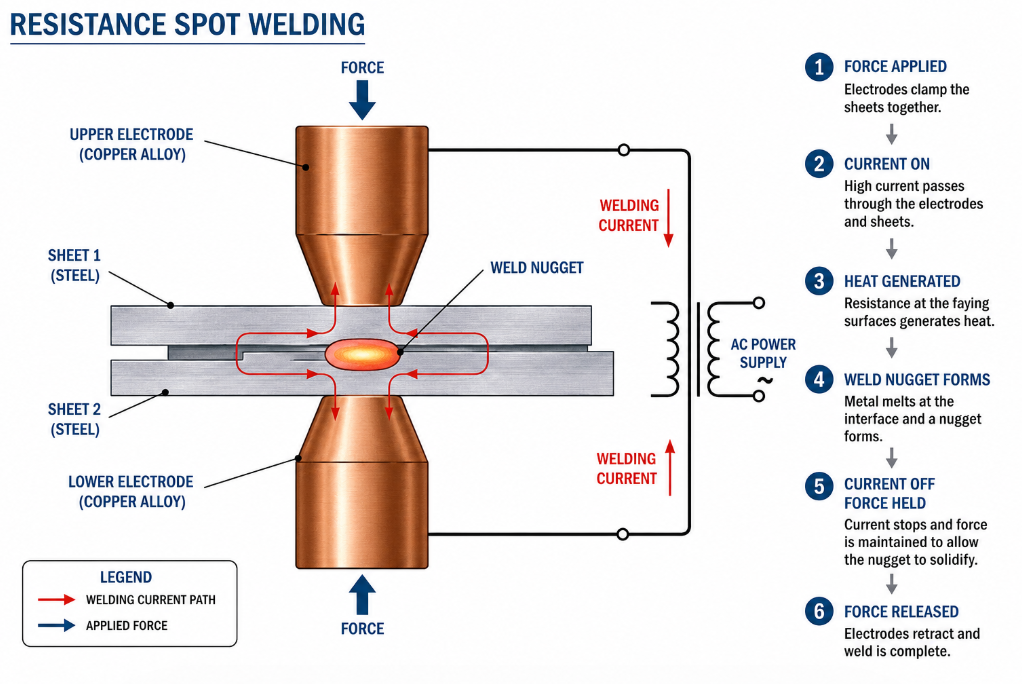
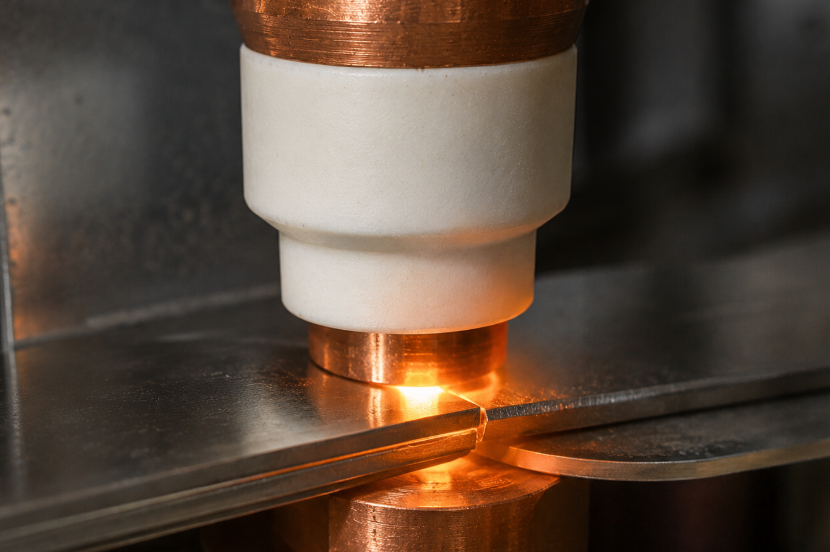
Resistance spot welding (RSW). The core process: two metal sheets are pressed together between electrodes, and a burst of current passes through them. Because metal resists current flow, heat builds at the contact point and melts a small pool that solidifies into a weld. No filler, no flame — just current, resistance, and force. For a buyer, the practical implication is that everything you purchase in this category exists to deliver current, apply force, or locate parts within that simple three-ingredient process.
Weld nugget. The small lens of melted-then-solidified metal that forms the actual joint. Nugget size largely determines weld strength, which is why much of welding engineering is really about controlling nugget formation. When someone says a weld is “undersized,” they mean the nugget is too small — and that often traces back to a consumable problem like a mushroomed cap or current lost to shunting.
Projection welding. A variant where small raised bumps (projections) on one part concentrate the current and force at chosen points, so the weld forms exactly where the projection sits. Weld nuts use this — the nut’s projections are designed to melt and fuse to the panel. Projection welding is why precise part location matters so much, and therefore why locating pins are a category of their own.
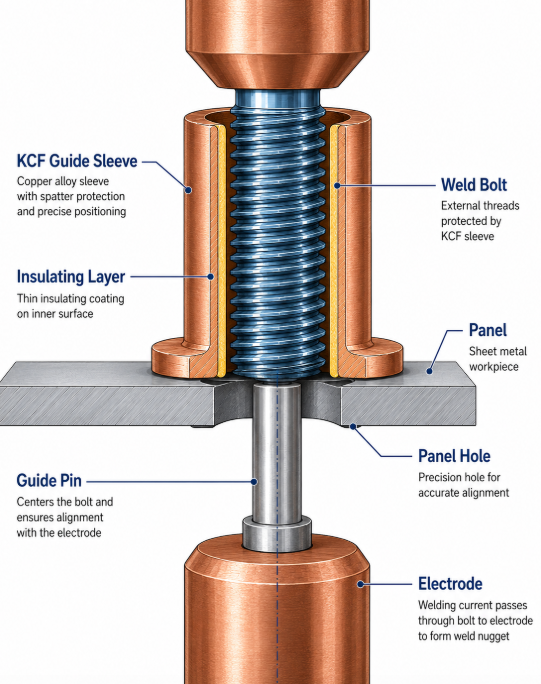
Nut welding. Projection welding applied specifically to attach a weld nut to sheet metal, creating a threaded mounting point. A locating pin positions the nut before the weld fires. This is the single most common application for the KCF guide pins we make, and the one where pin choice most directly affects weld quality.
Seam welding. A continuous series of overlapping spot welds made by rotating wheel electrodes that roll along the joint, producing a leak-tight seam rather than discrete spots. Used for fuel tanks, drums, and anything that must not leak. Seam welding consumes wheel electrodes rather than caps, a different wear pattern with its own material considerations.
Weld schedule. The recipe for a weld: the current, weld time, electrode force, and timing the machine applies. A correct schedule is matched to the material and thickness being joined; an inherited or guessed schedule is behind a surprising share of quality problems. Many issues blamed on parts are really schedule issues, which is why a good supplier asks about your schedule before blaming or replacing a consumable.
Duty cycle. How hard a station runs — roughly, welds per minute and how continuously. Duty cycle drives how much heat accumulates in electrodes and consumables, which in turn drives how fast they wear. Two plants buying identical caps can see very different cap life purely because their duty cycles differ, so it is always part of an honest life expectation.
Electrode and Consumable Terms
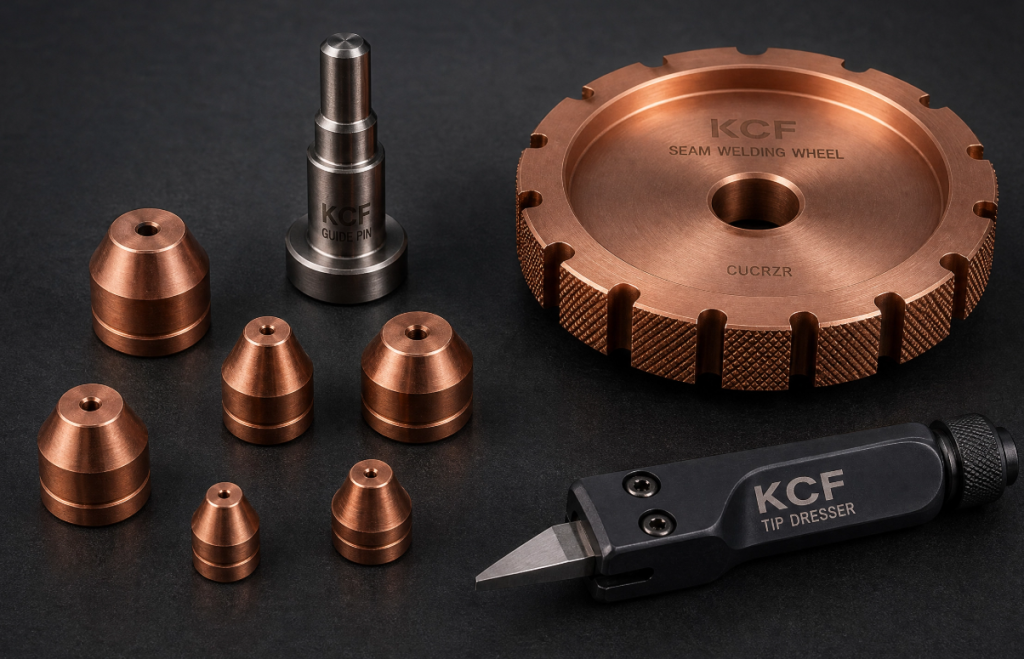
This is the vocabulary of the parts you actually buy. These spot welding terms describe electrodes, caps, and the locating components that make a weld possible.
Electrode. The current-carrying, force-applying part that contacts the workpiece. In spot welding it both delivers the weld current and presses the sheets together, then helps cool the spot afterward. Electrodes are consumables — they wear and get replaced. The word covers a family of parts: the cap, the shank, and on seam machines the wheel.
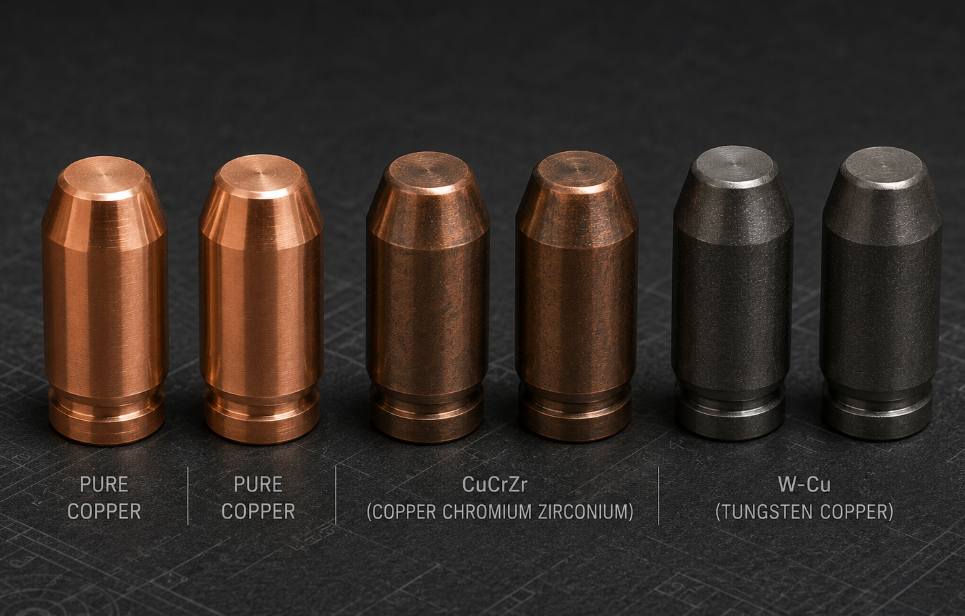
Cap (electrode cap / tip). The replaceable working end of an electrode that actually touches the part. Caps wear fastest and are swapped most often, which is why their material and quality dominate consumable cost. Because they are the highest-turnover part, caps are also where substandard material does the most financial damage. Our copper spot welding electrodes cover this category.
Shank. The body of the electrode that holds the cap and carries cooling water and current up to it. Longer-lived than the cap but still a wear and fit-critical part — a poor cap-to-shank fit hurts both cooling and current transfer, so the interface matters as much as either part alone.
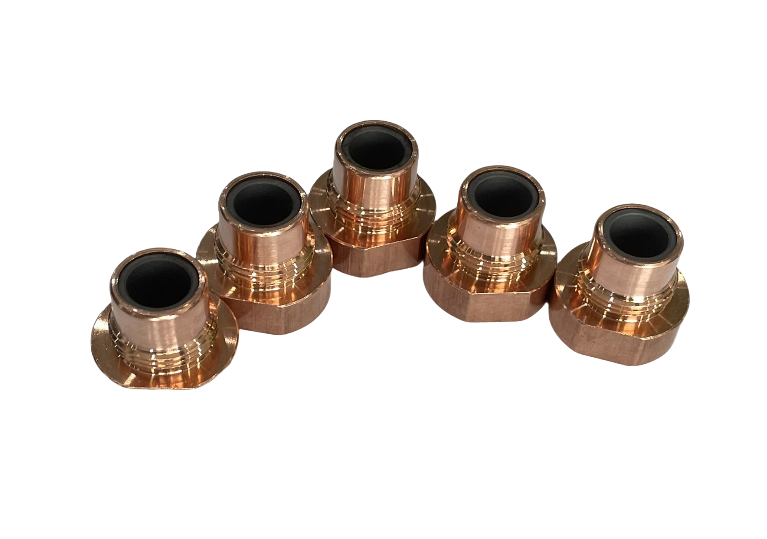
Guide pin (locating pin). The pin that positions a nut, bolt, or stud over the weld point and holds it there during welding — ideally without conducting current. A conductive pin invites shunting and sticking; an insulated one prevents both. For why an insulated pin matters here, see our explainer on KCF guide pins.
Guide sleeve. A sleeve working with or around a guide pin to locate a fastener or guide its motion, common in bolt and stud welding setups. Like pins, sleeves can be insulated where they sit in the current path, and like pins they need to match the fastener they guide.
Seam welding wheel. The rotating disc electrode used in seam welding. Its profile, diameter, and material determine weld quality along the seam, and like caps it is a wear part — though it wears across a rolling surface rather than at a single face.
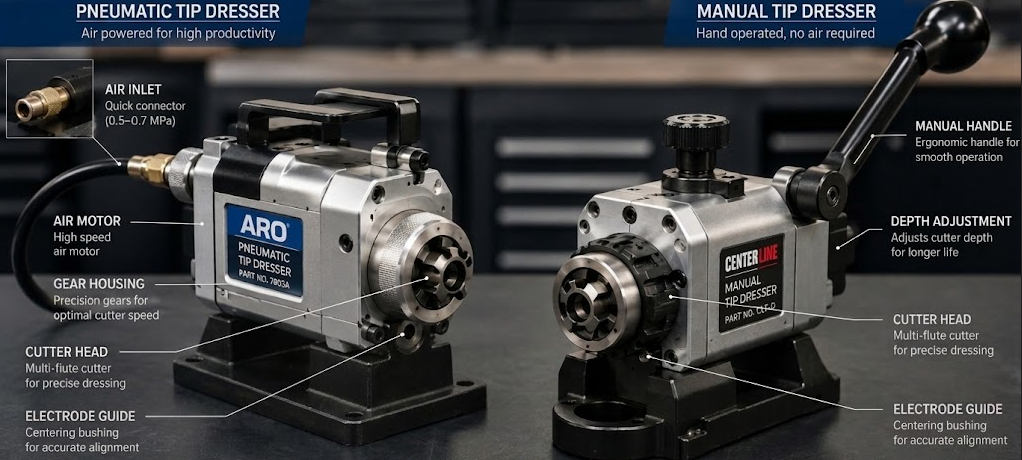
Tip dresser. A tool that re-cuts a worn electrode cap back to its correct face geometry, restoring weld quality and extending cap life. Regular dressing is one of the cheapest ways to extend consumable life, which is why it earns its own tool category. Our cap tip repair tools cover dressers and grinders.
Nut feeder. An automated device that presents weld nuts to the welding station in correct orientation and timing, replacing manual placement and boosting line output. On high-volume lines, feeder reliability directly affects throughput, so jam-resistance and correct sizing for your specific nut matter as much as raw feeding speed.
Material Terms
Material choice governs how long a part lasts and what it can weld. These spot welding terms describe the alloys and standards behind the parts.
RWMA class. The Resistance Welding Manufacturers Alliance classification (now under the American Welding Society) that groups electrode materials by conductivity and strength. It lets a buyer specify a material’s properties with a single shorthand instead of a full metallurgical description. The four-class framework and what each class is suited for is summarized well in the Copper Development Association’s overview of high-copper welding alloys, and the underlying material classes are defined in the AWS RWMA Resistance Welding Manual.
CuCrZr (chromium zirconium copper). The workhorse RWMA Class 2 electrode alloy — copper with small chromium and zirconium additions that, after aging heat treatment, resist softening at welding temperatures. The default choice for steel. See our CuCrZr versus pure copper comparison for when it wins.
Pure copper (Class 1 type). High-conductivity, low-strength copper used where maximum current delivery matters more than hot strength — chiefly welding aluminum and other high-conductivity metals. On steel it mushrooms quickly, which is the most common material mismatch buyers make.
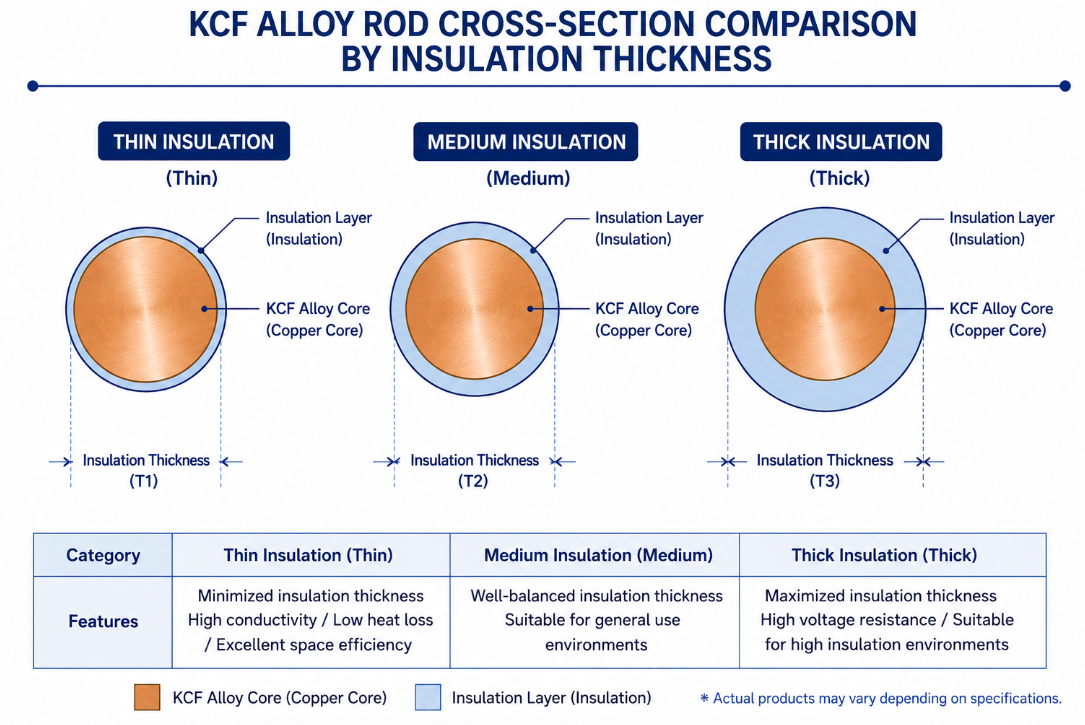
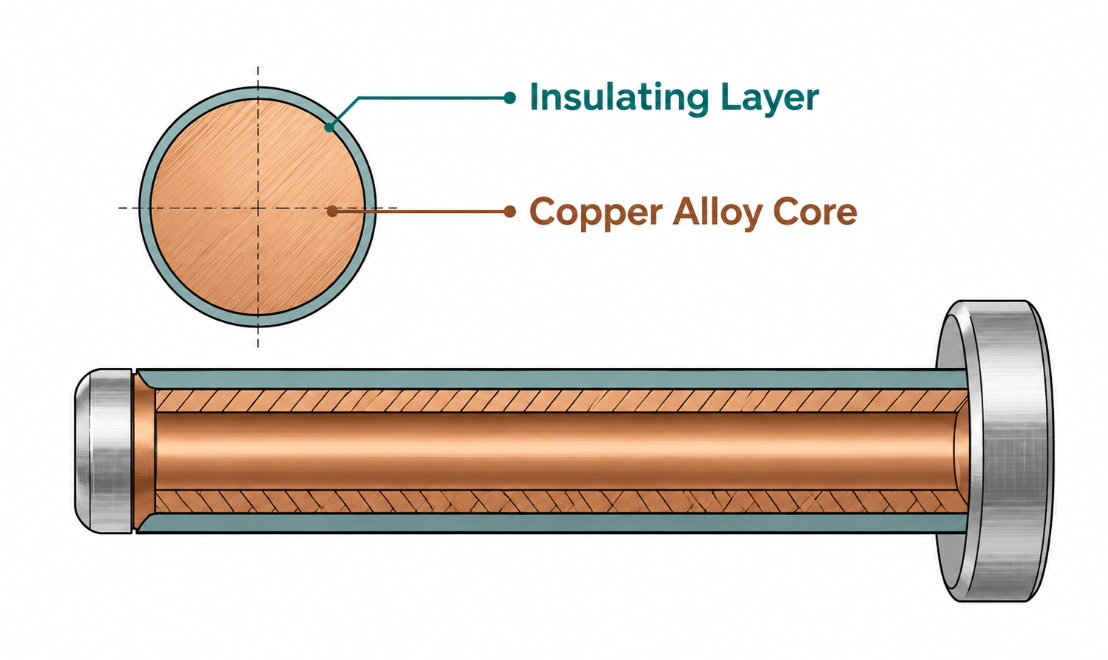
KCF alloy. A copper-based material carrying a hard insulating surface layer, used for locating components that must position a fastener without conducting current. The insulation, not the copper, is the functional part. See what KCF alloy is for the full picture.
Aging (precipitation heat treatment). The controlled heat treatment that gives CuCrZr its hot strength by forming fine strengthening particles. Material with correct chemistry but no aging behaves like soft copper — a hidden trap covered in our CuCrZr article. This is why a composition report alone does not fully verify a Class 2 electrode; the heat-treatment condition matters too.
IACS (% conductivity). The International Annealed Copper Standard, which rates conductivity as a percentage of pure soft copper at 100%. A quick way to read whether a material is pure copper (high-90s) or an alloy (70s–80s) from its certificate — and a fast sanity check when a claimed class and a claimed conductivity number do not match.
A note on why the material vocabulary is worth the effort: more money is lost in this category to material confusion than to any other single cause. A wrong process term might produce an awkward conversation, but a wrong material term — ordering pure copper for steel, accepting un-aged bar as aged, paying for an alloy and receiving plain copper — produces a recurring cost that compounds every shift until someone catches it. The six material terms above are the ones most worth committing to memory, because they are the ones standing between a buyer and the most expensive mistakes the category offers.
Failure Mode Terms
These spot welding terms name the things that go wrong — the vocabulary you need to describe a problem to a supplier accurately.
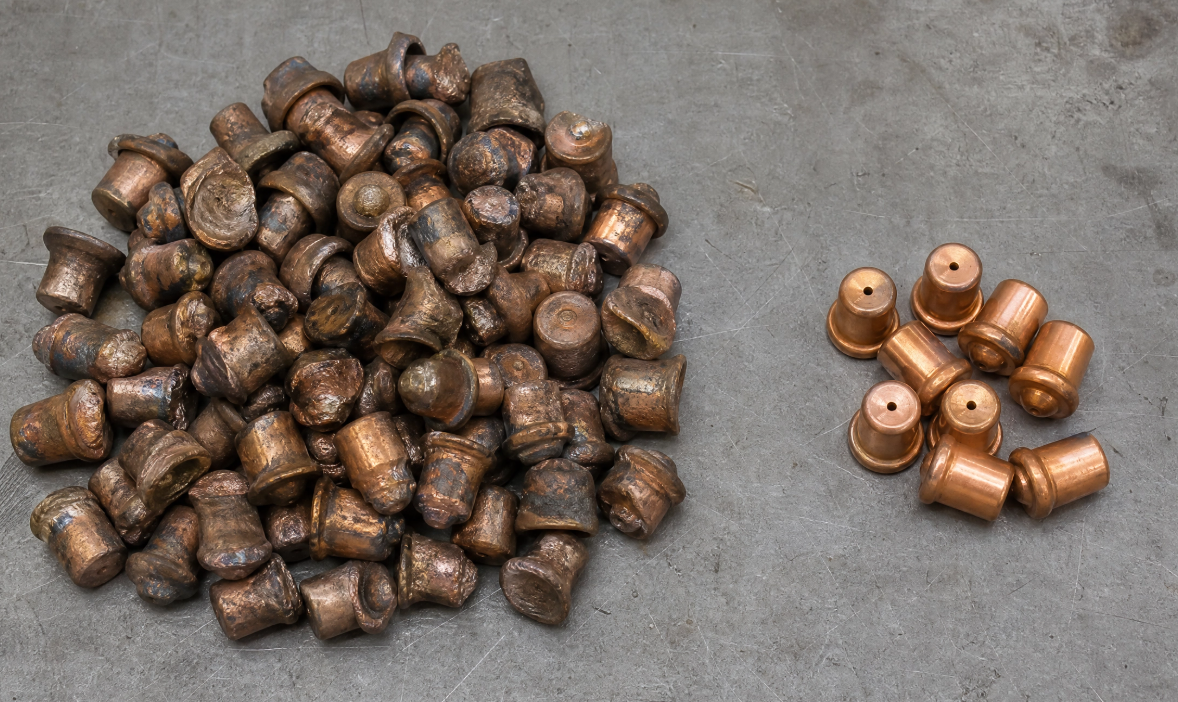
Mushrooming. When an electrode cap face spreads and flattens under heat and force, growing past its intended diameter. The expanded face lowers current density and degrades welds, and it is the classic end-of-life mode for caps, especially soft ones on steel. If your caps mushroom fast, the cause is usually one of: wrong material for the workpiece, poor cooling, excess current, or a missed dressing schedule.
Shunting. When welding current finds an unintended parallel path — through a previous weld, a conductive fixture, or a conductive locating pin — instead of the intended joint. The diverted current weakens the real weld. An insulated KCF pin exists largely to prevent pin-path shunting; see why nut welding electrodes stick. Shunting is insidious because it weakens welds without any visible drama at the joint.
Expulsion (spatter). Molten metal violently ejected from the joint when heat input exceeds what the weld can contain. Expulsion signals excess current, wastes energy, and sprays deposits that cause sticking and wear. Treat recurring expulsion as an alarm telling you the parameters are too hot, not as a normal part of welding.
Sticking. When a nut, panel, or workpiece fuses or jams to an electrode or pin instead of releasing cleanly. Causes range from a conductive pin to expulsion deposits to zinc transfer on galvanized sheet. Because the causes differ, the first diagnostic question is always “what exactly sticks to what?”
A Quick-Reference Glossary Table
For scanning, here are the 25 terms grouped by category:
| Category | Terms |
|---|---|
| Process | Resistance spot welding, weld nugget, projection welding, nut welding, seam welding, weld schedule, duty cycle |
| Electrodes & consumables | Electrode, cap, shank, guide pin, guide sleeve, seam welding wheel, tip dresser, nut feeder |
| Materials | RWMA class, CuCrZr, pure copper, KCF alloy, aging, IACS |
| Failure modes | Mushrooming, shunting, expulsion, sticking |
Terms Buyers Most Often Confuse
A few of these spot welding terms get mixed up constantly, and the confusion leads directly to ordering mistakes. Clearing them up is worth a short section.
Electrode versus cap: Buyers often use “electrode” when they mean “cap,” and vice versa. The distinction matters at order time: a cap is the small replaceable tip, while the electrode is the whole assembly. Asking for “electrodes” when you need caps, or quoting one against the other, produces price comparisons that are not comparing the same thing. When in doubt, describe the part by what it does — “the replaceable tip that touches the panel” — and let the supplier name it.
Guide pin versus electrode: These do opposite jobs and are sometimes lumped together because both are small metal parts sitting in the welding zone. The electrode conducts current; the guide pin should not. Confusing them is exactly how a conductive pin ends up where an insulated one belongs, with shunting and sticking as the result. If a part’s job is to locate without conducting, it is a guide pin and wants KCF, not electrode copper.
Mushrooming versus wear: Not all electrode degradation is the same. Mushrooming is specifically the face spreading wider under heat and force; ordinary wear is material slowly abrading away. They have different causes and different fixes, so describing which one you see helps a supplier diagnose. “The face is getting bigger” (mushrooming) points at heat, material, or cooling; “the face is eroding away” points more at abrasion and dressing.
Shunting versus expulsion: Both weaken welds, but they are nearly opposite problems. Shunting is current going where it should not, often producing a quiet undersized weld with no visible sign. Expulsion is too much energy at the joint, producing a violent, visible splash. A weld that looks fine but tests weak suggests shunting; a weld throwing sparks suggests expulsion. Naming the right one sends the supplier down the right diagnostic path.
CuCrZr versus pure copper: The most consequential material confusion, covered in depth in our dedicated comparison. The short version for a glossary: pure copper conducts better, CuCrZr holds up to heat better, and which one is “right” depends entirely on whether you weld steel (CuCrZr) or aluminum (pure copper). Treating them as interchangeable copper is the root of a whole family of consumable problems.
How These Terms Connect in a Real Purchase
Terms are easier to remember when you see them work together. Here is how they chain in a typical nut welding purchase:
| You are buying | Terms in play |
|---|---|
| Caps for a steel line | Electrode, cap, CuCrZr, RWMA class, aging, mushrooming, duty cycle |
| Guide pins for nut welding | Nut welding, projection welding, guide pin, KCF alloy, shunting, sticking |
| A tip dressing setup | Tip dresser, cap, mushrooming, weld schedule |
| A nut feeder upgrade | Nut feeder, nut welding, duty cycle |
| Aluminum welding caps | Electrode, pure copper, IACS, weld nugget |
Read across any row and you have the working vocabulary for that conversation. A buyer who can say “I need aged CuCrZr caps for a steel line that are mushrooming too fast at our duty cycle” will get a far better answer than one who asks for “some copper tips that last longer” — because the first sentence tells the supplier exactly what to diagnose.
This is the quiet payoff of a glossary: it is not about vocabulary for its own sake, but about compressing a paragraph of explanation into a single precise word that a supplier can act on. “Mushrooming” tells a supplier to look at heat, material, and cooling. “Shunting” sends them to look at current paths and fixture conductivity. “Un-aged” points straight at heat treatment. Each correct term is a shortcut past a round of back-and-forth, and on an urgent line-down call, those shortcuts are worth real time. The buyers who get fast, accurate help are almost always the ones who can name the problem in the supplier’s own language.
Why This Vocabulary Pays Off
Knowing these spot welding terms is not about sounding expert. It is about three concrete advantages in purchasing. First, precision: a quote request using correct terms returns an accurate quote instead of a guess. Second, verification: you cannot check whether you received aged CuCrZr if you do not know aging exists. Third, diagnosis: when a problem appears, naming it correctly — shunting versus expulsion versus mushrooming — is half the path to fixing it, because each word points at a different cause.
The suppliers worth working with will happily explain any of these terms in depth; a supplier who gets vague or impatient when you ask precise terminology questions is telling you something useful about how the relationship will go.
There is also a quieter benefit for buyers new to the category: this vocabulary is the entry ticket to evaluating suppliers at all. You cannot tell a knowledgeable supplier from a box-shifter if you cannot follow the technical conversation, and you cannot follow it without the words. A reseller can recite a catalog; only someone who understands the process can answer a follow-up question about why your caps mushroom or whether your pin might be shunting. Knowing these terms lets you ask the follow-up questions that separate the two — which is, in the end, what the supplier selection checklist is built around. Vocabulary and vetting are the same skill viewed from two angles.
A glossary looks like reference material, but for a buyer it is really a checklist of things worth understanding before money changes hands. The 25 terms here are the ones that recur in spot welding parts purchasing, and each one, understood properly, removes a place where a wrong order or a missed quality problem could hide. Bookmark this page and it doubles as a quick reference the next time a quote or drawing uses a word you want to pin down before approving the order.
If a term you have encountered in a quote or drawing is not here, or if you want to go deeper on any of the parts these terms describe, send us the term and the context. We would rather answer a terminology question now than ship the wrong part because the vocabulary did not line up. Explore our parts categories through the links above, or get in touch with the specifics of what you are sourcing — a clear question in this vocabulary almost always gets a clear, fast answer back.
Share This Article
Latest Articles
October 19, 2026
October 19, 2026
October 19, 2026
October 19, 2026
October 19, 2026

October 19, 2026
October 19, 2026
October 19, 2026