KCF Guide Sleeves for Bolt & Stud Welding: Protecting Threads

When you projection-weld a bolt or a stud to a panel, you face a problem that nut welding mostly does not: there are external threads right next to the weld, and welding current plus heat can damage them. A bolt that welds perfectly but arrives with scorched or distorted threads is a rejected part. This is where the guide sleeve earns its place in bolt and stud welding — it locates the fastener accurately and, just as importantly, protects the threads from the welding current. This article is about guide sleeves in the specific context of bolt and stud welding, where thread protection makes the sleeve’s insulating function not just useful but essential.
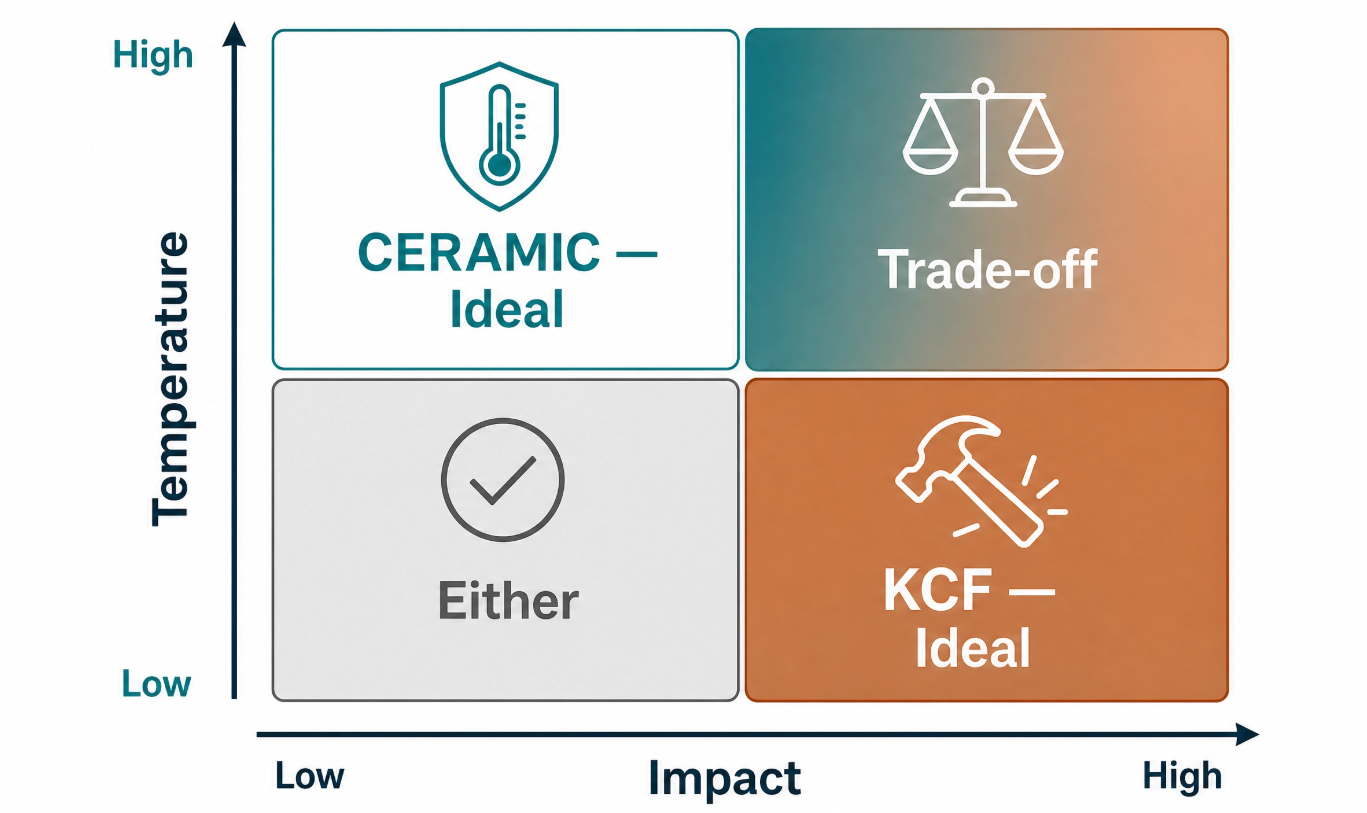
If you want the ceramic-versus-KCF material comparison for sleeves generally, our guide to ceramic vs KCF guide sleeves covers that decision; here the focus is the bolt-and-stud application and what it specifically demands of the sleeve.
Bolt and Stud Welding vs Nut Welding: Why the Sleeve Matters More
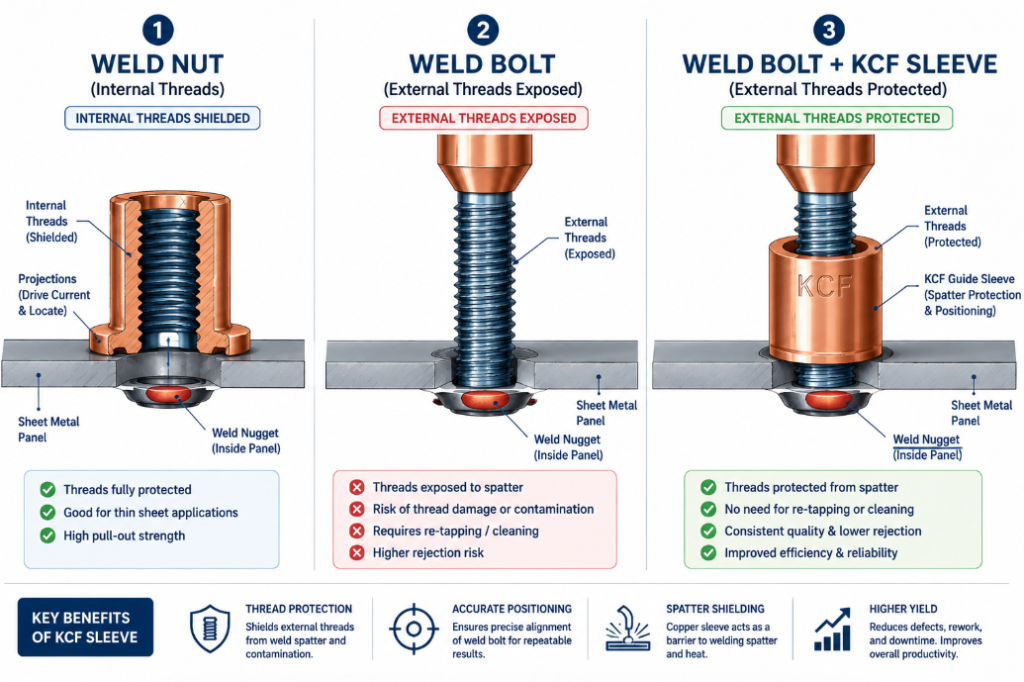
Nut welding and bolt or stud welding look similar but pose a different challenge to the locating components, and the difference centers on threads. A weld nut has internal threads, tucked inside the part where the weld geometry largely shields them. A weld bolt or stud has external threads, exposed on a shank that often passes through the panel right where the welding action happens. Those exposed external threads are vulnerable in a way internal threads are not.
This is why insulation is the headline requirement here. In through-hole bolt and stud applications, the locating component must protect those threads from the weld current — industry practice is explicit that locator pins with insulated sleeves are used specifically to protect threads from weld current in through-hole applications. A conductive component touching the threaded shank during welding can let current flow where it shouldn’t and damage the threads; an insulated sleeve prevents exactly that. Thread damage is the failure mode that bolt and stud welding most needs to design against, and the sleeve’s insulation is the primary defense.
Two other differences raise the demands on a bolt or stud sleeve. Bolts and studs are typically longer than the profile of a weld nut, so the guiding requirement is greater — a longer fastener needs more positive guidance to stay aligned through the weld. And stud welding often runs at a fast cycle rate, which means the sleeve must be wear-resistant to hold its accuracy over high volume. Length and speed both push the sleeve harder than a typical nut application does.
The length factor deserves a closer look, because it changes the geometry of the locating problem. With a short weld nut, the locating component only has to position a shallow part — there is little lever arm for the fastener to tilt around. A long bolt or stud is different: a small angular error at the base becomes a large positional error at the tip, so the further the fastener extends, the more precisely it must be guided to stay square and on-center. Weld bolts designed for through-hole applications are specifically engineered to be self-locating, available across a range of thread sizes, diameters, and lengths, as fastener manufacturers detail in their projection weld bolt specifications — but the welding-side guidance still has to match, and that guidance comes from the sleeve and any pin working with it. This is the same accuracy principle covered in our article on guide pins in welding accuracy, amplified by the fastener’s length: the longer the part, the less tolerance there is for a sloppy guide.
What a KCF Guide Sleeve Does in Bolt and Stud Welding
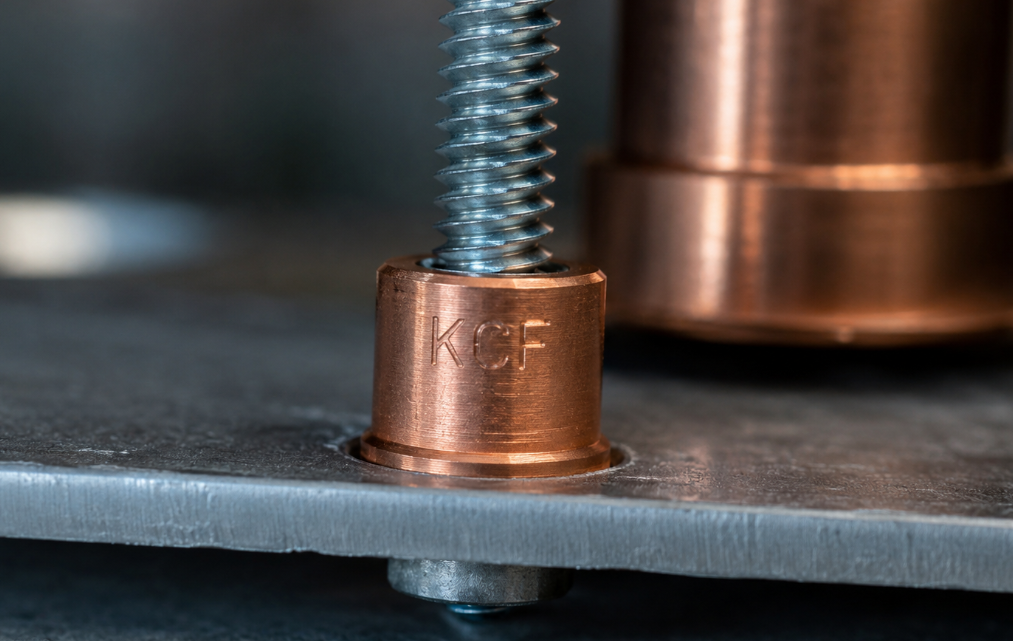
In the bolt and stud welding we supply sleeves for, the KCF guide sleeve performs a set of related jobs:
It guides the bolt or stud through the panel hole. The sleeve locates the fastener and guides its shank into and through the hole in the workpiece, registering it correctly for the weld. For longer fasteners, this guiding role is more demanding and more important than for a short nut.
It houses the threaded portion to protect the threads. The sleeve can surround the threaded section of the bolt, shielding those threads during the weld. This protective enclosure is much of the point in a threaded-fastener application.
It works together with a guide pin. In many setups the sleeve and a pin work as a pair — the pin sitting within the sleeve to locate the bolt — combining the sleeve’s protection with the pin’s central location. The interplay of sleeve bore and pin diameter is its own specification, covered in our sleeve comparison piece.
It is worth understanding why this pairing is common in bolt and stud work specifically. The sleeve does the job of surrounding and protecting the threaded shank, while a pin can provide precise central location — and on a long fastener, having both an outer guide (the sleeve) and a central reference (the pin) controls the fastener more completely than either alone. The sleeve resists the threaded shank tilting; the pin keeps the center true. For this to work, the clearance between the pin’s outer diameter and the sleeve’s inner bore has to be specified deliberately: tight enough that the pair locates precisely, loose enough that nothing binds as both parts heat during the weld. When a customer asks us for a sleeve-and-pin set for bolt work, we treat that mutual clearance as a real specification rather than assuming two separately-correct parts will work together — because, as with any mating pair, two parts each right on their own can still fail as an assembly if their fit was never specified.
It locates studs in stud welding. For stud welding specifically, the sleeve positions the stud accurately for projection welding to the panel, whether the stud passes through the sheet or attaches to its face. Stud welding electrodes are designed for projection welding screws, bolts, or pins in exactly these two configurations, and the sleeve is what holds the stud in correct position for a clean, square weld.
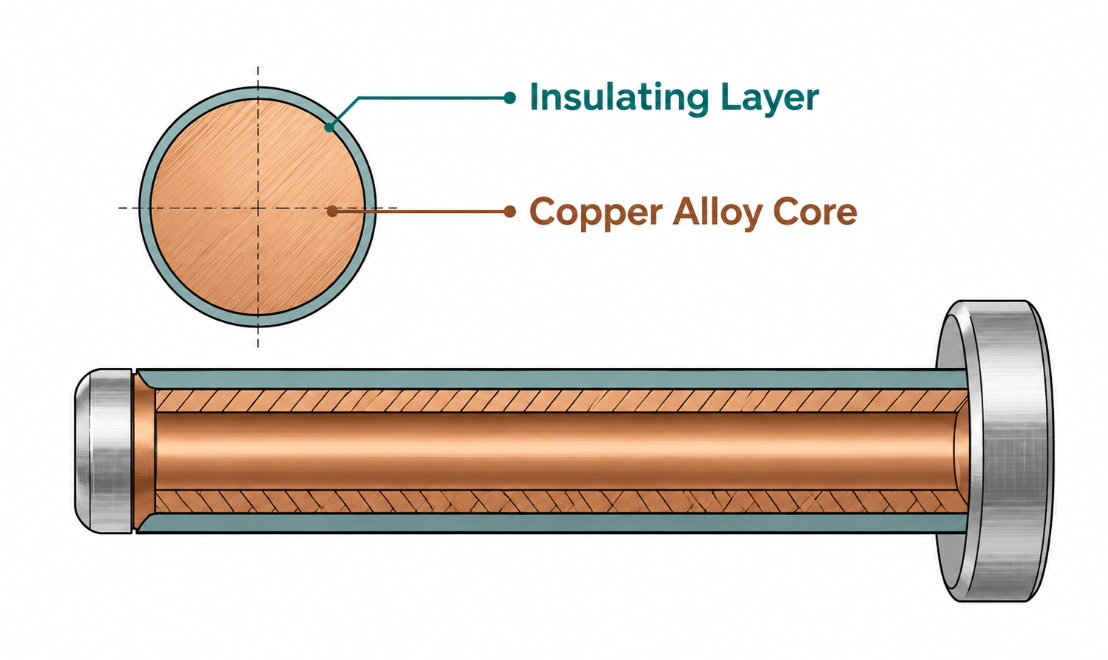
It isolates the welding current to protect threads and prevent shunting. This is the function that ties the others together. The sleeve’s insulating character keeps welding current from flowing through the sleeve into the threads — protecting the threads and preventing the stray current (shunting) that degrades weld quality. Industry systems include insulating sleeves precisely to prevent damage to the stud during the welding cycle, and to ensure good thread quality in the finished assembly.
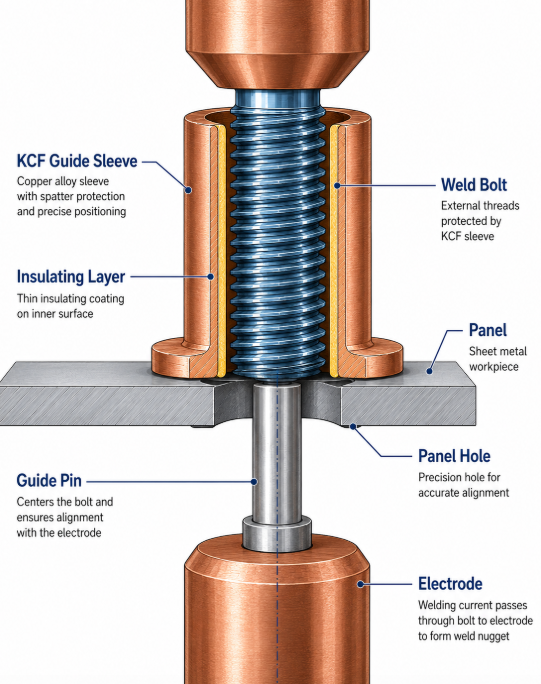
This last point is why KCF suits the application so well: the insulating layer lets the sleeve protect threads and resist shunting while still being a machinable, tough metal-cored part — insulation and durability in one component.
Table 1 — Guide Sleeve Jobs in Bolt/Stud vs Nut Welding
| Function | Nut Welding | Bolt / Stud Welding |
|---|---|---|
| Thread type at risk | Internal (shielded) | External (exposed) — higher risk |
| Thread protection need | Lower | High — primary design concern |
| Guiding demand | Moderate | Greater (longer fastener) |
| Wear demand | Application-dependent | High in fast stud cycles |
| Insulation role | Prevents shunting | Prevents shunting AND protects threads |
The right-hand column is consistently more demanding, which is the core message: a sleeve that is adequate for nut work may be under-specified for bolt and stud welding, where threads and length raise the bar.
Selecting a KCF Guide Sleeve for Bolt and Stud Welding
Choosing a sleeve for this application comes down to four specifications, each tied to the demands above.
Bore diameter and tolerance matched to the bolt. The sleeve’s inner bore must match the bolt or stud diameter with the correct fit — accurate enough to locate and guide the fastener, without binding. This is the foundational specification, and getting the bore-to-bolt fit right is what makes the sleeve locate accurately. The same bore-and-tolerance logic detailed in our KCF alloy rod specifications guide applies directly to sleeve bores.
Wall thickness balanced for strength. The wall — between bore and outer diameter — must be thick enough to resist cracking and deformation, but consistent with the bore and OD the application needs. Too thin and the sleeve becomes fragile under the mechanical and thermal load of a fast stud line; the wall has to balance durability against the dimensions the fastener requires.
Wear- and heat-resistant material. Because stud welding can run fast and hot, the sleeve material must resist wear (to hold its locating accuracy over volume) and tolerate the heat near the weld. A sleeve that wears or softens quickly loses both its accuracy and its protective function.
The fast-cycle demand of stud welding makes this more pointed than it first sounds. On a high-throughput stud line, a sleeve may locate thousands of fasteners per shift, and every cycle puts a small amount of wear on the bore and exposes the sleeve to weld heat. A sleeve material that wears even slightly faster than ideal will, over that volume, lose bore accuracy — and as the bore opens up, the fastener locates less precisely and the threads sit closer to the sleeve wall, eroding the very thread protection the sleeve exists to provide. So wear resistance is not a separate nice-to-have from thread protection; on a fast line, holding the bore dimension is what keeps the thread protection working over time. This is why a tough, wear-resistant metal-cored material has a real advantage in high-volume stud work over a more brittle alternative, even setting aside the impact resistance that thin sleeve walls benefit from.
Custom bore and OD to the bolt specification. Bolts and studs come in many sizes, so the ability to machine the sleeve’s bore and OD to a specific fastener is often essential. Because KCF is machinable, we routinely produce sleeve bores and outer diameters to a customer’s bolt specification — matching the sleeve to the fastener rather than forcing the fastener to a stock sleeve.
Table 2 — Bolt/Stud Guide Sleeve Selection
| Specification | Requirement | Why It Matters Here |
|---|---|---|
| Bore diameter & tolerance | Matched to bolt/stud diameter | Foundational — locates and guides the fastener |
| Wall thickness | Balanced: strong but dimensioned | Resists cracking under fast/hot cycles |
| Material | Wear- and heat-resistant | Holds accuracy and protection over volume |
| Custom bore / OD | Machined to bolt spec | Fits the actual fastener, not a stock size |
These four together define a sleeve that guides a long fastener accurately, protects its threads, and survives a fast production cycle — the combination bolt and stud welding requires.
A note on how these specifications interact, because they are not independent. The bore sets locating accuracy; the wall sets durability; the material sets how long both hold up; and customization is what lets all three be matched to your actual fastener rather than compromised toward a stock size. On an easy, low-volume bolt job you might get away with neglecting one of these. On a fast stud line welding safety-relevant fasteners — the kind of structural attachments where a failed thread or a misplaced stud has real consequences — all four have to be right together, because the application offers no margin for a sleeve that is almost adequate. Matching the sleeve fully to the fastener and the cycle is what separates a sleeve that simply works in a trial from one that holds up across a production run.
Real Cases: Bolt and Stud Sleeves in Practice
Two customer situations show the application’s demands met.
Case 1 — Custom sleeve to bolt specification. A customer needed sleeves matched to a specific bolt size their standard tooling didn’t accommodate. We machined the sleeve bore and OD to their bolt specification, producing a sleeve that fit and guided their particular fastener correctly — the customization that a real factory can provide and a stock-only supplier cannot.
Case 2 — KCF sleeve improved thread protection and location. A customer welding bolts was experiencing thread damage and inconsistent location with their existing sleeves. Switching to KCF sleeves — with the insulating layer protecting the threads from weld current and the part properly fit to the fastener — improved both thread protection and locating accuracy. The threads survived the weld cleanly, and the bolts located consistently.
Both cases turn on the same point: bolt and stud welding rewards a sleeve specified and built for its particular demands — the right bore for the fastener, insulation to protect the threads, and material to survive the cycle.
Getting Bolt and Stud Welding Right
Bolt and stud welding asks more of a guide sleeve than nut welding does, because exposed external threads and longer fasteners raise the stakes. The sleeve has to guide a long fastener accurately, protect vulnerable threads from welding current, and hold up to a potentially fast, hot cycle — and an insulated, machinable KCF sleeve, specified to the bolt, is well suited to all three. The threads that survive the weld and the fastener that locates true are what a properly chosen sleeve delivers.
If you’re welding bolts or studs and dealing with thread damage, inconsistent location, or sleeves that wear too fast, tell us your fastener specification — thread size, diameter, length — your cycle rate, and the trouble you’re seeing. We can work out the right bore, wall, and material, and machine a KCF guide sleeve to your bolt or stud specifically. Browse our KCF guide pins and sleeves range, or send your fastener details and let us match the sleeve to your application.
Share This Article
Latest Articles
October 20, 2026
October 20, 2026
October 20, 2026
October 20, 2026
October 20, 2026

October 20, 2026
October 20, 2026
October 20, 2026