Resistance Welding Electrode Materials: A Complete Comparison Guide

Ask a welding shop what their electrodes are made of, and the answer is often just “copper.” But “copper” covers a whole family of engineered materials with wildly different properties, and choosing the wrong one is behind a large share of the electrode problems we see. This guide is the complete map of resistance welding electrode materials — from high-conductivity coppers through the chromium-zirconium workhorses to the refractory tungsten and molybdenum compositions — organized so a buyer can find where their application sits and pick the right material rather than defaulting to whatever the last order happened to be.
We supply across this whole range, from CuCrZr through dispersion-strengthened copper to refractory composites, so this is a map drawn from stocking and machining these materials, not a textbook abstraction. For the specific head-to-head of the two most common choices, our CuCrZr versus pure copper comparison goes deeper on that pairing; this guide zooms out to the full landscape, including the materials that comparison does not cover.
The RWMA Classification System: The Map of Electrode Materials
Every serious discussion of electrode materials runs through the RWMA classification — the system maintained by the Resistance Welding Manufacturers Alliance, a standing committee of the American Welding Society. It groups electrode materials by their composition and properties so that a buyer can specify what they need with a shorthand instead of a full metallurgical spec.
The system divides into two broad groups, and understanding that division is the key to the whole landscape. According to the patent literature documenting the RWMA categories, Group A consists of copper-based alloys that gain strength from alloying, heat treatment, and cold working, while Group B consists of the harder, less conductive refractory metal compositions. Within Group A, the classes run from high-conductivity (Class 1) to higher-strength (Class 2 and beyond); Group B covers the copper-tungsten, tungsten, and molybdenum materials.
The single most common mistake we encounter is buyers who have never heard of this system at all — who choose an electrode on price or habit without knowing that a standardized framework exists specifically to match material to application. Knowing the map is the first step to navigating it.
Group A Class 1: High-Conductivity Coppers
Class 1 materials are the conductivity champions of the copper alloys. They have good strength but, above all, high electrical conductivity, and they are recommended for welding aluminum, magnesium, and other high-conductivity metals. Class 1 typically includes copper-zirconium (CuZr) and historically copper-cadmium (CuCd) alloys — though cadmium versions have largely fallen out of favor due to its hazardous nature, leaving zirconium copper as the common Class 1 choice.
When Class 1 is right: the workpiece itself conducts so well that generating weld heat is the challenge, and the electrode must deliver maximum current with minimal resistive loss on its own side. Welding aluminum is the textbook case. Here, a higher-conductivity electrode is not a luxury — it is what makes a consistent weld possible.
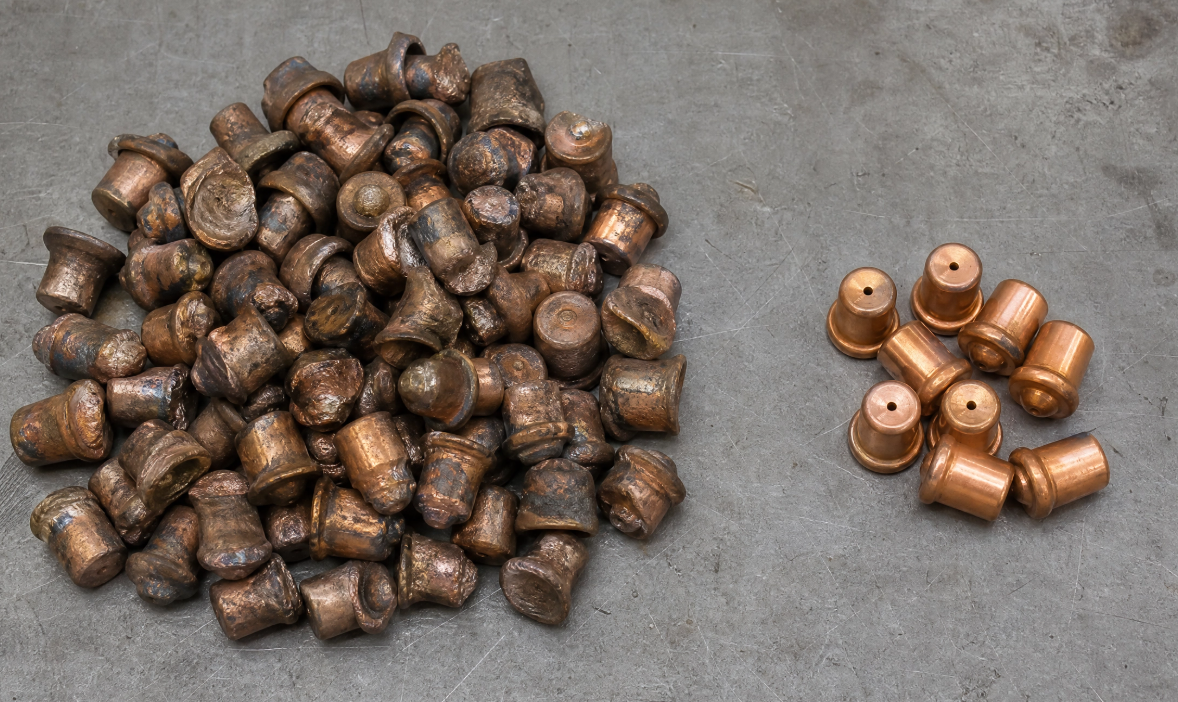
The trap: using a Class 1 conductivity-first material on steel, where it lacks the hardness to resist mushrooming. Conductivity is the wrong thing to optimize for steel; hardness matters more, and that points to Class 2.
Group A Class 2: CuCr and CuCrZr — The Steel Workhorses
Class 2 is where most production lives, and where our main electrode supply sits. These materials trade a slice of Class 1’s conductivity for substantially higher mechanical properties — they are the general-purpose electrodes, usable across a wide range of materials and conditions. Class 2 includes copper-chromium (CuCr) and copper-chromium-zirconium (CuCrZr), the latter being the dominant workhorse for steel spot welding.
When Class 2 is right: general steel and coated-steel production, which is the majority of resistance welding. Class 2 conductivity is ample for steel, and its hot strength — earned through aging heat treatment that forms strengthening precipitates — resists the mushrooming that destroys softer materials. This is the default, and for good reason.
The nuance: within Class 2, the aging condition matters enormously. CuCrZr that was never properly aged behaves like soft copper despite correct chemistry — a trap we cover in detail in the CuCrZr versus pure copper comparison. Specifying Class 2 is not enough; the material’s heat-treatment condition is part of the specification.
Dispersion-Strengthened Copper: High Strength With Retained Conductivity
Beyond the standard Class 2 alloys sits a more specialized option: dispersion-strengthened copper, in which fine particles of aluminum oxide are dispersed through the copper matrix. The result is a material that holds high strength and resists softening at elevated temperatures while retaining good conductivity — and crucially, it does not soften the way precipitation-hardened alloys can under sustained heat, because the oxide dispersion does not dissolve back into the matrix.
When dispersion-strengthened copper is right: high-pressure, high-heat applications where even aged CuCrZr softens too quickly, and where the operation needs maximum resistance to deformation without dropping to the low conductivity of refractory materials. It occupies a valuable middle ground — tougher under heat than Class 2, more conductive than Group B.
The reason it holds up where precipitation-hardened alloys fade is worth understanding, because it explains when the extra cost is justified. CuCrZr gets its strength from precipitates that form during aging — but those same precipitates can partly redissolve if the electrode runs hot enough for long enough, gradually softening the material over a long production run. Dispersion-strengthened copper gets its strength from oxide particles that were never in solution to begin with and cannot dissolve back, so its resistance to softening is far more stable under sustained heat. For a line that runs hot continuously — long shifts, high duty cycle, demanding stack-ups — that thermal stability is the property worth paying for, because the material does not quietly lose strength over the course of a shift the way an aged alloy can.
This is one of the materials the common CuCrZr-versus-copper discussion leaves out entirely, and for a demanding line it can be the answer that neither of the usual two provides.
Group B: Refractory Metal Compositions — Tungsten and Molybdenum
At the far end of the map sit the refractory compositions: copper-tungsten, tungsten, and molybdenum materials. These are stronger and harder than the copper alloys but have lower conductivity, and they behave fundamentally differently from Group A. According to refractory electrode references, these tungsten and molybdenum materials are used for applications like projection welding inserts, where the contact area is large relative to the weld and the material’s hardness matters more than raw conductivity.
When Group B is right: projection welding inserts and dies, applications demanding very high hardness and resistance to deformation under pressure, and — a key exception — welding high-conductivity metals like copper wire, where heat is generated within the refractory tip itself and conducted into the work.
The critical limitation: refractory materials are generally unsuitable for ordinary spot welding, because they suffer localized heating at the tip contact that can crack the electrode. This is the mirror image of the Class 1 trap — just as conductivity-first material fails on steel, hardness-first refractory material fails in general spot welding. Each material has a place, and using one outside its place is the recurring error.
The Complete Electrode Material Comparison
Here is the whole landscape in one view, organized by the trade-off that defines it — conductivity versus hardness:
| Material Group | Conductivity | Hardness / Strength | Best-Fit Application |
|---|---|---|---|
| Class 1 (CuZr, high-conductivity Cu) | Highest | Lower | Aluminum, magnesium, high-conductivity metals |
| Class 2 (CuCr, CuCrZr) | High | High | General steel & coated-steel production |
| Dispersion-strengthened Cu (Al₂O₃) | Good | Very high, heat-stable | High-pressure/high-heat steel; demanding lines |
| Group B (CuW, W, Mo) | Lower | Highest | Projection inserts, dies, copper-wire welding |
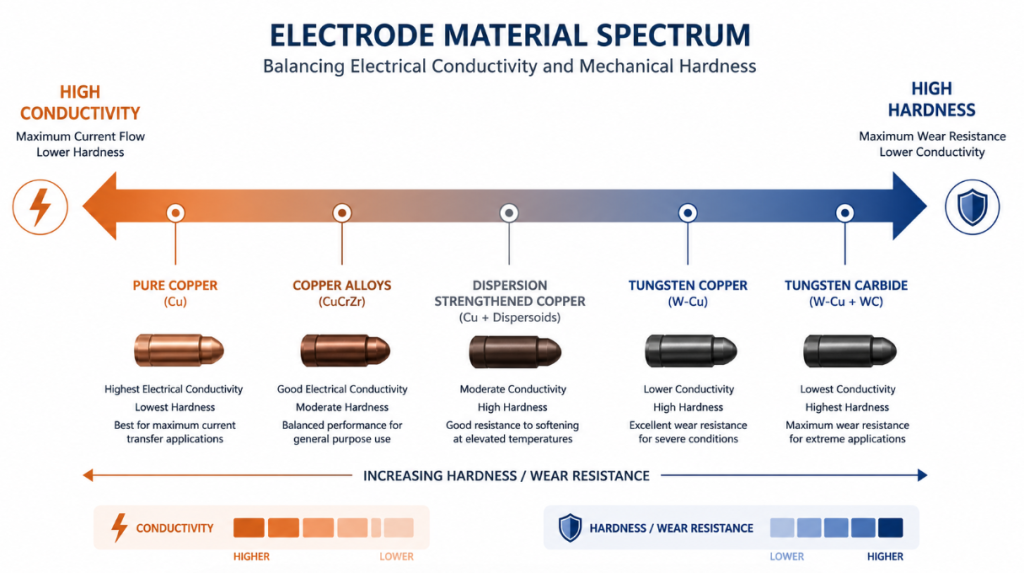
The pattern reading down the table is a single sliding trade-off: as you move from Class 1 to Group B, conductivity falls and hardness rises. There is no “best” material — only the right point on that slide for your workpiece and your pressures. The art of selection is locating your application on this spectrum.
How to Select the Right Electrode Material
Material selection comes down to matching the dominant demand of your application to the material that supplies it. Our selection guidance to customers follows this logic:
| Your Application | Dominant Demand | Recommended Material |
|---|---|---|
| Welding aluminum / high-conductivity metals | Maximum conductivity | Class 1 type |
| General steel / coated steel | Balanced conductivity + hardness | CuCrZr (Class 2) |
| High pressure / high hardness needs | Deformation resistance at heat | Dispersion-strengthened or Group B |
| Spot welding stainless / high-resistance materials | Specific balance for the material | Specific grade to application |
| Projection welding inserts | Hardness over conductivity | Group B refractory |
The recurring theme across every row: the question is never “which material is best in the abstract,” but “what does this specific workpiece and these specific pressures demand?” Welding different materials with the same electrode — a very common mistake — ignores that each workpiece pulls the answer to a different point on the spectrum. Steel and aluminum genuinely want different electrode materials, and a line running both should not standardize on one.
One application deserves a specific note because it confuses buyers: welding stainless steel and other high-electrical-resistance materials. Intuition might say a high-resistance workpiece needs a high-conductivity electrode to compensate, but the logic is more subtle. High-resistance materials generate abundant heat at the joint, so the electrode’s challenge is surviving that heat while maintaining the right balance of conductivity and hardness for the specific material — which often points to a particular Class 2 grade or, for certain setups, a refractory-faced electrode where heat is generated in the tip and conducted into the work. The point is not that one grade fits all stainless work, but that high-resistance materials are their own selection problem, distinct from both the aluminum case and ordinary mild steel, and worth treating as such rather than assuming a steel electrode transfers over unchanged.
Verifying You Got the Material You Specified
Selecting the right material only helps if you actually receive it, and this is where material substitution becomes a real risk — plain or low-grade copper sold as a premium alloy, un-aged material sold as aged. Because the difference is invisible to the eye, documentation is the buyer’s protection.
A capable manufacturer can provide material certification and composition reporting that lets you verify what you received against what you specified. We provide composition documentation precisely because, in a market where substitution happens, the certificate is what turns a claim into a verifiable fact. For a part whose performance depends entirely on its metallurgy, that verification is not bureaucratic overhead — it is the difference between buying a material and buying a label.
The substitution risk is not hypothetical, and it compounds the selection problem in a particular way: a buyer can select exactly the right grade for their application and still fail, because what arrived was not what the invoice claimed. This is why selection and verification are two halves of one task, not separate concerns. Choosing the correct grade gets you a specification; verifying the certificate gets you the actual material. Skipping the second step means the first was only a hope. The good news is that verification is cheap relative to its protection — a composition report costs a capable supplier almost nothing to provide, and an independent spot-check on a sample costs little against a container of consumables. A supplier who resists providing documentation, or whose price sits far below the market for the grade claimed, is answering the verification question before you even ask it.
Real Cases: Material Selection in Practice
Two situations from our records show selection working.
Case 1 — Right material, longer life. A customer was seeing short electrode life and inconsistent welds. The root issue was material mismatched to their application; switching them to the correct grade for their workpiece, with no other change, improved both electrode life and weld quality. The material had been the limiting factor all along.
Case 2 — Application-matched recommendation. A customer unsure which material suited their line described their application — workpiece, pressures, conditions — and we recommended the grade that matched rather than defaulting to the most common one. Matching the material to the actual application, rather than reaching for a habitual choice, is the service that prevents the mismatches this guide is built to help avoid.
Final Thoughts on Electrode Material Selection
The landscape of resistance welding electrode materials is wide, but it is navigable once you see it as a single trade-off between conductivity and hardness, with your workpiece deciding where on that line you should sit. Class 1 for high-conductivity metals, Class 2 for general steel, dispersion-strengthened copper for demanding high-heat lines, and refractory Group B for projection inserts and dies — each occupies its place for a reason, and the expensive mistakes come from using one outside its place.
If you are unsure which material your application calls for, the most useful thing you can do is describe what you weld, your pressures, and how your current electrodes fail. From those details we can point you to the right grade — and back it with material certification so you can verify you received it. Browse our copper spot welding electrodes range, or send your application and let the selection start from your actual conditions rather than from the most common default.
Share This Article
Latest Articles
October 19, 2026
October 19, 2026
October 19, 2026
October 19, 2026
October 19, 2026
October 19, 2026
October 19, 2026
October 19, 2026