High-Temperature Resistance Welding: Why Ceramic Pins & Sleeves Excel

In high-temperature resistance welding — thick-plate joints, high-current applications, sustained high-cycle production — the heat in and around the weld zone climbs to levels that change which locating-part material makes sense. As temperatures rise, a metal-cored part faces a problem ceramic does not: heat softens metal. This is where ceramic pins and sleeves come into their own. Where the thermal load is high, ceramic’s ability to hold its hardness, strength, and insulation at temperatures that degrade metals makes it the material that keeps performing. This article explains why ceramic excels specifically in high-temperature welding, the metallurgy behind that advantage, and — kept honest — the one condition (mechanical impact) where the decision gets more nuanced.
This is the high-temperature deep-dive within our broader ceramic coverage; for the general question of when to choose ceramic across all conditions, see when to use ceramic pins and sleeves, and for the head-to-head material comparison, ceramic vs KCF guide sleeves.
The High-Temperature Welding Applications Where Heat Is the Challenge
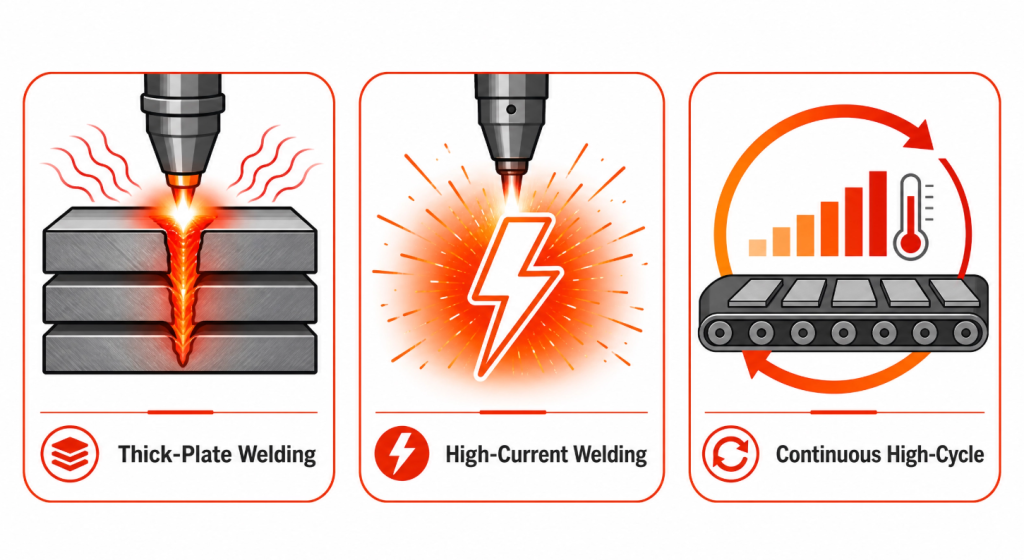
Not every welding application runs hot enough for temperature to be the deciding factor, but several do — and these are where ceramic’s thermal advantage matters most. Based on what our customers use ceramic for, three high-temperature scenarios stand out.
Thick-plate and multi-layer welding. Welding thick plate, or multiple stacked layers, generates substantial heat because the joint requires significant energy to form. The greater the material mass and the more layers involved, the more heat the weld zone and surrounding components absorb. Thick-section resistance welding is recognized as a high-heat-input process, and the locating parts in such setups sit in a hot environment. The thicker the section, the more energy it takes to bring the joint to welding temperature, and the more of that heat radiates into the surrounding tooling — so heavy-section work is inherently a high-thermal-load environment for any part near the weld.
High-current, high-heat-input welding. Heat generation in resistance welding scales sharply with current — the heat produced rises with the square of the current. Applications running high welding currents to achieve the needed weld therefore put more thermal load on everything in the weld zone. Studies of resistance spot welding confirm that as welding current increases, the generated heat input increases significantly, raising the temperature the surrounding parts experience.
Continuous high-cycle production. Even where each individual weld is not extreme, a continuously running high-cycle line produces sustained heat. The locating parts do not get long to cool between welds, so heat accumulates, and the parts operate at an elevated steady-state temperature through the production run. Sustained operation, not just peak temperature, is part of the thermal challenge.
This sustained-heat scenario is worth distinguishing from peak-temperature scenarios, because it changes the nature of the demand. A single high-energy weld subjects a part to a brief temperature spike; a continuously running line subjects it to a high baseline temperature that never fully relaxes. Between welds, a locating part normally sheds some heat — but as cycle rate climbs, the cooling interval shrinks, and at high enough throughput the part simply does not return to a low temperature before the next weld adds more heat. The result is a part running hot continuously rather than momentarily. For a metal-cored part, prolonged operation at an elevated temperature is a different stress than a brief spike: sustained heat gives softening and degradation mechanisms time to act. Ceramic’s advantage here is that its high-temperature stability is not time-limited — it holds its properties under sustained heat as readily as under brief heat, because the material is simply stable in that temperature range. For a high-throughput line that runs hot all shift, that sustained stability is exactly what the application needs.
These three conditions — mass, current, and continuous operation — are where temperature becomes the dominant factor in material choice, and where a part that softens with heat becomes a liability.
Why Ceramic Outperforms KCF When It’s Hot
The core of ceramic’s high-temperature advantage is simple: ceramic holds its properties at temperatures that degrade metal. Several specific advantages follow from that.
Ceramic retains hardness and strength at high temperature. Where metals soften as they heat, alumina maintains useful mechanical strength and structural stability at temperatures where most steels experience severe softening and creep, as documented by ceramic engineering specialists noting that alumina maintains its properties at temperatures approaching 1,700°C in many applications. A ceramic locating part stays hard and dimensionally stable in heat that would soften a metal-cored part.
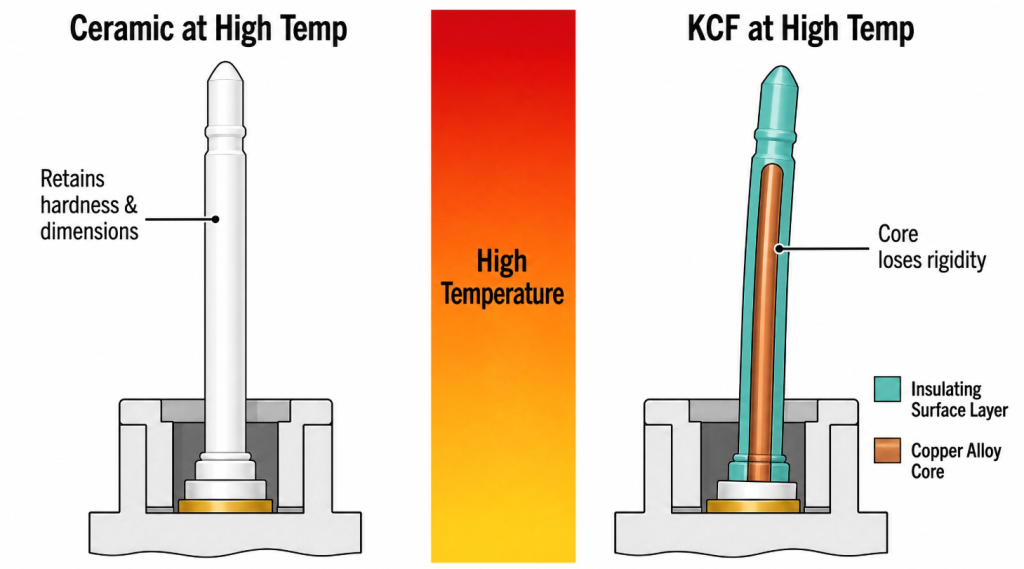
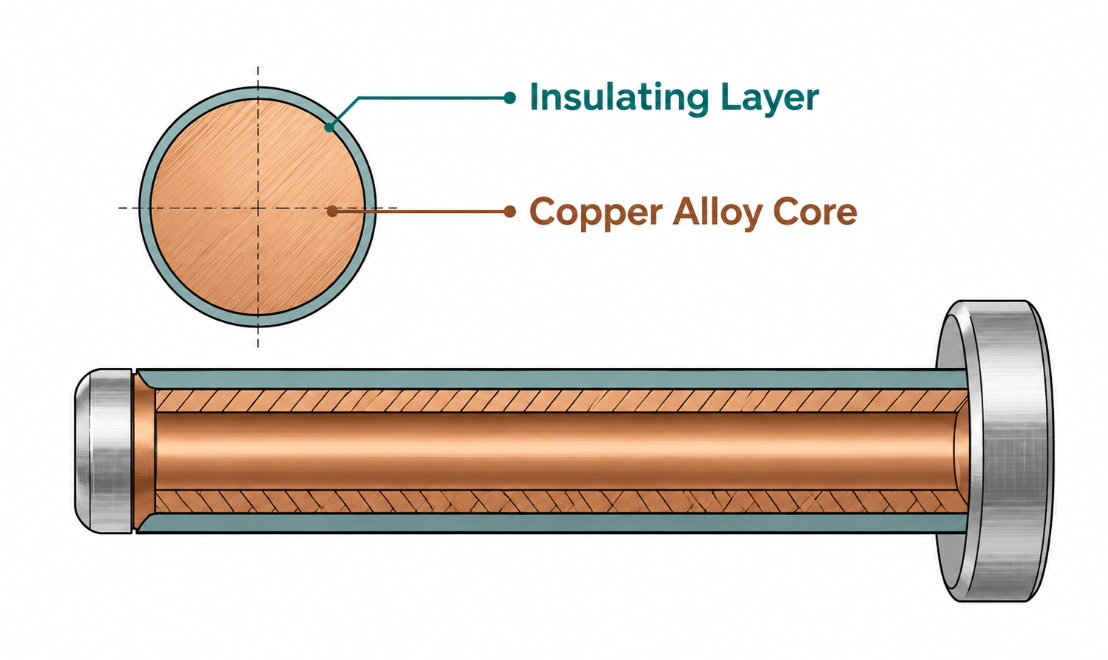
A metal core softens; ceramic does not. This is the heart of the comparison. A KCF part has a metal core, and metals lose hardness and strength as temperature rises — at high enough temperatures, the core softens and the part’s performance declines. Ceramic, having no metal to soften, sidesteps this entirely. In the hottest applications, this is the difference between a part that holds up and one that gradually gives way.
This deserves a closer look, because it is the mechanism that makes the whole high-temperature case for ceramic. KCF is an outstanding material across the great majority of welding conditions — its toughness, machinability, and insulating layer make it the workhorse choice, and in most applications its metal core operates comfortably within its temperature range. The high-temperature scenario is the specific case where that strength reaches its limit: every metal has a temperature above which it begins to soften and lose mechanical properties, and a locating part whose core has softened no longer holds its dimensions or resists wear the way it should. Ceramic has no such transition in the relevant range — it is already a high-temperature material by nature. So this is not a knock on KCF; it is a recognition that the hottest applications cross into territory where a metal core is working against its own temperature limit, and a non-metallic material that was built for heat simply does not face that constraint. Choosing ceramic for high heat is choosing the material whose fundamental nature suits the condition.
Ceramic holds its insulation at high temperature. Ceramic continues to insulate effectively at elevated temperatures, in conditions where other materials would soften, degrade, or become conductive, as ceramic insulation references confirm alumina provides effective insulation at elevated temperatures where polymers or glass would fail. The insulation that prevents shunting stays reliable even when the weld zone is hot.
It is worth being precise here, because accuracy matters more than overstatement. Ceramic’s insulation is not literally infinite at every temperature — at extreme temperatures (well above 1000°C), even alumina’s resistivity does decline somewhat. But this is far above the temperatures that locating parts in resistance welding actually experience, and the relevant comparison is against the alternatives: in the temperature range these parts operate, ceramic continues to provide effective electrical isolation in conditions where polymer-based or lower-temperature materials would have already softened or begun to conduct. The practical takeaway is that across the high-temperature range relevant to welding, ceramic’s insulation stays dependable while heat-sensitive materials do not — and that dependability is exactly what a shunting-sensitive application needs when the weld zone runs hot.
Ceramic resists oxidation and degradation in heat. Metals can oxidize and degrade at high temperature; ceramic does not. Alumina is chemically inert and thermally stable, usable in oxidizing atmospheres to very high temperatures without the oxidation that affects metals, as documented by ceramic suppliers noting alumina’s thermal stability up to 1,600°C and resistance to corrosion. The part does not deteriorate from heat exposure the way a metal component might.
Ceramic holds dimensional stability in heat. With low thermal expansion and high-temperature stability, ceramic retains its shape and dimensions across a wide temperature range — and for a locating part, dimensional stability under heat means locating accuracy is preserved even as temperatures climb.
Table 1 — Ceramic vs KCF at High Temperature
| Property Under Heat | Ceramic | KCF (Metal Core) |
|---|---|---|
| Hardness / strength | Retained at high temperature | Metal core softens as heat rises |
| Insulation | Holds at elevated temperature | Layer over core; metal affected by heat |
| Oxidation resistance | Inert — does not oxidize | Metal can oxidize at high temp |
| Dimensional stability | Stable across wide temp range | Affected as core heats |
| Best thermal fit | Highest-temperature applications | High, but below ceramic’s ceiling |
The right-hand column shows where the metal core becomes the limiting factor: as heat rises, KCF’s metal — excellent in most conditions — eventually softens, while ceramic keeps going. When heat is the dominant challenge, that distinction decides the material.
An Honest Caveat: Temperature Isn’t the Only Factor
It would be misleading to present ceramic as the automatic choice for any hot application, because temperature rarely acts alone — and ceramic’s brittleness does not go away just because the application is hot. Three honest qualifications keep the recommendation accurate.
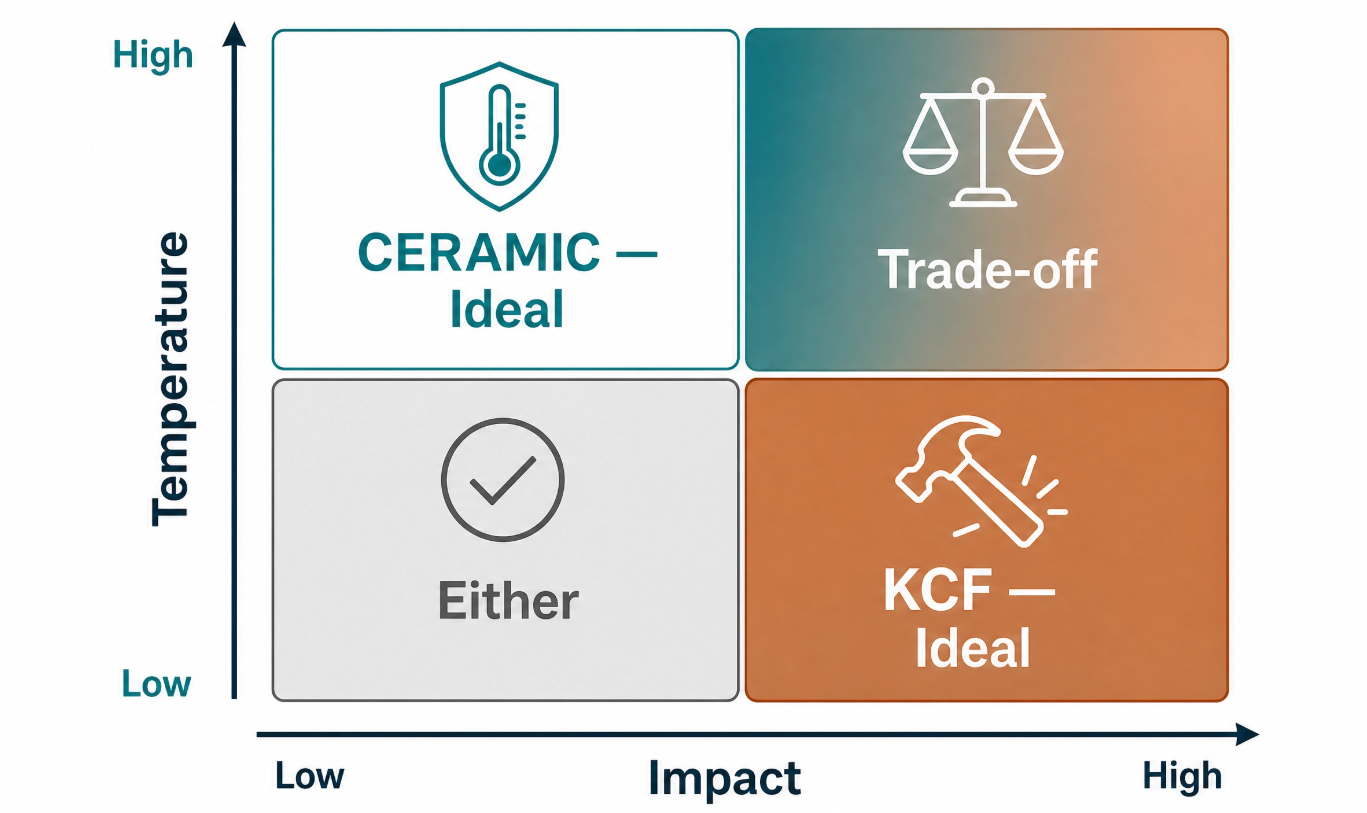
High temperature plus high impact still has to be weighed. Many high-temperature welding applications are also high-impact — a fast thick-plate line, for instance, may be both hot and mechanically aggressive. Here the decision is a genuine trade-off: ceramic handles the heat better, but KCF handles the impact better, and which wins depends on the specific balance. A hot application is not automatically a ceramic application if it also pounds the locating part hard.
Heat doesn’t cancel the need for impact resistance. Ceramic’s brittleness is a property of the material, present at any temperature. A hot application that also subjects the part to mechanical shock still exposes ceramic to the cracking risk that brittleness brings. The heat advantage and the impact disadvantage coexist; one does not offset the other.
Best fit: high temperature with low impact. Ceramic’s sweet spot is exactly where these factors align in its favor — high thermal load combined with low mechanical impact. A hot but mechanically gentle application is ideal for ceramic: it gets the full benefit of ceramic’s heat resistance with little exposure to its brittleness. That combination is where ceramic is not just viable but clearly the best material.
There is also a point worth knowing about thermal shock specifically. While ceramic withstands sustained high temperature exceptionally well, rapid, extreme temperature swings (thermal shock) are harder on it than steady heat, owing to its thermal expansion characteristics. For the steady or gradually-changing temperatures of most welding-locating applications this is not a concern, but an application with violent thermal cycling deserves a conversation about the specifics.
Table 2 — High-Temperature Material Decision
| Your Condition | Better Material |
|---|---|
| High temperature, low impact | Ceramic (its sweet spot) |
| High temperature, high impact | Trade-off — weigh heat vs shock (often KCF) |
| High temperature, needs customization | Often KCF (machinability) |
| Moderate temperature, high impact | KCF |
| Severe thermal shock (rapid cycling) | Discuss specifics — neither is automatic |
The table frames the real decision: ceramic owns the high-temperature-low-impact quadrant decisively, while mixed conditions require weighing heat against the other demands. Naming your full set of conditions — not just the temperature — is what points to the right material.
Real Cases: Material Choice for High-Temperature Applications
Two customer situations show high-temperature material selection in practice.
Case 1 — Material selected for a high-temperature application. A customer with a genuinely high-temperature welding application needed locating parts that would hold up to the heat. Selecting ceramic for its temperature resistance, hardness retention, and high-temperature insulation gave them parts suited to the thermal demands their application placed on the locating components — a deliberate match of material to the heat condition.
Case 2 — Switching to ceramic improved high-temperature performance. A customer running a hot application with metal-cored locating parts was seeing performance decline under the thermal load — the kind of softening and degradation that heat imposes on metal. Moving to ceramic, which holds its hardness and insulation at temperatures that affect metal, improved performance in that high-temperature context. The change addressed the root issue: the metal had been operating beyond where it stayed at its best, and ceramic was not.
Both cases turn on the same recognition: when the application is genuinely hot, the locating-part material has to be one that performs at temperature — and that is precisely ceramic’s strength.
Matching the Material to the Heat
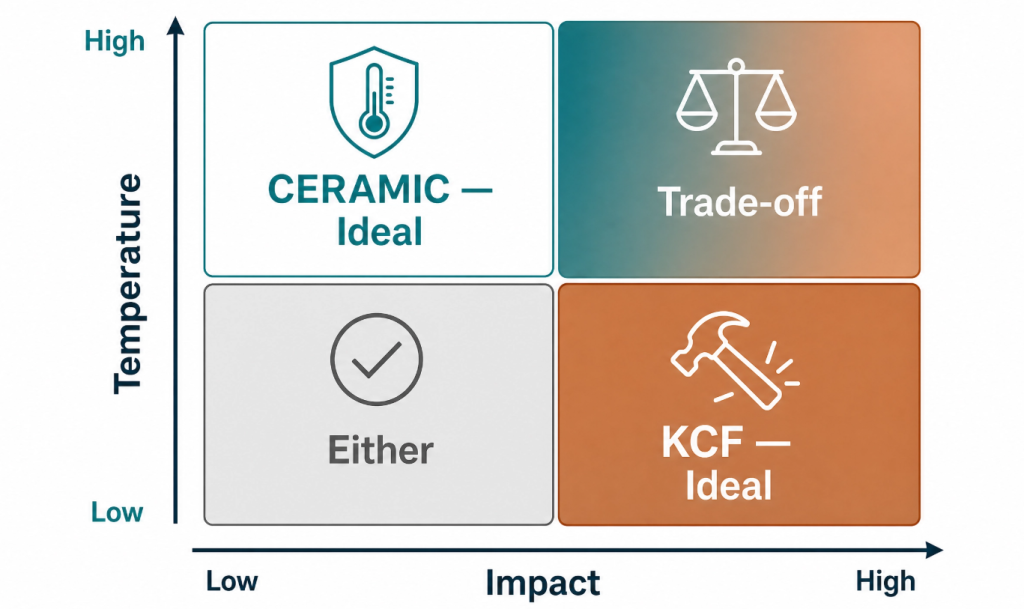
High-temperature resistance welding asks something specific of a locating part: hold your hardness, your insulation, and your dimensions at temperatures that soften and degrade metals. Ceramic answers that demand well — its retention of properties at high temperature, where a metal core would soften, makes it the material of choice when heat is the dominant challenge, provided the application is not so mechanically aggressive that brittleness becomes the bigger risk. The honest rule is that ceramic excels in high-temperature, lower-impact conditions, and the full set of conditions — not the temperature alone — determines the right choice.
Because we make both ceramic and KCF, we can help you weigh heat against impact, customization, and your other demands rather than steering you to one material. Tell us about your high-temperature application — your temperatures, whether the part also takes mechanical shock, your cycle rate, and your accuracy needs — and we’ll recommend the material that genuinely fits the thermal and mechanical reality. Browse our ceramic pins and sleeves range, or send us your application and let us help you match the material to the heat. Getting that match right the first time saves the cost and downtime of a part that softens or cracks where the other material would have held.
Share This Article
Latest Articles
October 19, 2026
October 19, 2026
October 19, 2026
October 19, 2026
October 19, 2026
October 19, 2026
October 19, 2026
October 19, 2026