KCF Parts in Automotive Welding: Where & Why They’re Used

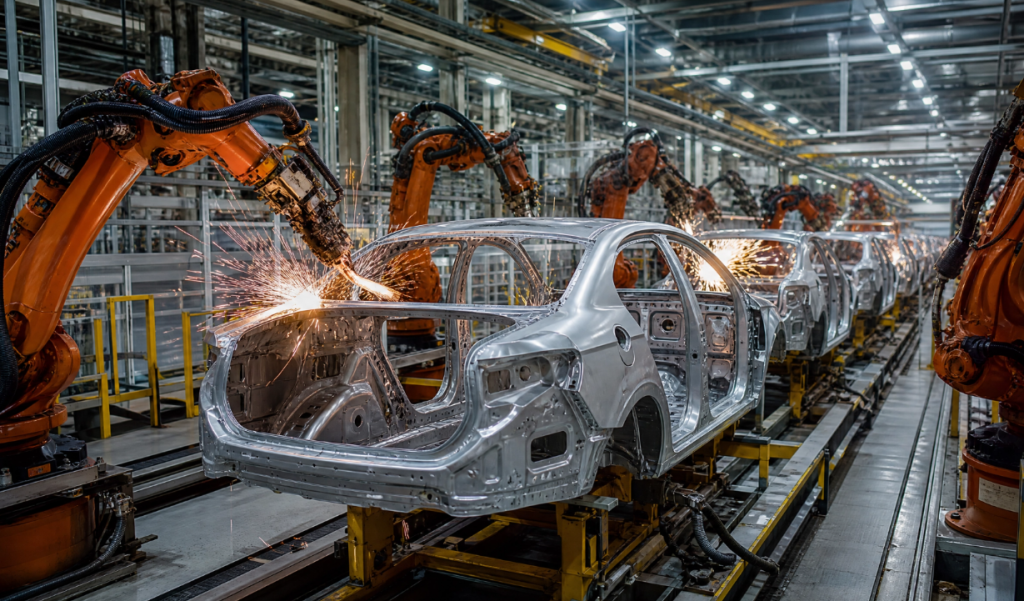
The automotive industry is where resistance welding runs hardest — highest volumes, toughest materials, and the least tolerance for a bad weld, because the weld might be holding a seat belt anchor. It is also where KCF locating parts earn their place. This article maps where KCF guide pins and sleeves are used across automotive welding, why car manufacturing is so demanding on these parts, and what makes KCF suited to an environment that punishes anything less than the right material. It pulls together the application side of the KCF parts we cover in detail elsewhere, viewed through the lens of the industry that uses the most of them.
For the underlying material and component details, our explainers on what KCF alloy is and KCF guide pins cover the fundamentals; here we focus on how those parts perform in the specific, demanding context of building cars.
Where KCF Parts Are Used in Automotive Welding
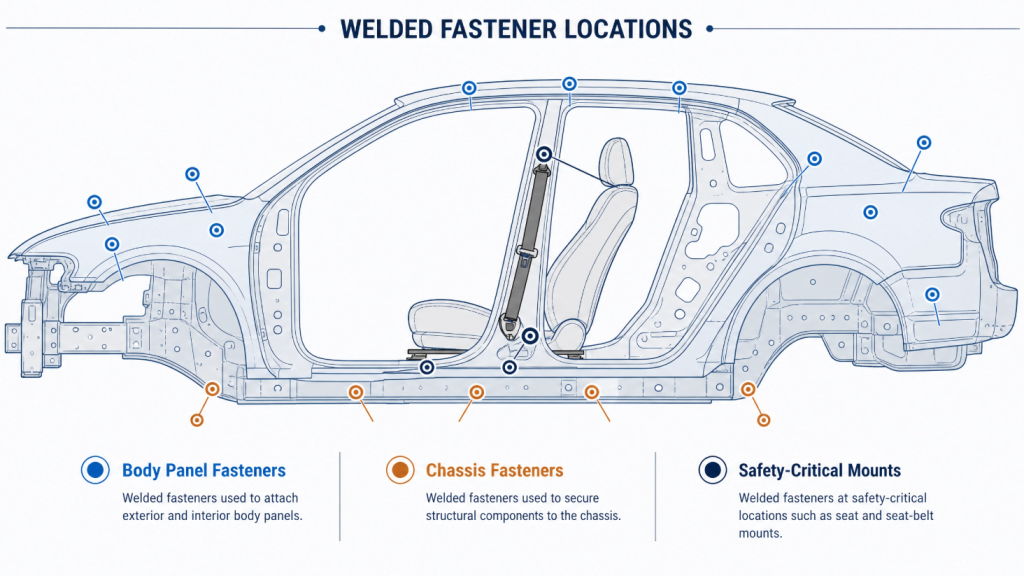
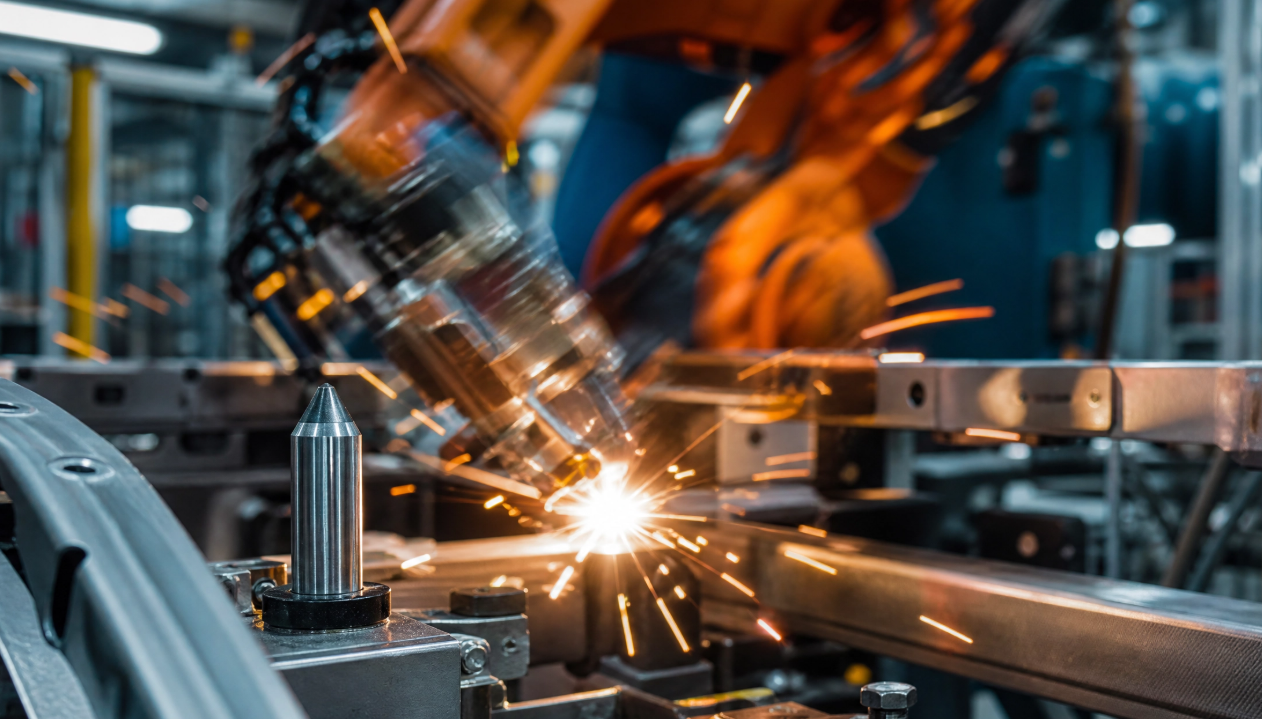
A modern vehicle is held together by an enormous number of welds and welded fasteners, and KCF locating parts show up across several automotive welding applications:
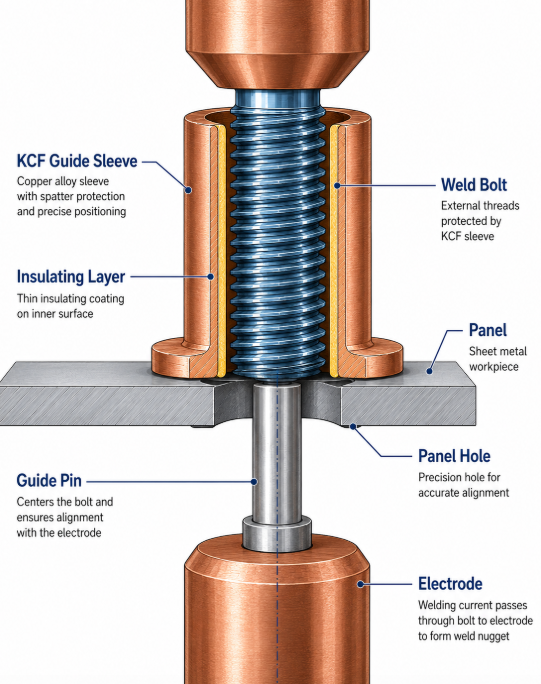
Body panel nut and bolt welding. Threaded fasteners are projection-welded to body panels throughout a vehicle, giving the mounting points that countless components later bolt to. KCF guide pins and sleeves locate those nuts and bolts precisely for welding — one of the most common automotive uses.
Chassis and frame fastener welding. Structural fasteners on the chassis and frame carry load, and locating them accurately for welding is part of building a sound structure. KCF parts position these fasteners in a demanding structural context.
Safety-critical component mounting. This is where the stakes peak. Fasteners that anchor seat belts, seats, and airbag brackets must be welded with absolute reliability — a weak weld here is a safety failure, not a quality blemish. Accurate location and reliable insulation directly support weld quality on these critical attachments.
High-strength and galvanized steel welding. Modern bodies are built largely from advanced high-strength steel (AHSS) and galvanized sheet, and welding these materials is hard on everything in the weld zone. KCF parts operate in this environment as locating components alongside the electrodes doing the welding.
Battery pack and EV component welding. As vehicles electrify, battery packs and new EV components bring their own welding needs, and KCF locating parts extend into these newer automotive applications as the industry shifts.
The EV transition is worth flagging as a genuine growth area rather than a passing mention, because it is reshaping what automotive welding looks like. Electric vehicles add whole new categories of welded assembly that internal-combustion vehicles never had — battery module and pack structures, busbar and terminal connections, and the mounting points for electric drivetrain components — each with its own locating and joining requirements. As automakers and their suppliers build out EV production, the demand for precise, durable locating parts extends into these new applications, and the same KCF properties that suit conventional body welding — accuracy, durability, reliable insulation — carry over. For a parts supplier, this means automotive demand is not static; it is expanding into new assembly types as the vehicle fleet electrifies, and locating parts follow that expansion.
These applications share a theme: each involves locating a fastener accurately and reliably in a high-volume, high-stakes production environment. That theme is what drives the requirements below.
Why Automotive Manufacturing Is So Demanding on These Parts
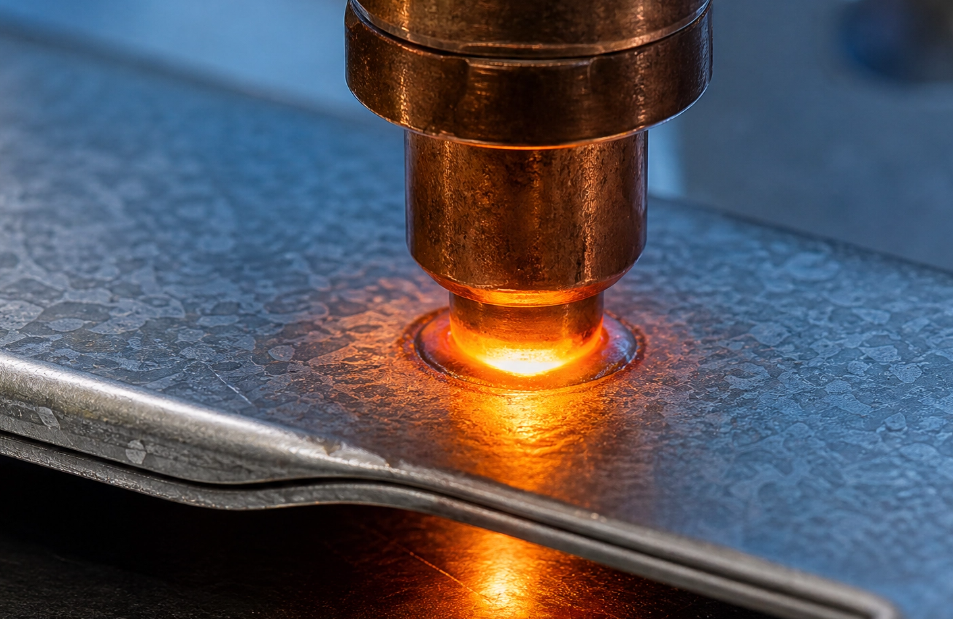
Car manufacturing imposes some of the most severe requirements any application places on locating parts, for five reasons that compound one another.
Safety-critical welds cannot fail. When a weld holds a seat belt or airbag bracket, weld quality is a safety matter. There is no acceptable rate of weak or defective welds on these joints, so every factor that supports weld quality — including reliable insulation from the locating part to prevent shunting — carries a weight it would not in a non-critical application.
The mechanism behind this matters, because it explains why the locating part is part of the safety chain and not merely a positioning aid. If a locating part conducts when it should insulate, welding current can shunt through it instead of fully through the joint, producing a weld that looks complete but is undersized and weak — and on a safety-critical joint, an invisible weak weld is the worst possible failure, because it passes visual inspection while being structurally deficient. The same logic that makes shunting a quality problem on any line makes it a safety problem on an automotive safety joint. Add to this the material degradation challenge: as electrodes degrade welding coated steels, weld quality drifts, and the mushrooming and face degradation we cover in our article on electrode mushrooming become quality risks that, on a safety joint, no automaker can accept. This is why automotive welding pairs reliable locating parts with disciplined electrode management — both feed the same weld-quality outcome.
Galvanized and high-strength steels are hard on the weld zone. This is a genuine materials challenge, not a marketing line. AHSS is the dominant body material precisely because it enables lighter, stronger, more crash-resistant vehicles, as documented in research on AHSS in automotive body structures. But these materials are difficult to weld: galvanizing shifts the welding current higher and narrows the process window as zinc coating thickness increases, and high-grade AHSS can suffer strength loss from coating-induced effects, as detailed in studies of galvanized dual-phase steel spot welding. Everything in the weld zone works harder with these materials.
Production runs at extreme speed. Automotive lines weld at a pace that demands locating parts hold their accuracy over enormous volumes. A part that wears even slightly too fast loses its locating precision across a production run, so wear resistance is not a luxury — it is what keeps the line producing accurate welds shift after shift.
Automation demands locating consistency. Automotive fastener welding is heavily automated, and automation depends on every part being located identically every cycle. The locating component is what delivers that consistency; any variation it introduces propagates into the automated process.
This consistency requirement is more unforgiving in automotive than almost anywhere else, because of scale and integration. An automotive line may weld thousands of fasteners per vehicle across hundreds of vehicles per day, with no human checking each location — the automation assumes the locating part puts every fastener exactly where the programming expects. If the locating part wears or drifts, it does not announce the problem; it silently shifts weld positions, and because the process is automated and high-volume, a drifting part can produce a large number of subtly mislocated welds before anyone notices. This is why durability and consistency are inseparable in automotive: a part that holds its dimensions holds the line’s accuracy, while a part that wears undermines the entire automated assumption that location is reliable. The locating part is, in effect, a silent reference the whole automated cell trusts — which is why automakers care so much about parts that hold that reference over volume.
Long life reduces costly downtime. On an automotive line, stopping to change worn locating parts is expensive downtime. Parts that last longer between changes directly reduce that cost, which is why service life is a real economic factor, not just a technical one. Electrode and locating-part degradation during the welding of coated steels is a recognized challenge in automobile manufacturing, affecting weld quality as parts wear — a problem studied across hundreds of consecutive welds of coated automotive steel.
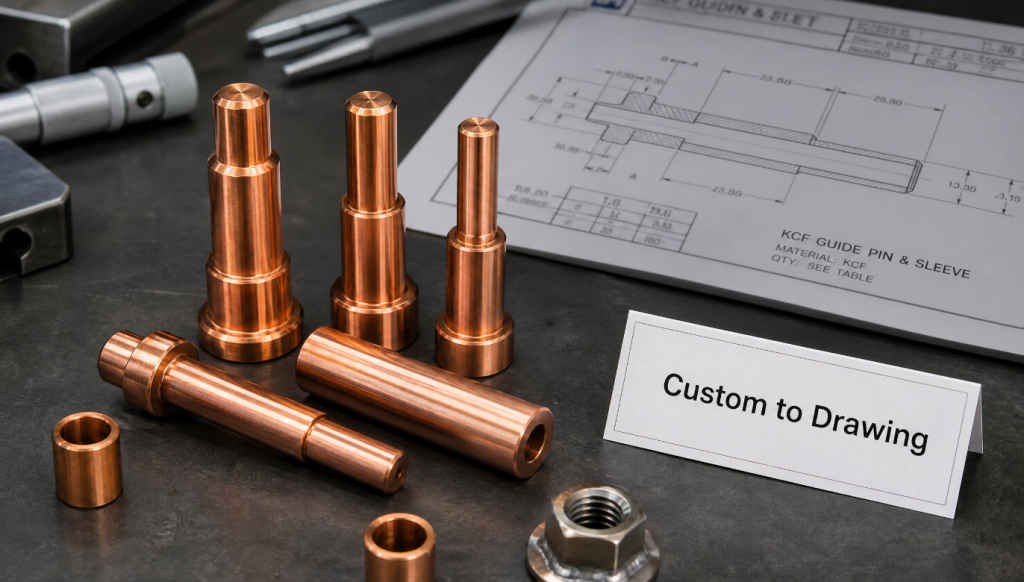
Table 1 — Automotive Demands on KCF Locating Parts
| Demand | What It Requires | Consequence If Unmet |
|---|---|---|
| Safety-critical weld quality | Reliable insulation, accurate location | Weak welds on safety joints — unacceptable |
| Galvanized / AHSS materials | Durability in a harsh weld zone | Faster degradation, quality drift |
| Extreme production speed | Wear resistance to hold accuracy | Locating precision lost over volume |
| Automation consistency | Identical location every cycle | Variation propagates through the line |
| Long service life | Durability between changes | Costly line downtime for replacements |
The columns reinforce one point: automotive welding stacks demands that a lesser locating part cannot meet simultaneously. Each requirement alone is manageable; together they set a high bar.
Why KCF Suits the Automotive Environment
Set the demands above against KCF’s properties and the fit becomes clear. Each automotive requirement maps to a KCF strength.
Impact resistance for automated, fast-cycle lines. KCF’s toughness lets it withstand the mechanical knocks of high-speed automated welding without deforming — holding its shape, and therefore its accuracy, where a more brittle part might chip or crack. For the fast, automated reality of an automotive line, that impact resistance directly supports sustained accuracy.
Wear resistance to hold locating accuracy. Because KCF resists wear, it holds its dimensions and its locating precision over the high volumes automotive production demands — reducing the accuracy drift and the replacement frequency that drive downtime. This is the property that turns into real economic value on a fast line.
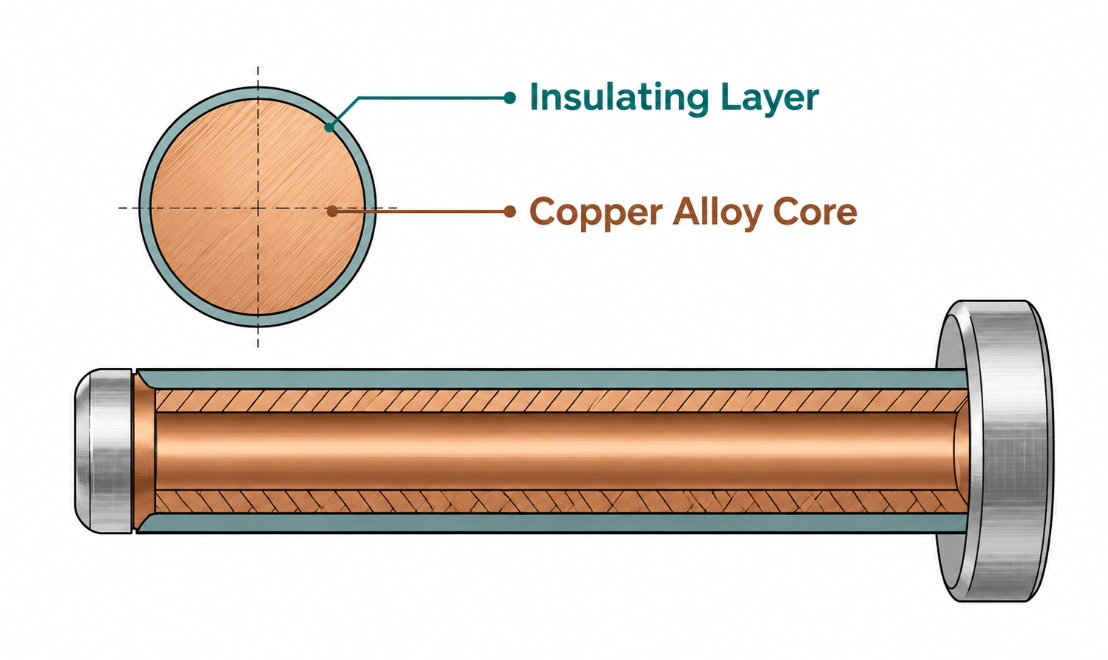
Reliable insulation for weld quality on safety parts. KCF’s insulating layer keeps welding current from shunting through the locating part, supporting the weld quality that safety-critical automotive joints demand. On a seat belt anchor, that reliable insulation is part of the chain that makes the weld sound.
Customization to automaker drawings. Automotive applications come with specific, exacting drawings, and KCF’s machinability means parts can be produced to an automaker’s or tier supplier’s specification. We routinely machine KCF parts to customer drawings — matching the part to the application’s precise requirements rather than forcing a standard part to fit.
Material certification for automotive supply chains. Automotive supply chains demand traceability and documentation, and the ability to provide material certification supports those requirements. For a tier supplier who must document what goes into their process, that certification is part of doing business in automotive.
This documentation requirement runs deeper in automotive than in most industries, because the entire supply chain is built on traceability. A tier supplier welding safety-critical fasteners has to be able to show their own customer — the automaker — what materials and components went into the process, and that obligation flows down to the parts they buy. A locating-part supplier who can provide material certification fits into that traceability chain; one who cannot becomes a gap in it. For a buyer in automotive, then, a supplier’s ability to document the material is not a nicety but a qualification requirement — which is one more reason a real factory able to certify what it makes has an advantage over a source that cannot stand behind its material with paperwork.
Table 2 — Matching KCF Properties to Automotive Needs
| Automotive Need | KCF Property | Benefit |
|---|---|---|
| Fast automated cycles | Impact resistance | Holds shape and accuracy under knocks |
| High-volume production | Wear resistance | Sustains locating precision; less downtime |
| Safety-critical weld quality | Reliable insulation | Prevents shunting; supports sound welds |
| Exacting automaker specs | Machinability | Custom parts to drawing |
| Supply-chain traceability | Material certification | Meets documentation requirements |
Read across and the alignment is consistent: the properties that define a good KCF part are precisely the ones automotive welding requires. That alignment is why the industry is such a natural home for these parts.
Real Cases: KCF Parts in Automotive Production
Three customer situations show KCF parts meeting automotive demands.
Case 1 — Automotive supplier application. An automotive-sector customer needed locating parts for fastener welding on their line. KCF parts provided the combination of accurate location, durability, and reliable insulation their automotive application required — the kind of demanding, quality-sensitive use these parts are built for.
Case 2 — High-cycle and safety-relevant improvement. A customer running a fast line with quality-critical welds was experiencing problems with locating-part performance under the pace and stakes of the application. Moving to KCF parts — with the impact and wear resistance to hold up at speed and the reliable insulation to support weld quality — improved performance in that demanding context.
Case 3 — Custom parts to automotive specification. A customer needed locating parts matched to their specific automotive application requirements. We machined KCF parts to their specification, producing components that fit their particular fasteners and tooling — the customization automotive applications routinely require, which a real factory can deliver.
The common thread: each case involved an application where the demands were high and the margin for an inadequate part was low — which is the automotive norm, and where KCF’s combination of properties pays off.
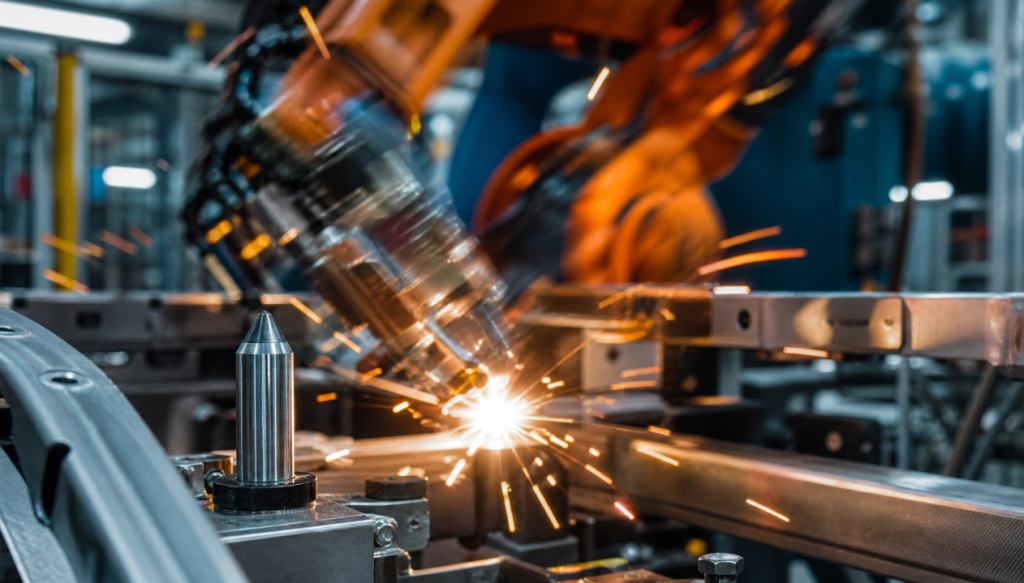
The Right Parts for a Demanding Industry
Automotive welding is unforgiving — safety-critical joints, difficult materials, relentless speed, and a heavy cost for downtime — and it rewards locating parts built to meet all of those demands at once. KCF’s impact resistance, wear resistance, reliable insulation, machinability, and documentation align closely with what car manufacturing requires, which is why KCF guide pins and sleeves are a natural fit across automotive fastener welding, from body panels to safety components to emerging EV applications.
If you’re welding fasteners in an automotive or tier-supplier context and need locating parts that hold up to the pace, the materials, and the quality demands, tell us about your application — the components you’re welding, your materials, your cycle rate, and your specifications. We can recommend and machine KCF parts suited to your automotive requirements, and provide the material documentation your supply chain expects. Browse our KCF guide pins and sleeves range, or send your application and let us match the parts to the demands of your line.
Share This Article
Latest Articles
October 19, 2026
October 19, 2026
October 19, 2026
October 19, 2026
October 19, 2026
October 19, 2026
October 19, 2026
October 19, 2026