What Causes Electrode Mushrooming in Resistance Welding?

Mushrooming is the most recognizable way a spot welding electrode dies. The once-precise tip face spreads outward and flattens, like the cap of a mushroom growing on the end of the electrode — and as it grows, weld quality quietly slides with it. Every shop that runs resistance welding meets this failure, and most treat it as simply “electrodes wearing out.” But mushrooming is a specific mechanical phenomenon with specific causes, and understanding it precisely is what separates shops that manage it on a schedule from shops that fight it as a recurring fire.
This article explains exactly what mushrooming is, the physics of why it happens, the four root causes we confirm when we investigate it, the destructive chain reaction it triggers, and how to control it. Three tables below summarize the causes, the consequences, and the fixes. Real customer cases show what controlling it looks like in practice.
What Is Electrode Mushrooming, Exactly?
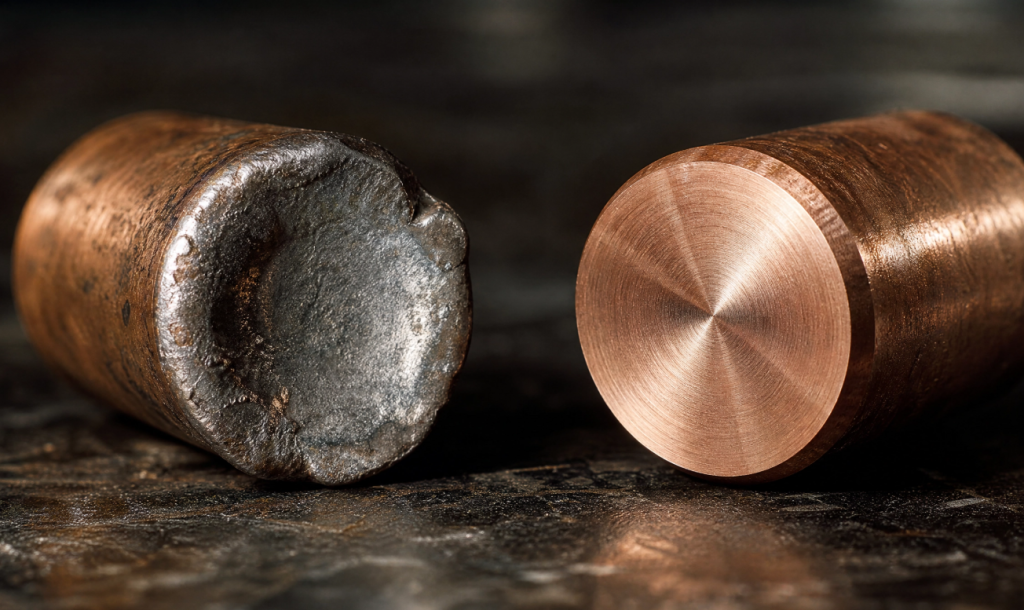
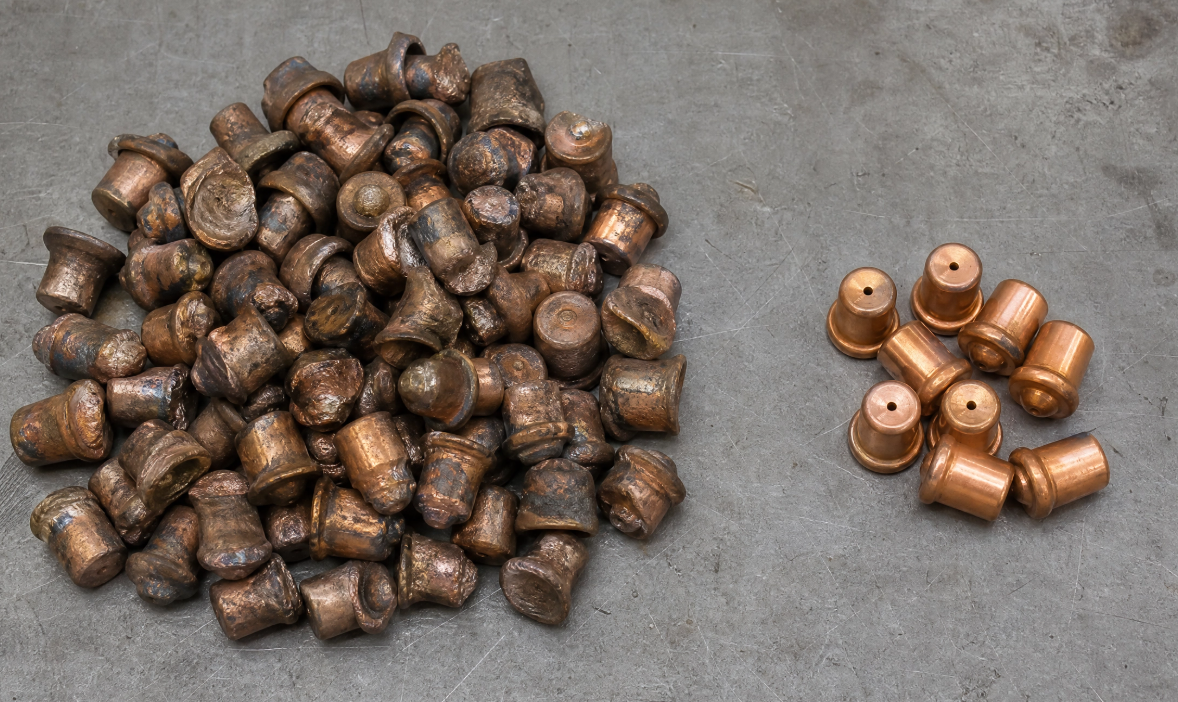
Mushrooming is the progressive spreading and flattening of an electrode cap’s contact face under the combined action of heat and pressure during welding. The tip starts at a designed diameter that concentrates current into a precise spot; as the material at the face deforms outward, that diameter grows, the face flattens, and the once-sharp geometry becomes a wide, mushroom-shaped end.
The phenomenon is well documented in welding research as one of the two principal electrode wear modes. A study of electrode wear during resistance spot welding identifies mushrooming and plateau forming as the main wear modes of resistance-spot-welding electrodes, both of which deform the electrode contact area and thereby influence weld quality. This is the key point for any buyer: mushrooming is not cosmetic damage to the electrode — it is a change in the contact geometry that directly degrades the weld.
The patent literature describes the mechanism plainly: repeated heating and pressing causes softening, mushrooming, and other deformation of the electrode, and as the welding tip face enlarges, current requirements increase until the electrode must be replaced. That progression — spread, enlarge, compensate, replace — is the life cycle of a mushroomed cap, and every stage of it is worth understanding.
It helps to distinguish mushrooming from the other ways an electrode can fail, because the fixes differ. Mushrooming is bulk deformation: the material of the face flows outward and the diameter grows. That is different from pitting or cavitation, where small holes form in the face; different from alloying, where elements from the workpiece or its coating chemically combine with the copper to form a softer, more resistive surface layer; and different from simple abrasive wear, where material is gradually ground away rather than spread. Real electrodes often suffer several of these at once, and on coated steel mushrooming and alloying tend to reinforce each other. But mushrooming specifically — the spreading, flattening growth of the face — is the mode driven by the heat-and-pressure softening this article focuses on, and it is the one that dressing and material choice most directly address.
The Physics: Why Electrode Mushrooming Happens
At its core, mushrooming is what happens when a metal is asked to hold its shape while hot and under load, and cannot. Three forces converge on the electrode face during every weld:
Heat. Welding generates intense heat at the electrode-workpiece interface — that is the whole point of resistance welding. The electrode face soaks in this heat cycle after cycle.
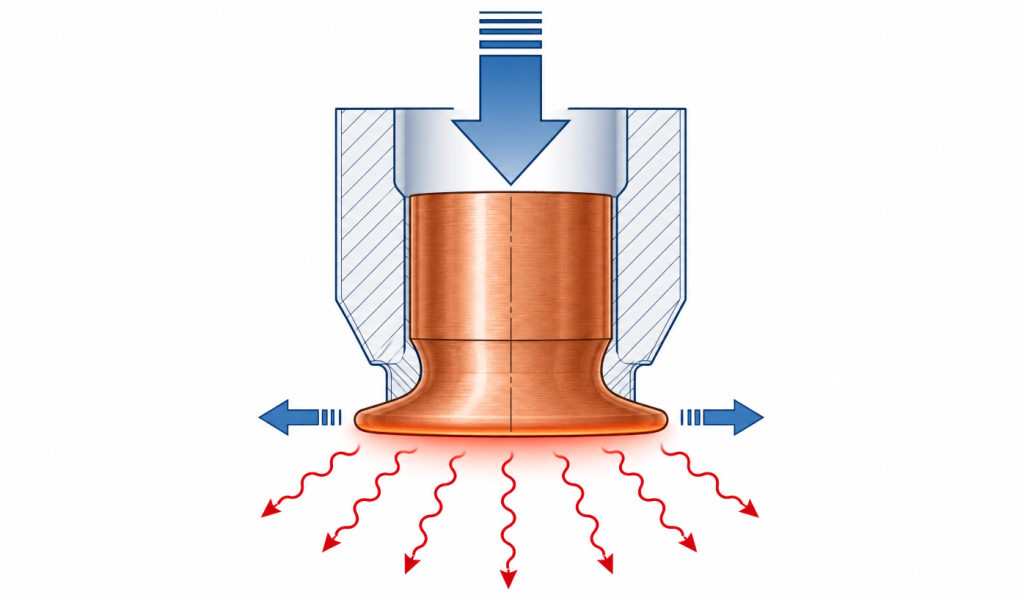
Pressure. The electrode presses on the workpiece with substantial force to make the weld. That force acts directly on the heated, softened face.
Softening. Here is the heart of it, and the single most important cause our investigations confirm: copper and copper alloys lose strength as they heat up. A hot electrode face is a soft electrode face, and a soft face under pressure spreads. This is why electrode softening — the combined effect of heat and pressure — is the fundamental mechanism of mushrooming. Everything else is a factor that makes this softening worse or better.
Once you see mushrooming as “the face got hot enough to soften, and the pressure spread it,” every root cause below becomes intuitive: each one either raises the heat, raises the pressure, or lowers the material’s resistance to softening.
It is worth dwelling on the softening point, because it is the hinge the whole phenomenon turns on. Metals are not rigid at all temperatures — their strength falls as they heat, and copper falls faster than many. At room temperature a copper alloy face would shrug off the electrode force entirely; it is only because welding drives the face to a high temperature that the same force becomes able to deform it. This temperature dependence is why two electrodes can behave so differently under identical force and current: the one that runs cooler, or is made of a material that holds its strength to a higher temperature, keeps its shape, while the one that runs hot or is made of soft material spreads. The face does not deform because the force is enormous; it deforms because the force meets metal that heat has temporarily weakened. Hold that idea and the controls later in this article — cool the face, harden the material, ease the pressure — read as three ways of restoring the strength that heat took away.
The Four Root Causes of Electrode Mushrooming
When we trace a mushrooming complaint to its source, the cause is almost always one — or a combination — of these four.
Mushrooming Cause 1: Insufficient Cooling and Electrode Softening
A spot welding electrode is designed to shed its heat into internal cooling water between welds. When that cooling is inadequate — low flow, a blocked passage, scale buildup, a cooling tube positioned poorly — the face never gets a chance to cool, and its temperature climbs weld after weld. A hotter face is a softer face, and a softer face mushrooms faster. The role of cooling is explicit in the engineering: cooling fluid is supplied to the electrode cavity specifically to limit heating and the softening and deformation of the electrode that would otherwise result. Inadequate cooling is one of the most common mushrooming causes we confirm, and one of the most fixable.
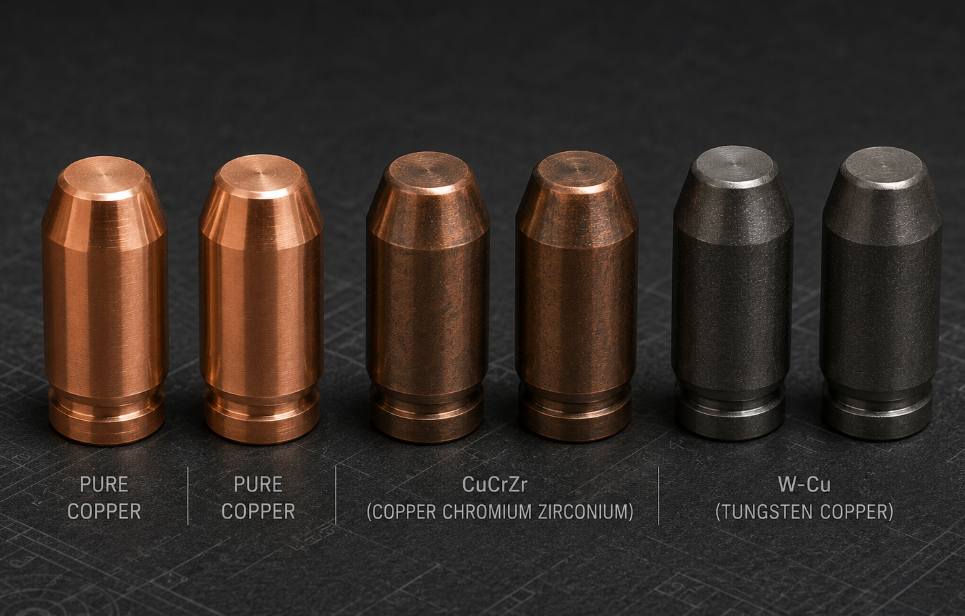
Mushrooming Cause 2: Soft Material — Pure Copper or Un-Aged CuCrZr
The electrode’s resistance to softening is a material property, and the wrong material has too little of it. Pure copper, lacking any strengthening mechanism, softens readily and mushrooms quickly on steel. Genuine CuCrZr resists this through aging heat treatment that forms strengthening precipitates — but CuCrZr that was never properly aged behaves like soft copper despite correct chemistry. Either way, a material that softens at lower temperature mushrooms sooner. We cover this trap in depth in our comparison of CuCrZr versus pure copper electrodes; for mushrooming specifically, the lesson is that material is the electrode’s built-in defense against deforming, and a soft material has dropped its guard before the first weld.
Mushrooming Cause 3: Excessive Electrode Force or Pressure
Mushrooming is spreading under pressure, so more pressure means more spreading. Electrode force set higher than the joint requires pushes harder on the softened face, accelerating the outward flow of material. Excess force is a less obvious cause than heat or material — it often hides as a setting nobody questions — but on a face already softened by welding heat, surplus pressure is surplus deformation.
Mushrooming Cause 4: Excessive Welding Current and Heat Input
More current means more heat, and more heat means a softer face. Welding current set higher than necessary — or crept up over time to compensate for other problems — raises the thermal load on the electrode and softens it further. Because heat input scales with the square of current, even a modest current increase is a significant heat increase, and that heat goes straight into softening the face that is about to be pressed.
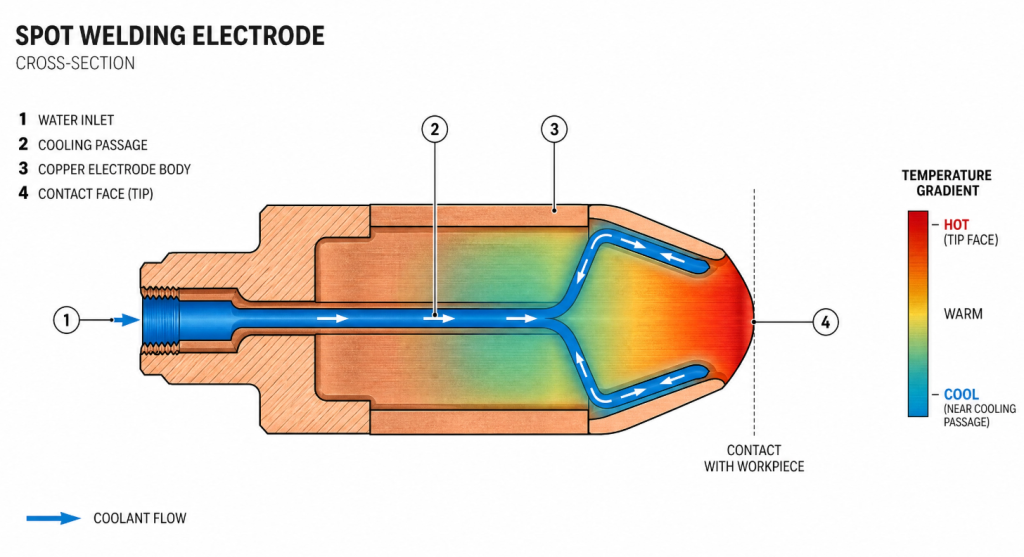
Table 1 — Root Causes of Electrode Mushrooming
| Root Cause | Mechanism | How It Drives Mushrooming |
|---|---|---|
| Insufficient cooling | Face cannot shed heat between welds | Higher face temperature → softer face → faster spread |
| Soft material (pure Cu / un-aged CuCrZr) | Material lacks softening resistance | Deforms at lower temperature than aged alloy |
| Excessive electrode force | Surplus pressure on softened face | More force → more outward spreading |
| Excessive current / heat input | Square-law heat increase at face | More heat → softer face → faster spread |
The pattern across all four: each raises heat, raises pressure, or lowers the material’s resistance — exactly the three terms in the softening mechanism. Fixing mushrooming means addressing whichever of these your line is feeding.
The Mushrooming Chain Reaction: Why It Gets Worse
Mushrooming is dangerous not just because it degrades a weld, but because it triggers a self-accelerating cycle that makes everything worse. This is the most important thing for an operator to understand.
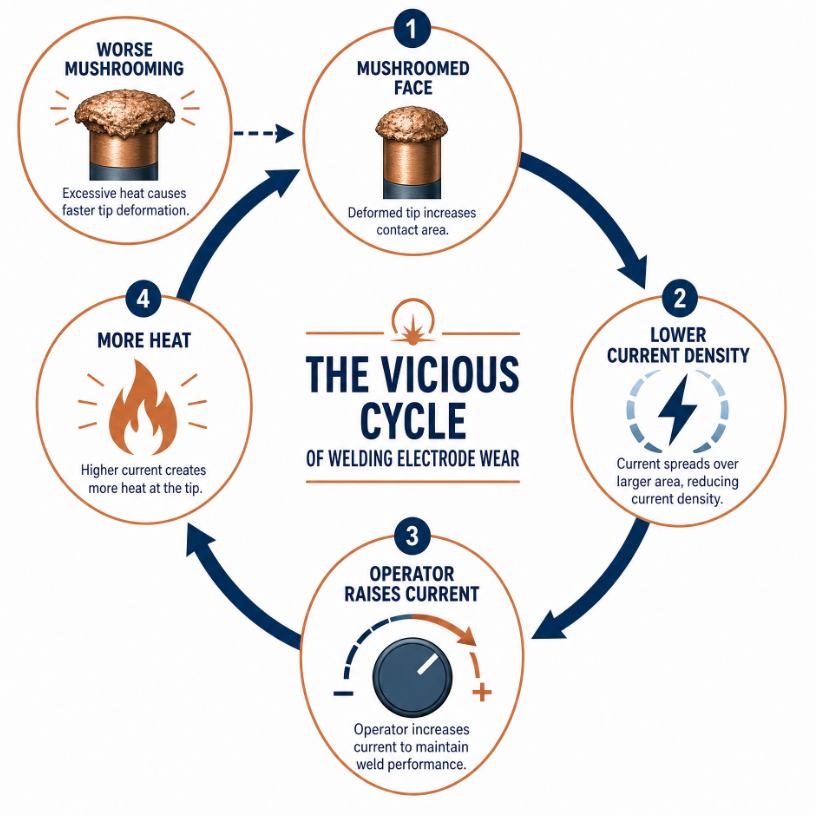
It begins with current density. The whole reason a cap face has a designed diameter is to concentrate current into a defined area, achieving the current density that forms a proper nugget. When the face mushrooms wider, the same current spreads over a larger area, so current density drops — and a weld that was correctly sized starts coming out undersized and weak.
Then comes the human response that turns a problem into a spiral. Seeing weak welds, an operator raises the current to compensate. It works briefly — until the extra current puts more heat into the face, softens it further, and spreads it wider, which drops current density again, which prompts another current increase. The research describes exactly this feedback: the mushrooming effect increases the set parameters, which in turn leads to a still larger mushroom effect. Each turn of the current knob treats the symptom and feeds the disease.
The consequences compound from there: a mushroomed, mislocated face shifts weld position and destabilizes quality; the enlarged hot face promotes sticking and, on coated steel, accelerates zinc pickup. The full failure picture of how these factors interlock is covered in our article on why electrodes wear out too fast.
The reason this cycle is so insidious is that each individual step is locally rational. Raising the current when welds come out weak is not a foolish reaction — it genuinely restores nugget size for a while, and from the operator’s chair it looks like a fix that works. The damage is invisible and deferred: the extra heat does its softening over the following hundreds of cycles, not immediately, so cause and effect are separated in time and never get connected. By the time anyone notices the caps are dying far too fast, the line is running at a current setting nobody would have chosen deliberately, and each new cap inherits that punishing setting and mushrooms even faster than the last. This is why breaking the cycle is a discipline rather than a one-time fix: the rule has to be that a drifting weld triggers a check of the face and the cooling first, and a current adjustment only from a freshly dressed, properly cooled baseline. A shop that internalizes that one rule removes the single most destructive mushrooming accelerator there is.
Table 2 — The Consequences of Electrode Mushrooming
| Consequence | What Happens | Result |
|---|---|---|
| Current density drops | Same current over a larger face area | Undersized, weak welds |
| Current raised to compensate | Operator increases parameters | More heat → worse mushrooming (vicious cycle) |
| Weld position shifts | Deformed face mislocates the spot | Unstable, inconsistent weld quality |
| Sticking and pickup rise | Enlarged hot face grabs material | More downtime, faster degradation |
The table makes the trap visible: row two is what converts a manageable wear process into a runaway one. Breaking the cycle means never answering a mushroomed face with more current.
How to Control Electrode Mushrooming
Mushrooming cannot be eliminated — it is inherent to pressing a hot metal face onto a workpiece — but it can be controlled, slowed, and managed predictably. Our standard guidance to customers rests on four practices.
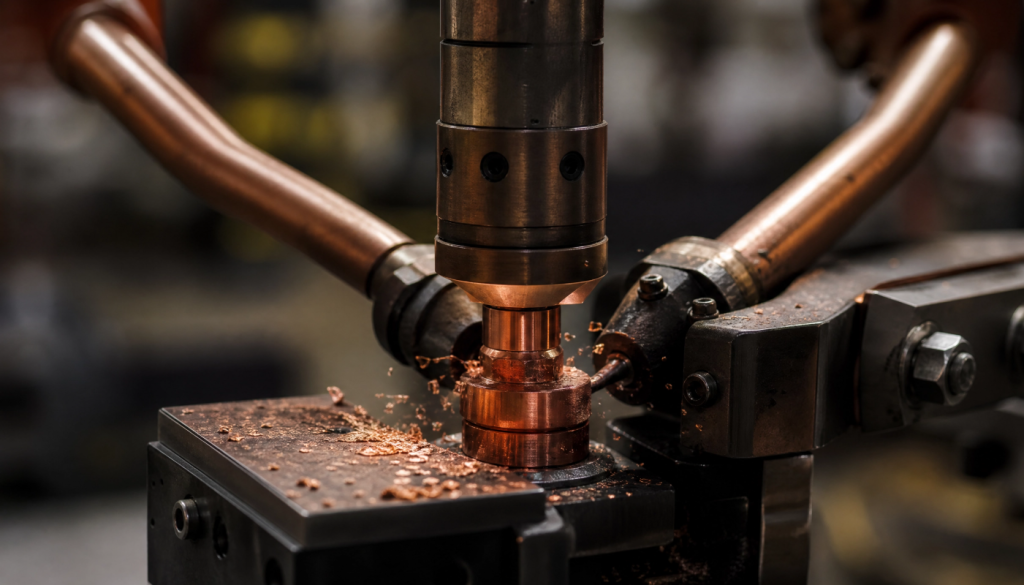
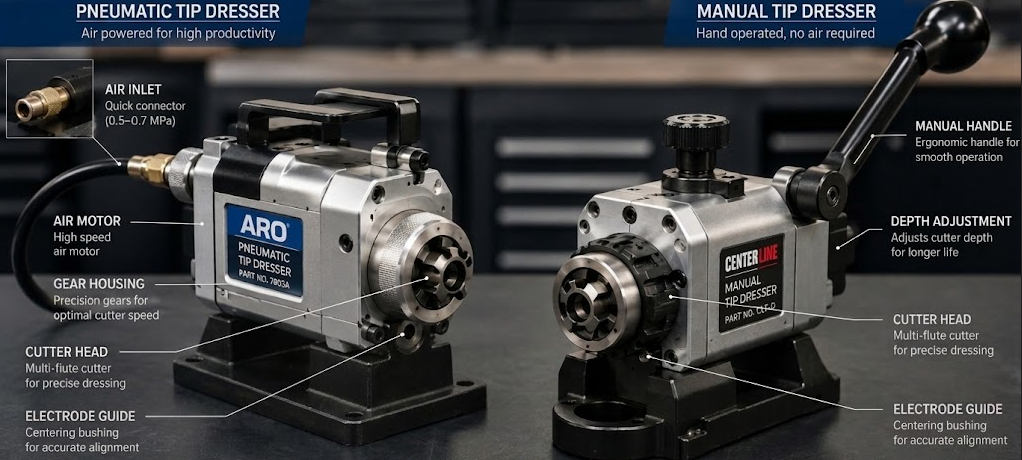
Dress on a schedule to restore face geometry. Tip dressing re-cuts the mushroomed face back to its correct diameter and geometry, restoring current density and weld quality. Done on a regular schedule — before the spread becomes severe — dressing is the primary tool for managing mushrooming, which is why a proper pneumatic tip dresser is core equipment, not an accessory. Our cap tip repair tools cover dressers for exactly this. Research increasingly supports basing dressing timing on process data rather than guesswork, since tip-dressing restores original geometry and well-timed dressing extends electrode life further.
Lock in correct, aged CuCrZr material. Since material is the electrode’s resistance to softening, specifying genuine aged CuCrZr (for steel) gives the face the hot strength to resist spreading in the first place. The base copper-alloy properties that govern this behavior are characterized in references such as the Copper Development Association’s technical resources.
Ensure adequate cooling. Keeping cooling water flow full and unobstructed holds the face temperature down, keeping it harder and slowing the spread. Verifying flow at each gun is a simple, high-return check.
Set parameters to the material, and replace on a weld-count schedule. Honest current and force settings avoid feeding the cycle, and logging electrode life in weld counts lets you replace caps on a planned schedule before mushrooming becomes severe — rather than reacting after quality has already drifted.
A word on how these four practices work together, because they are not independent fixes to pick one from. Dressing manages the deformation after it starts; material and cooling slow how fast it starts; parameters and planned replacement keep the whole process inside a predictable envelope. A shop that dresses diligently but runs soft material on poor cooling will be dressing constantly, fighting a spread that the material and cooling keep feeding. A shop with excellent material and cooling but no dressing discipline will still eventually mushroom and drift quality. The leverage comes from doing all four, because each one removes a different part of the problem: take away the heat (cooling), raise the resistance (material), restore the geometry (dressing), and stop feeding the cycle (parameters and planned replacement). Lines that adopt the full set rarely raise mushrooming as a complaint at all — it recedes into a routine, scheduled maintenance item that no longer surprises anyone.
Table 3 — Mushrooming Control Measures
| Control Measure | What It Does | Addresses Which Cause |
|---|---|---|
| Scheduled tip dressing | Restores face diameter & geometry | Manages the deformation directly |
| Aged CuCrZr material | Raises resistance to softening | Soft-material cause |
| Adequate cooling water flow | Keeps face temperature down | Insufficient-cooling cause |
| Correct parameters + planned replacement | Avoids the vicious cycle; pre-empts severe spread | Excess force/current causes |
These four together turn mushrooming from an unpredictable failure into a managed maintenance item — which is the realistic goal, since the phenomenon itself cannot be designed away.
Real Cases: Controlling Mushrooming in Practice
Three customer situations show the control measures working.
Case 1 — Right material slows the spread. A customer was mushrooming caps rapidly on a steel line. Switching them to properly aged CuCrZr, with no other change, slowed the mushrooming markedly and extended cap life — the harder, aged material simply resisted the spreading that the previous softer caps could not.
Case 2 — Cooling repair restores life. Another customer saw severe mushrooming concentrated on one gun. The cause was a compromised cooling circuit on that station; once flow was restored, the face ran cooler, mushrooming on that gun slowed to match the others, and cap life recovered.
Case 3 — Dressing discipline extends life. A customer relying on irregular, late dressing switched to regular scheduled dressing with a proper dresser. Restoring the face geometry before the spread became severe extended electrode life and stabilized weld quality, with no change to the caps themselves.
The common thread: in each case, mushrooming was brought under control by addressing one of its specific causes — material, cooling, or dressing — rather than by accepting it as inevitable.
How to Diagnose Your Mushrooming Problem
When mushrooming is hurting a line, work through this sequence:
- Check cooling first. Verify water flow at the affected gun against a healthy one. Asymmetry between identical stations is the fastest clue, and cooling is the most common fixable cause.
- Question the material. Is it pure copper on steel? Is it CuCrZr that might be un-aged? Soft material mushrooms regardless of everything else.
- Review parameters. Look for current that crept up to compensate for earlier problems, and force set higher than the joint needs.
- Audit the dressing schedule. Is dressing timed to weld counts, or done late when the spread is already severe? Late dressing lets mushrooming win.
- Log weld counts. Without data, mushrooming is managed by impression; with it, you can set a replacement schedule and catch the spread before it drifts quality.
A line that has good cooling, correct aged material, honest parameters, and disciplined dressing will still mushroom eventually — but slowly, predictably, and on your schedule rather than its own.
Final Thoughts on Electrode Mushrooming
Mushrooming looks like simple wear, but it is a precise mechanical story: a copper face softened by heat, spread by pressure, accelerated by a current-density feedback loop that tempts operators into making it worse. Once you see it that way, the controls follow logically — keep the face cool, give it the hot strength of aged material, press it no harder than necessary, and dress it back to shape on a schedule before the spread runs away.
If mushrooming is costing you weld quality or consumable budget, tell us what you weld, your current cap material, how your cooling is set up, and how your caps look when they fail. From those details we can usually point to the dominant cause and recommend the fix — whether that is aged CuCrZr caps, a dressing setup from our cap tip repair tools range, or a cooling and parameter review. Diagnosing a mushroomed cap is cheap and fast; living with one quietly is not.
Share This Article
Latest Articles
October 19, 2026
October 19, 2026
October 19, 2026
October 19, 2026
October 19, 2026
October 19, 2026
October 19, 2026
October 19, 2026