The Role of Guide Pins in Projection & Nut Welding Accuracy

The Role of Guide Pins in Projection & Nut Welding Accuracy
In nut and projection welding, the weld is only as good as the positioning that precedes it — and the positioning depends on a part that does no welding at all: the guide pin. It locates the nut, bolt, or stud precisely over the weld point and holds it there while the weld is made. Get that positioning right and you get consistent, strong, correctly placed welds; get it wrong and you get misaligned nuts, weak joints, and assembly problems downstream. This article is about that often-underestimated relationship between the guide pin and weld accuracy — why positioning determines weld quality, how the pin delivers it, and what happens when the pin’s accuracy degrades.
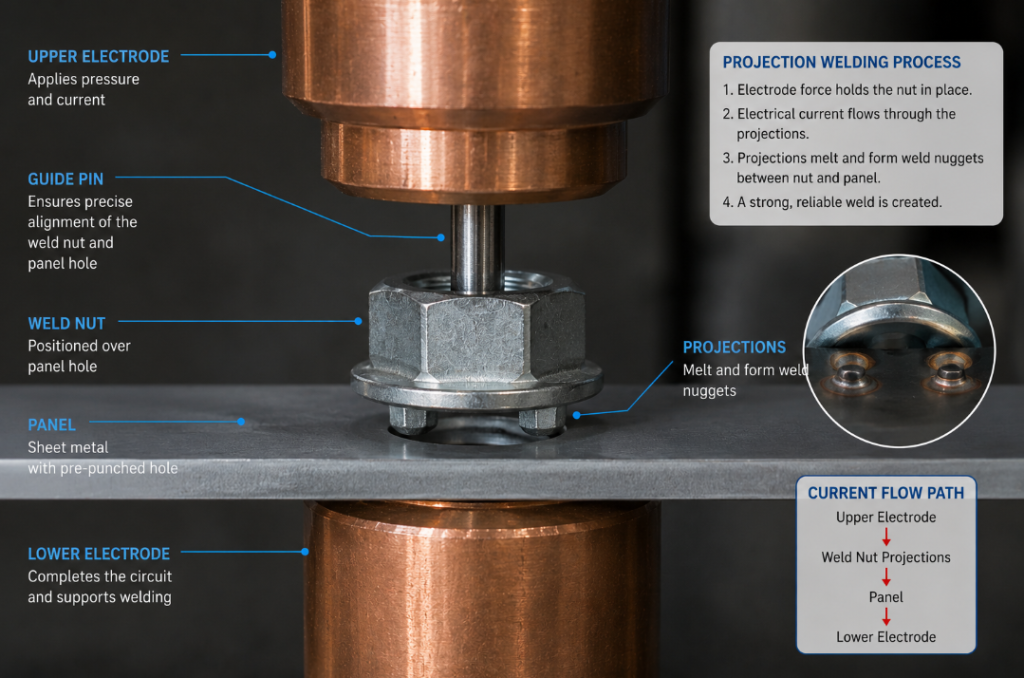
This is the accuracy-focused companion to our piece on KCF guide pins, which covers the part itself; here the lens is precision — how the pin governs where the weld lands and how good it is.
Why Positioning Accuracy Determines Weld Quality
The stakes behind nut and bolt welding accuracy are higher than they first appear. A modern car body contains roughly 300 welded fasteners, and the quality of their attachment is critical for safety and reliability — components as important as axles, seat belts, and steering columns anchor to them, as documented in industry coverage of projection welding for nut and bolt attachment. When a fastener that anchors a seat belt is welded out of position, the consequence is not cosmetic.
Positioning accuracy is what stands between a correct weld and a flawed one, and the guide pin is the part that delivers it. Its job is to put the nut or bolt exactly where it belongs relative to the weld point and the panel hole, and to keep it there during the weld. Several distinct accuracy functions ride on that one part.
What the Guide Pin Does for Accuracy
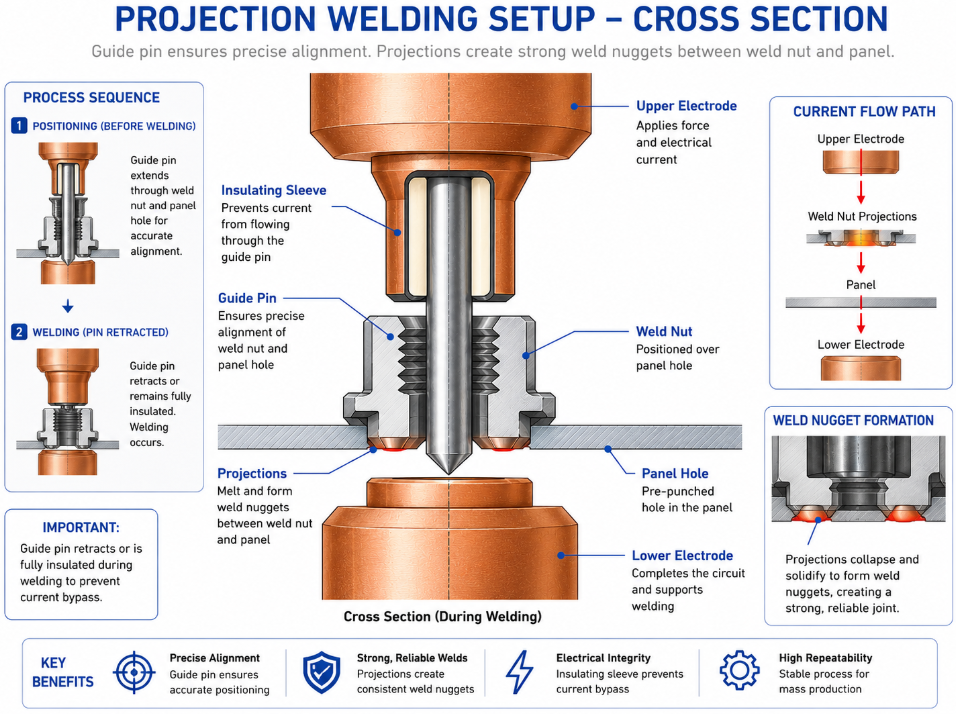
In the nut and projection welding we supply pins for, the guide pin performs five accuracy-related jobs at once:
It aligns the nut or bolt precisely with the weld point. This is the core function — positioning the fastener exactly where the weld must form, so the nut sits true to the panel and the weld lands where the design intends.
It keeps every workpiece consistent. In production, consistency is everything. The pin ensures that part number 10,000 is positioned identically to part number one, which is what makes high-volume welding repeatable rather than a series of slightly different welds.
This consistency function is worth dwelling on, because it is where the pin quietly earns its keep on a production line. Manual positioning, even by a skilled operator, varies slightly from part to part — a fraction of a millimetre here, a small angle there — and on a line producing thousands of parts, that variation accumulates into a spread of weld positions and a spread of weld quality. A guide pin removes the human variability from the equation: it locates every fastener the same way, every cycle, so the only thing that changes between parts is what the pin cannot control. This is precisely why automated, high-volume fastener welding depends on positive mechanical location rather than operator judgment. The pin is what lets a line weld the ten-thousandth nut as accurately as the first, and it is why pin wear matters — as the pin drifts, that hard-won consistency drifts with it.
It prevents the nut from shifting or sitting skewed. Without positive location, a nut can drift out of position or seat at an angle, welding crooked. The pin holds it square and centered.
It guides a bolt or stud through the panel hole. For through-hole applications, the pin guides the fastener into and through the hole, aligning the central hole of the nut directly with the opening in the workpiece — the precise registration that a clean joint requires.
Perpendicular alignment is part of this too, and it is easy to overlook. Projection welding requires the fastener to be aligned perpendicular to the flat electrodes and to the centerline of the cylinder above, as industry guidance on welding fasteners by spot or projection explains, and for through-hole work the insulated locating electrode protects the threads while holding that alignment. A pin does not only position the fastener in the plane of the panel — it helps keep it square to the electrodes, so the projections collapse evenly and the nut sits flat rather than tilted. A fastener located in the right spot but sitting at a slight angle still welds poorly, which is why squareness is as much a part of accuracy as position.
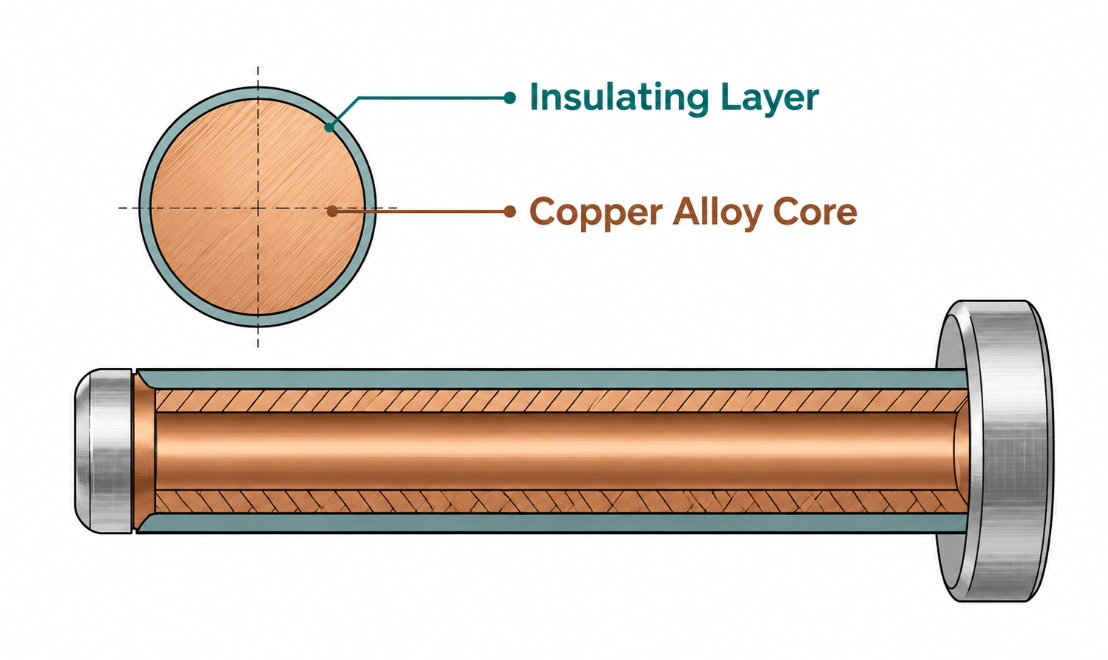
It isolates the welding current to prevent shunting. Here accuracy and electrical function meet. A locating pin sits in the current path, so it must position without conducting. An insulated pin locates the fastener and simultaneously prevents stray current from flowing through the pin itself. The patent literature describes exactly this dual role: a centrally mounted alignment pin, insulated from the electrode by a non-conductive sleeve, locates the nut while its electrical isolation prevents arcing — and on many designs the pin even withdraws at the instant of welding to further avoid shunting.
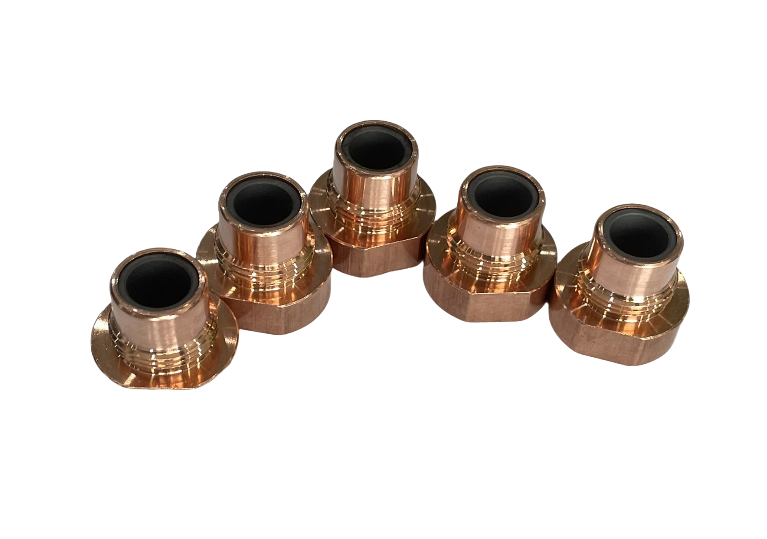
This is why pin material matters so much for accuracy specifically: the pin has to locate precisely and not conduct, and on KCF pins the insulating layer is what lets one part do both jobs at once.
It is worth understanding the two complementary defenses against shunting, because they explain different pin designs you may encounter. The first defense is insulation: an insulated pin can sit in the current path throughout the weld and still not conduct, because its surface does not pass current. The second defense, used on some designs, is retraction: the pin advances to locate the fastener, then physically withdraws into the electrode at the instant the weld fires, so it is simply not in the circuit when current flows. Some systems combine both. For a buyer, the practical point is that locating accuracy and shunting prevention are not in tension — a well-designed locating pin delivers both, whether through insulation, retraction, or a combination. An insulated KCF pin achieves it without any moving mechanism, which is part of its appeal: precise location and electrical isolation from a single static part, with nothing to actuate or time.
When Guide Pin Accuracy Fails: The Consequences
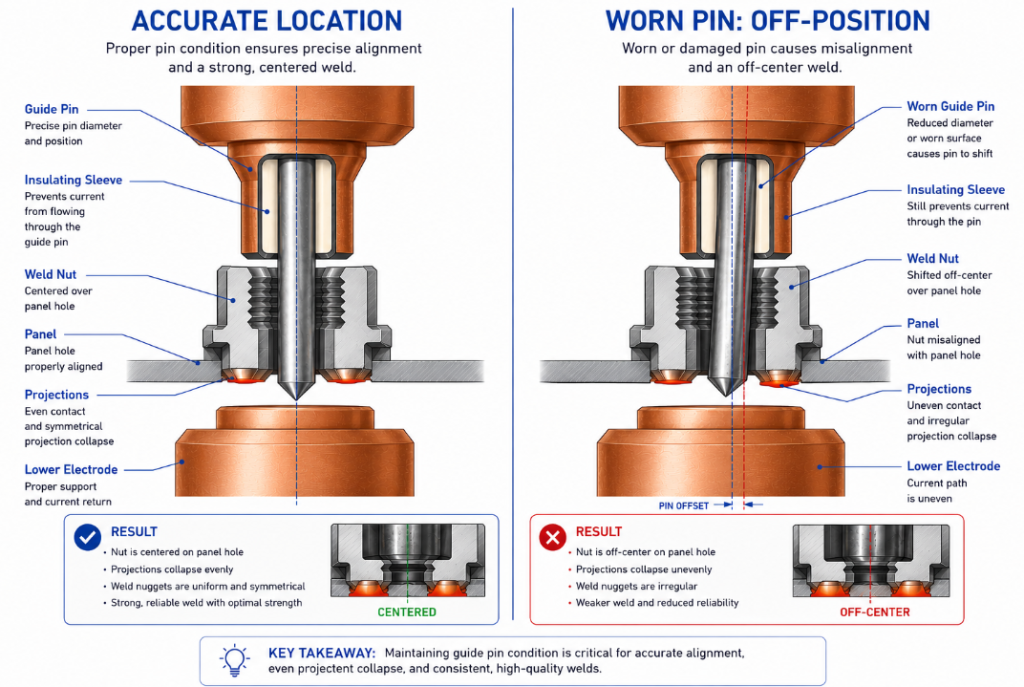
A guide pin that has lost its accuracy — through wear, deformation, wrong sizing, or conductivity — produces a chain of downstream problems. Understanding these failure modes is how you recognize a pin-accuracy problem when quality starts slipping.
Worn or deformed pin → degraded positioning. A pin is a wear part. As it wears or deforms, the location it provides drifts from correct, and positioning accuracy falls with it. Yesterday’s precise pin becomes today’s approximate one.
Positioning drift → wrong weld location → insufficient strength. When location drifts, the weld forms in the wrong place. A weld that is off-position may not develop the strength the joint needs, because the projections and the weld nugget are not where the design intended them to be.
Inaccurate location → nut welded off-position → assembly failure. This is the consequence that reaches the customer. A nut welded out of position means the thread is misplaced — the mating part will not assemble correctly, or the threads end up non-concentric, and what should be a simple bolt-up becomes a rejected part.
Conductive pin → shunting → weak welds. If the pin conducts when it should insulate, welding current shunts through the pin instead of fully through the joint. The diverted current produces a weak, undersized weld — and the failure is invisible, because the part looks welded while being structurally deficient. This is the same shunting mechanism behind several of the sticking and quality problems detailed in our article on why nut welding electrodes stick — an insulated pin is the defense against it, which is exactly why a locating pin’s material has to insulate as well as locate.
Wrong pin dimension or tolerance → looseness or binding. A pin whose diameter or tolerance does not match the nut hole or fixture produces either looseness (the fastener wanders, location is sloppy) or binding (the pin jams, fouling the cycle). Both are accuracy failures rooted in specification.
Table 1 — Guide Pin Accuracy Failures and Their Consequences
| Pin Problem | Immediate Effect | Downstream Consequence |
|---|---|---|
| Worn / deformed pin | Positioning accuracy degrades | Welds drift off-position over time |
| Positioning drift | Weld forms in wrong location | Insufficient weld strength |
| Inaccurate location | Nut welded off-position | Assembly fails; threads non-concentric |
| Conductive pin | Current shunts through pin | Weak, invisible-defect welds |
| Wrong diameter / tolerance | Looseness or binding | Sloppy location or jammed cycle |
The throughline is that a small loss of pin accuracy amplifies into a large quality problem — a worn or mis-specified pin does not fail quietly, it fails as scrapped assemblies and field reliability risk.
How to Keep Guide Pins Accurate Over Time
If pin accuracy determines weld accuracy, then maintaining pin accuracy is a production priority, not an afterthought. Four things keep a guide pin locating precisely over its service life.
Wear-resistant material to hold dimensional accuracy. A pin that resists wear holds its dimensions — and therefore its locating accuracy — far longer. Since dimensional precision is what positioning depends on, a wear-resistant pin material directly extends how long accurate location lasts before the pin drifts out of tolerance. This is a core reason material choice matters for locating pins.
Impact resistance to resist deformation. Locating pins take mechanical knocks — fastener insertion, handling, the cycle itself. A pin that resists impact without deforming keeps its shape and its accuracy, where a pin that deforms under impact loses both. Toughness preserves precision.
Correct diameter and tolerance matched to the nut hole. Accurate location starts with correct specification. The pin’s diameter and tolerance must match the nut hole and fixture so the fit locates precisely — neither loose nor binding. This is foundational: even a perfectly maintained pin cannot locate accurately if it was the wrong size to begin with. The bore-and-fit logic this depends on is the same one detailed in our KCF alloy rod specifications guide.
Regular inspection and replacement of worn pins. Because pins wear, accuracy is preserved by checking them and replacing them before wear degrades location past tolerance. Catching a worn pin on a schedule — rather than after it has scrapped a batch — is what keeps positioning consistent over the long run.
Table 2 — Maintaining Guide Pin Accuracy
| Practice | What It Preserves | Why It Matters |
|---|---|---|
| Wear-resistant material | Dimensional accuracy over time | Location stays precise longer |
| Impact resistance | Pin shape under mechanical load | Prevents deformation-driven drift |
| Correct diameter & tolerance | Precise fit to nut hole | Foundational; wrong size can’t locate |
| Scheduled inspection / replacement | Accuracy before tolerance is lost | Catches wear before it scraps parts |
Together these turn pin accuracy from something that silently degrades into something you actively maintain — which is the difference between consistent welds and a slow drift into quality problems.
Real Cases: Accuracy Restored
Three customer situations show pin accuracy driving weld quality.
Case 1 — Corrected tolerance solved a positioning problem. A customer had persistent positioning trouble — fasteners locating inconsistently. The pin’s tolerance was not correctly matched to the nut hole. Correcting the tolerance to the proper fit resolved the positioning problem directly; the location became precise once the pin fit the hole as it should.
Case 2 — Wear-resistant pins held accuracy longer. A customer was losing positioning accuracy as pins wore quickly. Switching to a more wear-resistant pin material meant the pins held their dimensions — and their locating accuracy — far longer, extending the interval over which welds stayed precise before pins needed replacement.
Case 3 — Better location improved weld consistency. A customer with inconsistent weld quality traced it to imprecise fastener location. Improving the locating accuracy — through correct pins, properly specified and maintained — improved weld consistency across the production run, because consistent location produces consistent welds.
The common lesson: in every case, weld quality moved in lockstep with locating accuracy. Fix the location and the welds follow.
Accuracy Starts With the Pin
It is easy to focus on the weld itself — the current, the force, the schedule — and overlook that all of it acts on a fastener whose position was set by the guide pin. Positioning accuracy determines weld quality, and the guide pin determines positioning accuracy. A pin that locates precisely, resists wear and impact to hold that precision, fits the nut hole correctly, and is replaced before it drifts is what stands quietly behind every consistent, correctly placed, full-strength weld.
If you are seeing positioning problems — nuts welding off-center, inconsistent quality, assembly issues downstream — the guide pin is one of the first places to look. Tell us about your fastener, your nut hole dimensions, and the positioning trouble you’re seeing, and we can help work out whether the issue is pin wear, a tolerance mismatch, material, or conductivity — and supply guide pins specified to locate your fasteners accurately and hold that accuracy in production. Browse our KCF guide pins and sleeves range, or send your application and let us help you put the weld exactly where it belongs.
Share This Article
Latest Articles
October 20, 2026
October 20, 2026
October 20, 2026
October 20, 2026
October 20, 2026
October 20, 2026
October 20, 2026
October 20, 2026