How to Order Custom Welding Parts: A Practical Guide for Buyers

Most welding locating parts and electrodes are, in the end, custom parts. A guide pin has to fit your nut and your fixture; a seam wheel has to fit your machine’s shaft; a cutter blade has to match your electrode’s face. That means the majority of orders start not with a catalogue number but with a drawing, a sample, or a photograph of a worn part — and how well that starting information is prepared largely determines whether the parts you receive fit. This guide covers the ordering process from the buyer’s side: what to send, the specification gaps that cause the most trouble, how sampling works, and what quality documentation to ask for. It’s written to make your enquiry easier to quote and your parts more likely to be right the first time.
If you’re still choosing a supplier, see our guides on how to choose a spot welding parts supplier and OEM factory vs trading company. This article assumes you’ve chosen and are ready to order.
What to Send for a Custom Part: Five Starting Points
Buyers arrive with different levels of documentation, and all of them are workable. Here’s what we can start from.
A drawing (CAD or PDF). The most direct route. A drawing with dimensions, tolerances, and material specified lets us quote accurately and machine to a defined standard. Both 2D drawings and 3D models are useful, and they do different jobs: a 3D model conveys the shape and machining access, while a 2D drawing tells the supplier what matters — which dimensions are critical and which are not. If you have both, send both.
A physical sample. A sample part — new or worn — can be measured and reproduced. Sending a sample is often the fastest route when no drawing exists, particularly for a replacement part whose original documentation is long gone. A worn sample works too; we measure the unworn features and reconstruct the original dimensions.
Dimensions or a description. No drawing, no sample, just measurements and a description of what the part does. This works for straightforward geometries: a pin of a given diameter and length, a sleeve with a given bore. Sketch it if you can — even a hand sketch with dimensions removes most ambiguity.
A photograph of the old part. Photos of the worn part, ideally alongside a ruler or caliper for scale, plus the key measurements. This is a very common starting point for replacement parts and works well when combined with a few measured dimensions.
Nothing but the application. Sometimes a buyer knows the problem but not the part specification — this is genuinely common, and it’s one of the situations we’re most used to. Tell us the fastener, the machine, the sheet, and what the part has to do, and we can propose a specification and produce a drawing for your approval. You don’t need to arrive with engineering documentation to start a conversation.
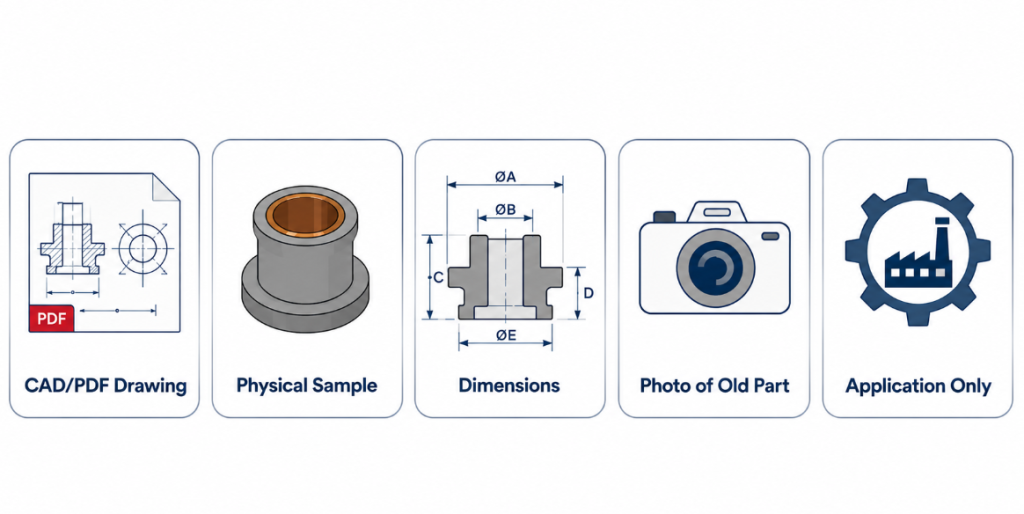
Table 1 — Starting Points for a Custom Order
| You Have | What We Do | Best For |
|---|---|---|
| CAD or PDF drawing | Quote and machine to the drawing | Defined parts, repeat orders |
| Physical sample | Measure and reproduce | Replacements with no drawing |
| Dimensions / description | Work from your measurements | Simple geometries |
| Photo of the old part | Reconstruct with your measurements | Worn replacement parts |
| Only the application | Propose a spec, draw for approval | When you’re unsure what you need |
Every row is a legitimate way to start. The more defined the input, the faster and more precise the quote — but the absence of a drawing is never a reason not to ask.
The Four Gaps That Cause the Most Trouble
In practice, four kinds of missing information account for most of the back-and-forth and most of the parts that come back wrong.
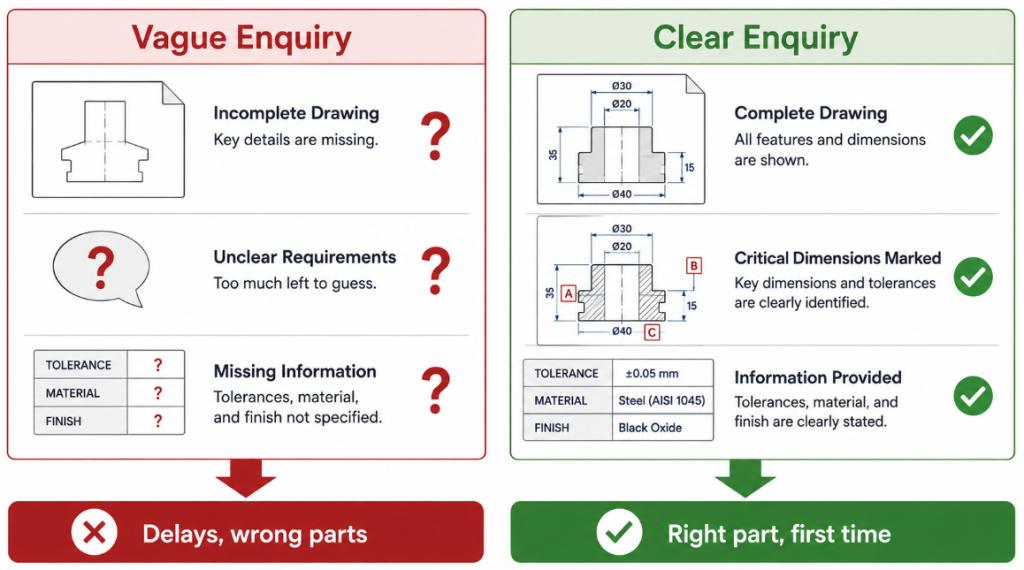
Unclear or incomplete drawings. Drawings missing dimensions, with ambiguous features, or with conflicting views. A quote based on an incomplete file may look attractive but may not include the right material, inspection, or production method — and a drawing that conflicts with an accompanying 3D model produces a wrong quote outright. The fix is a quick self-check before sending: can someone who has never seen this part make it from what’s on the page?
There’s a lead-time cost to this as well as a quality one. Lead time is affected by the quality of the enquiry itself — missing material details, unclear tolerancing, or late design changes can pause a project while the questions get resolved. Every ambiguity is an email round-trip, and with a time-zone gap each round-trip can cost a day. Ten minutes spent completing the drawing before sending it routinely saves a week of clarification later, which is why the self-check is worth doing even when you’re in a hurry — especially when you’re in a hurry.
Tolerances not specified. The most common technical gap, and the one with the biggest cost consequences in both directions. If tolerances aren’t stated, the maker has to guess — and guessing tight raises cost, while guessing loose risks a part that doesn’t locate accurately. The professional approach is to state which dimensions are critical and let the rest run to general tolerances. As machining suppliers put it plainly: if tolerance is not important, do not make it tight by default; if a feature is critical, mark it clearly. Tightening non-functional dimensions beyond the design need only raises cost and scrap risk.
Material not specified. Which alloy, which grade, what condition. For welding parts this matters a great deal — CuCrZr versus other coppers, KCF versus ceramic, alumina at one purity grade or another all behave differently and cost differently. If you’re not sure, say what the part must do and let us recommend; what causes trouble is an unstated assumption on either side.
Not knowing what you need. A buyer who knows the symptom but not the specification. This isn’t a failing — it’s a normal situation, especially when the person ordering isn’t the person who designed the setup. The remedy is to say so: describe the application rather than guessing at a specification, and let the supplier ask the questions. A good supplier will ask about fits, mating parts, and what’s critical before machining anything.
Table 2 — Specification Gaps and Fixes
| Gap | Consequence | Fix |
|---|---|---|
| Incomplete drawing | Wrong quote, wrong part | Self-check: could a stranger make it? |
| Tolerances unstated | Cost too high or part inaccurate | Mark critical dims; general tolerance the rest |
| Material unstated | Wrong alloy or grade supplied | State the duty; ask for a recommendation |
| Spec unknown to buyer | Guesswork on both sides | Describe the application, not a guess |
Notice that three of the four fixes cost the buyer nothing but a few minutes of clarity — and that the fourth, admitting you don’t know the spec, is often the most valuable thing you can say.
What Else to Include in Your Custom Part Enquiry
Beyond the drawing or sample, a few pieces of context make the difference between a quotation and a conversation.
Quantity — trial and repeat. How many now, and roughly how many per order after that. Quantity affects pricing and how the part is set up, and a trial quantity followed by repeat batches is a normal and sensible pattern.
Your machine and mating parts. For a guide pin, the nut and the hole. For a seam wheel, the welder’s shaft. For a cutter blade, the electrode and the dresser. Welding parts almost never work alone, so telling us what the part mates with lets us sanity-check the specification before cutting metal.
The duty. Sheet material, thickness, coating, and roughly how hard the line runs. This context lets a supplier flag a specification that doesn’t suit the job — a face width mismatched to sheet thickness, for instance, is worth catching before production.
What matters most to you. Accuracy, life, cost, lead time — these trade against each other, and knowing your priority helps us propose sensibly rather than guessing at your intent.
Sampling a Custom Part: Confirm Before You Commit
For a custom part, making one and checking it beats making a thousand and hoping. Two routes work, and both are normal.
Sample first, then production. We produce a sample to your drawing or specification, you receive and check it — fit it to your machine, run it if you can — and once it’s confirmed, production follows. This is the safest route for a part with critical fits or an unfamiliar geometry, and it’s what we’d suggest for a first order of anything non-trivial.
A small trial batch to drawing. Where the part is straightforward or the drawing is well-defined, a small first order can serve as the trial: enough parts to install and run, few enough that a problem isn’t expensive. This suits buyers who need working parts rather than a single sample to inspect.
Either way, the principle is the same: confirm the first article before committing to volume. It costs a little time up front and saves the far larger cost of a full production run that doesn’t fit. If you’re ordering a custom part for the first time from any supplier, asking for a sample or a small trial is simply good practice.
Quality Documentation: What to Ask For
Ask for documentation on the things you can’t verify by eye. For welding parts, four items cover most needs.
Material certification. Documents what the material actually is. For a part whose performance depends on its alloy — and where the key property may only appear after heat treatment — certification of the material is the foundation of everything else.
Dimensional inspection reports. Measured results for the part’s dimensions, confirming it was made to the drawing. If your enquiry named critical dimensions, the report should show the results for those features specifically — as machining suppliers put it, if the RFQ names a functional dimension, the report should show the result for that feature. That’s the whole point of marking them: a report full of measurements on features nobody cares about proves very little, while a report confirming the three dimensions that control your fit proves what matters.
Performance reports such as hardness. Where a property like hardness matters — and for heat-treated welding parts it does — a test report is direct evidence that the processing achieved its purpose. Hardness is measurable and you can re-check it yourself, which makes it a genuinely verifiable data point rather than a claim.
Pre-shipment photos or video. Images or video of the finished parts before they ship. This is a simple, practical check that lets you see what’s coming before it’s on a plane, and it catches obvious problems while they’re still cheap to fix.
Table 3 — Documentation to Request
| Document | Verifies | Why It Matters |
|---|---|---|
| Material certification | The alloy supplied | Performance depends on material |
| Dimensional inspection report | Made to drawing | Confirms critical dimensions |
| Hardness / performance report | Processing achieved its purpose | Measurable; you can re-verify |
| Pre-shipment photos or video | What’s actually shipping | Catches problems before transit |
The common thread: each document covers something you cannot check from a distance. Asking for them isn’t distrust — it’s the normal apparatus of buying manufactured parts remotely, and any capable supplier expects the request.
Putting It Together: A Simple Order Path
For a custom welding part, a sensible path looks like this. Send what you have — drawing, sample, photo, or just the application — along with your quantity, your machine and mating parts, and your duty. Expect questions: a supplier who asks about fits, critical dimensions, and materials before quoting is doing the job properly. Agree the specification, including which tolerances are critical and which are general. Get a sample or small trial batch and confirm it. Then release production, with the documentation you need specified in the order rather than requested afterwards.
Follow that path and most of what goes wrong with custom parts simply doesn’t happen. The parts fit because the fits were discussed; the tolerances are right because they were marked; the material is right because it was stated; and you knew what was coming because you saw it before it shipped.
Ordering Custom Welding Parts: Send Us What You Have
Ordering custom welding parts is mostly about clarity at the start. Send a drawing if you have one, a sample or photo if you don’t, or just describe your application if you’re not sure what you need — all are workable starting points. Mark the dimensions that matter and let the rest run general, state the material or ask for a recommendation, tell us the quantity and what the part mates with, confirm a sample before volume, and specify the documentation you want with the order. That’s the whole process, and it’s what makes custom parts arrive right.
Tell us what you need — send a drawing, a sample, a photo of the worn part, or simply describe your application and machine — and we’ll work out the specification with you, quote it, sample it where sensible, and manufacture it with the material certification, dimensional and hardness reports, and pre-shipment images you ask for. Browse our KCF guide pins and sleeves and other ranges, or just send us your part and let’s get it made.
References
- UneedPM — Custom CNC Turning China Guide (2D vs 3D file roles; do not tighten tolerances by default): https://www.uneedpm.com/custom-cnc-turning-china-china-cnc-machining-turning-guide/
- UneedPM — CNC Machining Supplier China OEM Guide (RFQ completeness, sample/pilot lot approval path, cost drivers): https://www.uneedpm.com/cnc-machining-supplier-china-oem-guide-how-to-choose-the-right-manufacturing-partner/
- JXD Machining — China CNC Machining Outsourcing Guide (inspection reports should report the functional dimensions named in the RFQ): https://www.jxd-machining.com/china-cnc-machining-outsourcing-guide-2026/
Share This Article
Latest Articles
October 18, 2026
October 18, 2026
October 18, 2026
October 18, 2026
October 18, 2026
October 18, 2026
October 18, 2026
October 18, 2026