
OEM Factory vs Trading Company: How to Verify a Real Manufacturer

The single biggest fear we hear from international buyers sourcing welding parts from China is some version of this: “How do I know I’m dealing with an actual factory, and not a trading company marking up someone else’s product?” It is a reasonable fear. The supplier landscape genuinely contains both, and the difference affects your price, your ability to customize, your technical support, and what happens when something goes wrong. This guide explains the real distinction, gives you the concrete methods to verify which one you’re talking to — and, importantly, does not pretend every trading company is a villain, because that would be both untrue and unhelpful.
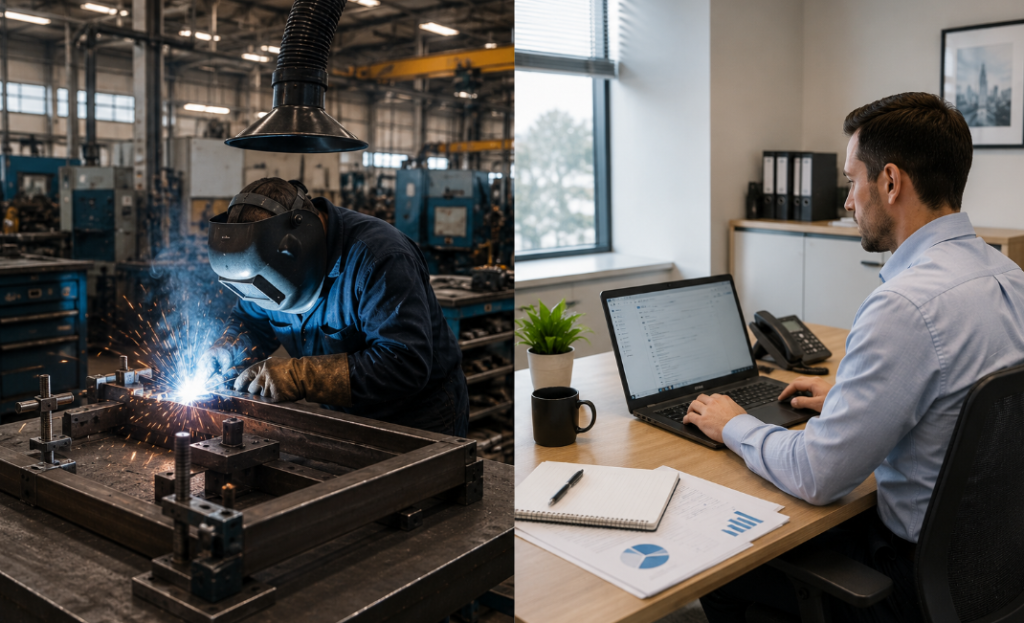
We write this as a factory, which we will be upfront about. But the goal here is not to tell you “always buy from factories” — it is to give you the verification tools to know what you’re dealing with, so you can make the right call for your own situation and your own product needs. Our broader guide to choosing a spot welding parts supplier covers supplier selection generally; this article zooms in on the one question of factory-versus-intermediary.
The Real Difference Between an OEM Factory and a Trading Company
The distinction is simpler than the anxiety around it suggests. An OEM factory owns production equipment and physically makes goods — including, in the OEM sense, making products to your design and specifications. A trading company does not manufacture; it sources products from factories and resells them, sitting as an intermediary between you and whoever actually makes the part.
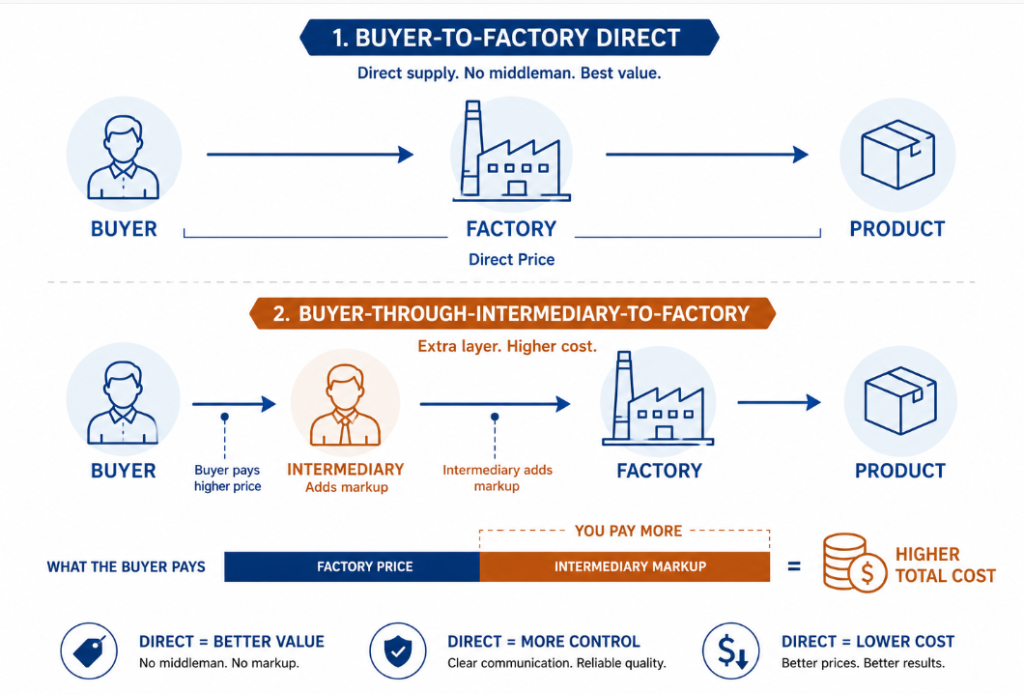
That intermediary position is not inherently bad — we will come back to that — but it has direct consequences. When you buy from the factory that makes the part, you are one step from production: the price has no reseller markup layered on it, technical questions go to people who actually make the thing, customization is a conversation with the producer, and after-sales issues reach whoever is responsible for the product. When you buy through an intermediary, each of those runs through a middle layer that adds margin, can dilute technical depth, and lengthens the chain when something needs fixing.
For a buyer purchasing within a single, specific product category — like resistance welding consumables — dealing directly with the specialist factory is usually the stronger choice for exactly these reasons. The advantages concentrate where the product is focused.
Why This Matters: What Buyers Are Really Afraid Of
When buyers ask us to prove we’re a real factory, the worry underneath is usually one of five specific fears, and each maps to a real consequence of an intermediary chain:
Paying a markup. A trading company has to make its margin somewhere, and that somewhere is the price you pay over what the factory charges.
Sample-versus-bulk mismatch. The fear that the sample looks great but the production run doesn’t match it — a risk that grows when the seller doesn’t control production.
No one to reach when problems arise. The dread of an after-sales issue disappearing into a chain where no one takes responsibility.
Can’t customize, or technical questions go unanswered. The frustration of needing a custom bore or a specific tolerance, or asking a real technical question, and hitting a salesperson who can’t engage because they don’t make the product.
Uncontrollable lead times. The more intermediate links between you and production, the less anyone can promise — or control — when your order actually ships.
These fears are legitimate. The answer is not to assume the worst of everyone, but to verify — and verification is very doable. One practical angle that ties several fears together: ask pointed questions about lead time and who controls it. A factory scheduling its own production can give you a real answer about when your order runs and ships, because the production line is theirs to schedule. An intermediary is quoting you a date that depends on a factory it does not control, with its own queue and priorities — so the promise is softer, and delays propagate through the chain with no one fully in charge. When a supplier can speak concretely and confidently about their own production schedule, that confidence is itself evidence they own the production. Vagueness about lead time often signals an intermediate link absorbing the uncertainty.
How to Verify You’re Dealing With a Real Factory
Here are the concrete methods, ordered roughly from most decisive to supporting evidence. No single one is foolproof, but together they make it very hard for an intermediary to pose as a factory.
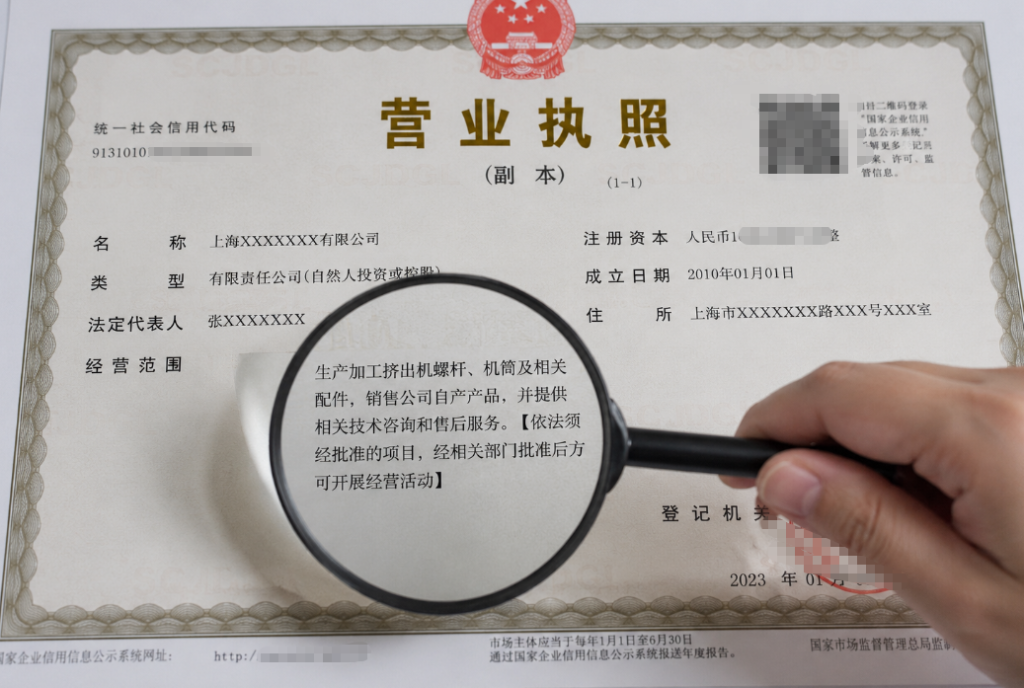
Check the Business License Scope — the Hardest Thing to Fake
The most reliable single check is the supplier’s Chinese business license, specifically the “Business Scope” field. This field legally states what the company is registered to do. As verification specialists explain, a manufacturer’s business scope contains manufacturing terms like 生产 (production), 制造 (manufacturing), or 加工 (processing), whereas a pure trading company’s scope shows only trading and sales terms (销售, 批发, 贸易). This is hard to fake because it is a government registration, not a self-made claim. Ask for the business license, and have the business scope checked — a few dollars for a translator if needed, and you have your most decisive single data point.
Verify Against Official Government Databases
A license copy can be doctored; the government database cannot. The registration can be cross-checked against China’s official enterprise databases — systems like the National Enterprise Credit Information Publicity System (NECIPS / GSXT) — to confirm the company details are real and current. As quality-assurance specialists note, you can verify the documents through government registration databases rather than trusting a filed copy. Checking the license against the official source closes the gap between “they sent me a certificate” and “the certificate is real.”
Cross-Check Factory Address Consistency
A real factory’s registered address sits in an industrial zone, and it should be consistent across the business license, the sample shipment, and the invoice. A mismatch — three different entities, or an address that turns out to be a commercial office building rather than an industrial facility — is a serious red flag that the seller is not who they claim. Consistency across these documents is a quiet but powerful signal of a single, real manufacturing entity.
Request a Live Video Factory Tour
Ask the supplier to walk the production line on a live video call — showing equipment, work in progress, and raw material storage during working hours. A real factory can do this readily; an intermediary cannot show a production line it does not have. This has become standard practice for overseas buyers precisely because it is hard to fake in real time, and a factory accustomed to verification will respond to the request promptly rather than deflecting.
Ask Real Technical Questions
This is one a specialist factory passes effortlessly and an intermediary often fails. Ask detailed technical questions about the product — material specifics, tolerances, why one option suits your application over another. The people who actually make a part can engage on its engineering; a salesperson reselling it frequently cannot go past surface answers. The depth of technical response tells you whether you’re talking to the maker.
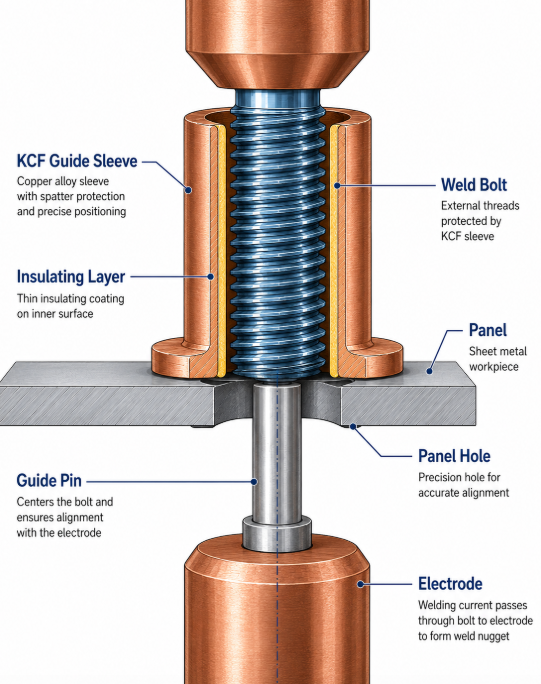
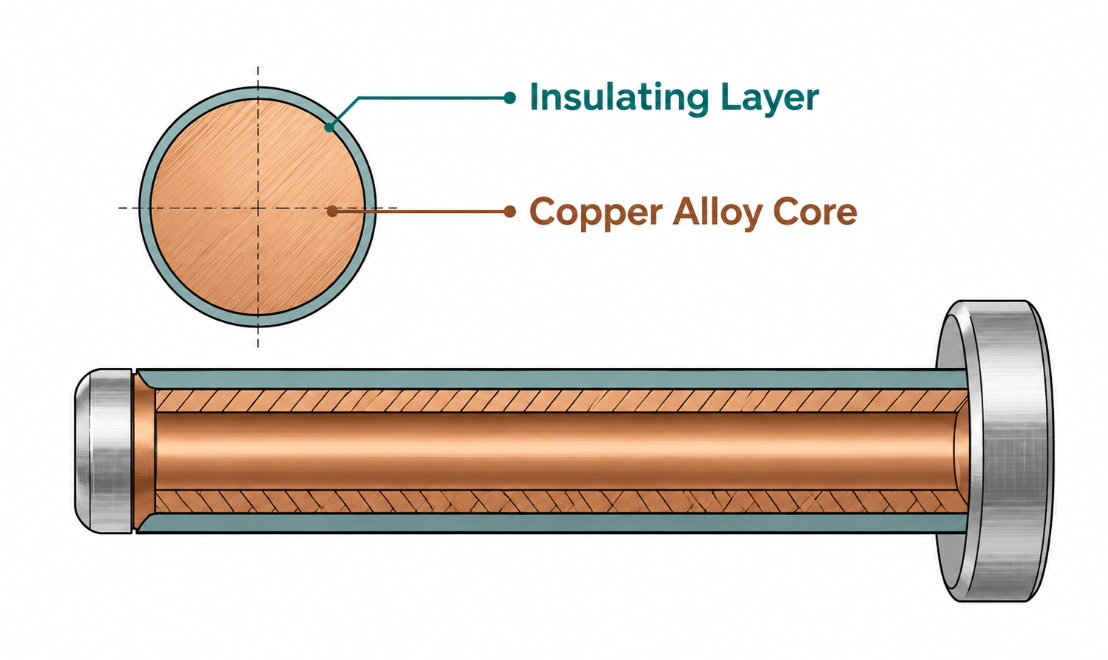
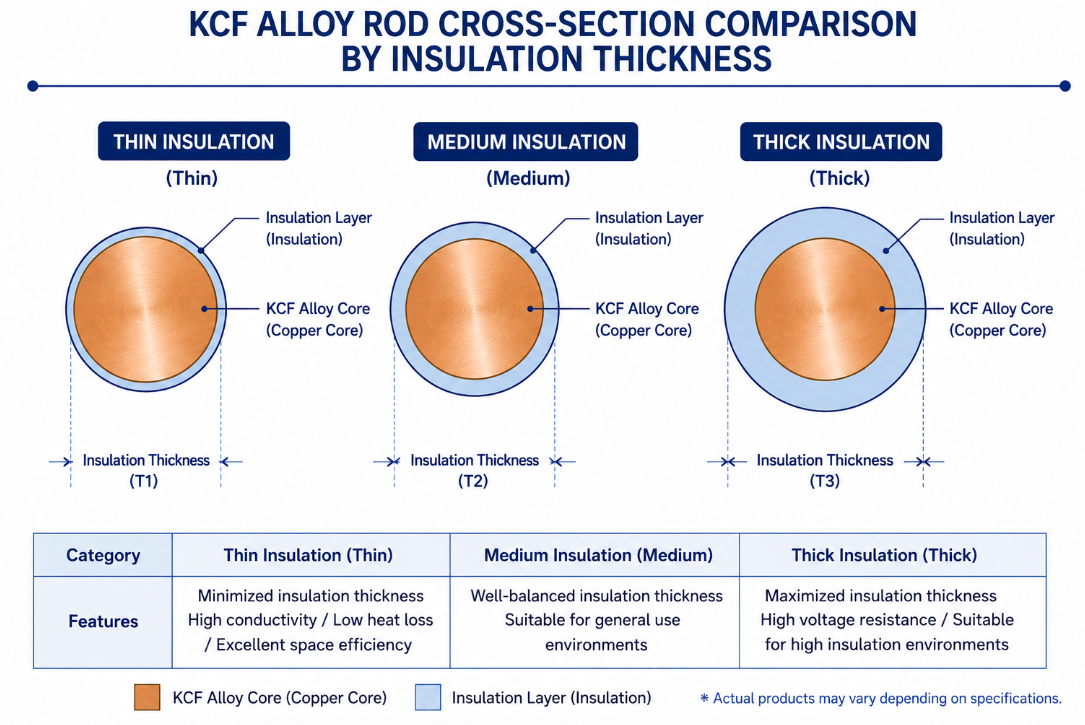
For welding parts specifically, the questions that separate makers from resellers are concrete. Ask why a particular electrode material suits your workpiece and a real factory will walk you through the conductivity-versus-hardness trade-off the way our electrode materials guide lays it out; a reseller tends to deflect to “this is our best seller.” Ask about the bore tolerance on a guide sleeve, or the insulation layer thickness on a KCF rod, and a maker can discuss the specifics our KCF alloy rod specifications guide details — because they set those specifications. The test works because real engineering knowledge is hard to fake and easy to verify if you arrive with a few pointed questions.
Check Factory Sample-to-Bulk Consistency and OEM Capability
Two practical tests close the set. First, the “golden sample” approach — keep an approved sample as your quality benchmark and verify the production run against it; quality-control practice treats samples as your best defense before mass production. Second, ask whether they can manufacture to your drawing — a custom diameter, a specific tolerance, a particular geometry. Genuine OEM capability to produce to your specification is something only a real factory has; an intermediary can only offer what its source factories already make.
Quick Reference Table — Factory vs Trading Company: What to Check
The table below condenses every verification dimension above into a single side-by-side reference you can keep beside you while evaluating a supplier.
| Dimension | Real OEM Factory | Trading Company |
|---|---|---|
| Business scope | Contains | Only |
| Production equipment | Owns it; can show on video | None to show |
| Address | Industrial zone, consistent across docs | May be commercial office; may mismatch |
| Technical questions | Answered in depth by makers | Often surface-level only |
| Customization (OEM) | Produces to your drawing | Limited to source factories’ offerings |
| Price structure | No reseller markup | Margin layered on factory price |
| After-sales | Direct to responsible party | Through an intermediary layer |
| Lead time control | Self-controlled | Depends on intermediate links |
In Fairness: When a Trading Company Genuinely Adds Value
It would be dishonest to leave the impression that trading companies are simply to be avoided — and dishonesty is bad sourcing advice. Trading companies provide real value in the right circumstances. A buyer purchasing many different product categories at once benefits from a good trading company’s ability to consolidate that purchasing through a single relationship rather than managing dozens of factories. They can add genuine value in logistics coordination, quality inspection, and handling the friction of international trade. Some specialized trading companies focused on a single product category, with solid factory relationships, work nearly as well as dealing with the factory directly — even on price.
So the honest framing is not “factory good, trading company bad.” It is: understand which one you’re dealing with, and match it to your need. If you are sourcing one focused product category — like welding consumables — and you want the best price, the deepest technical support, custom capability, and direct after-sales, a specialist factory is usually the stronger choice. If you are consolidating a wide, mixed purchasing program and value a single coordinating partner, a capable trading company may serve you better. The point of verification is not to eliminate one option; it is to know what you have so you can choose deliberately.
There is even a middle category worth knowing about, because the real world is not cleanly binary: many genuine factories operate their own export trading divisions, and some register a separate trading entity for tax or licensing reasons while still owning and running a factory. So a company showing both manufacturing and trading terms in its business scope is not automatically suspect — it may be a real manufacturer with an export arm. The verification methods above resolve this case too: a real factory with a trading division can still show you the production line, answer the technical questions, and produce to your drawing, while a pure intermediary using a broad business scope to look capable cannot. The methods test for actual capability, which is what you care about, rather than for a label, which can be ambiguous.
What We Can Show You as a Factory
Since we’ve laid out what to verify, it’s only fair to state plainly what we offer on each point, so you can hold us to the same standard this article asks you to apply to anyone.
We have our own production equipment and workshop — we manufacture, we do not resell. We can arrange a factory visit or a live video tour of the production line. We can provide our factory qualifications and business license for you to verify against the official databases. We can manufacture to your drawing — custom diameters, lengths, tolerances, and geometries are OEM work we do routinely. And your technical questions reach our engineers and technical team directly, not a sales intermediary who can’t engage on the engineering. Everything this article tells you to check, we are set up to satisfy — because that is what being a real factory means.
Verifying Your Supplier Is Worth the Hour It Takes
The fear of dealing with the wrong kind of supplier is reasonable, but it is also solvable in an afternoon of verification. Check the business license scope, confirm it against the official database, cross-check the address, ask for a live video tour, pose real technical questions, and test customization capability. Run those checks and the uncertainty largely dissolves — you will know whether you’re talking to a factory or an intermediary, and you can decide accordingly with your eyes open.
If you’re evaluating us, we invite exactly that scrutiny — ask us the technical questions, ask for the video tour, ask for the documents to verify. Tell us what welding parts you need and what matters most to you, whether that’s price, customization, technical depth, or after-sales certainty, and we will show you the factory behind the answer. The right supplier relationship starts with knowing precisely who is on the other end — and a supplier confident enough to invite verification is usually telling you something true about themselves before you have checked a single document.
Share This Article
One Comment
Leave A Comment
Latest Articles
October 19, 2026
October 19, 2026
October 19, 2026
October 19, 2026
October 19, 2026
October 19, 2026
October 19, 2026
October 19, 2026
[…] still choosing a supplier, see our guides on how to choose a spot welding parts supplier and OEM factory vs trading company. This article assumes you’ve chosen and are ready to […]