Seam Welding Wheels: Selection and Maintenance Guide

Seam welding asks something different of its electrodes. Instead of a stationary cap making one weld at a time, a seam welding wheel rolls continuously along the joint, conducting current and applying force as it turns — producing the continuous, leak-tight seams that fuel tanks, drums, and tubes depend on. That rolling, always-working duty changes everything about how the electrode is selected and maintained: the wheel never rests between welds, heat is constant rather than intermittent, and wear spreads around a rim that must hold its profile to keep the seam continuous. This guide covers the seam welding wheel itself — how the duty differs from spot welding, how to select a wheel for your application, the problems wheels run into, and how to maintain them for consistent, leak-tight seams.
The material fundamentals behind the wheel are the same copper-alloy story we’ve covered for spot electrodes — our CuCrZr vs pure copper comparison applies here too — but the wheel’s duty puts its own spin on how those materials are used and cared for.
How Seam Welding Differs: The Wheel Never Rests
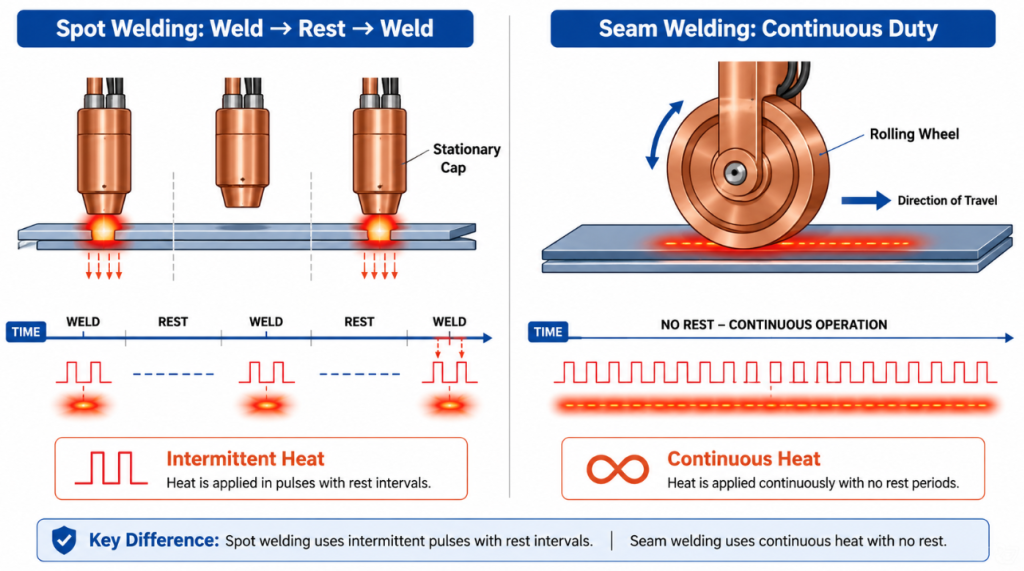
Resistance seam welding is a close relative of spot welding — the same heat-from-resistance principle — but the electrode is a motor-driven wheel rather than a stationary cap, rolling along the joint to produce a seam of overlapping or continuous welds. Depending on how current pulses are timed against travel speed, the result is a continuous seam, an overlapping seam, or spaced roll-spot welds — and for the leak-tight joints that define this process, it’s the continuous and overlapping modes that matter.
That continuous duty is the defining difference from the electrode’s point of view. A spot electrode welds, then rests while parts index; heat comes in pulses with recovery between them. A seam wheel making a continuous seam is conducting, pressing, and rolling through the whole weld — the heating is essentially constant while the seam runs. This is why continuous seam welding carries higher cooling requirements than spot work: the constant discharge heating gives the electrode no between-weld recovery, so heat management has to happen while the wheel works, not between jobs.
The rolling contact also changes the wear picture. A spot cap wears at one face; a wheel wears around its entire rim as it rolls, and what it must preserve is not just a flat face but a rim profile — the contour that contacts the sheet and shapes the seam. Lose the profile and the seam suffers along its whole length, not at one point.
Where seam wheels earn their living. The applications our customers run seam wheels on are exactly the leak-tight, continuous-joint jobs the process was built for: fuel tank sealing welds, drums, cans and container bodies, longitudinal seams on tubes and profiles, radiators and heat exchangers, and sheet-to-sheet joining on coil and panel work. What unites them is the demand for a joint that is continuous and tight — gas-tight, liquid-tight, or simply unbroken — which is precisely what a well-selected, well-maintained wheel delivers and a degraded one cannot.
Selecting a Seam Welding Wheel
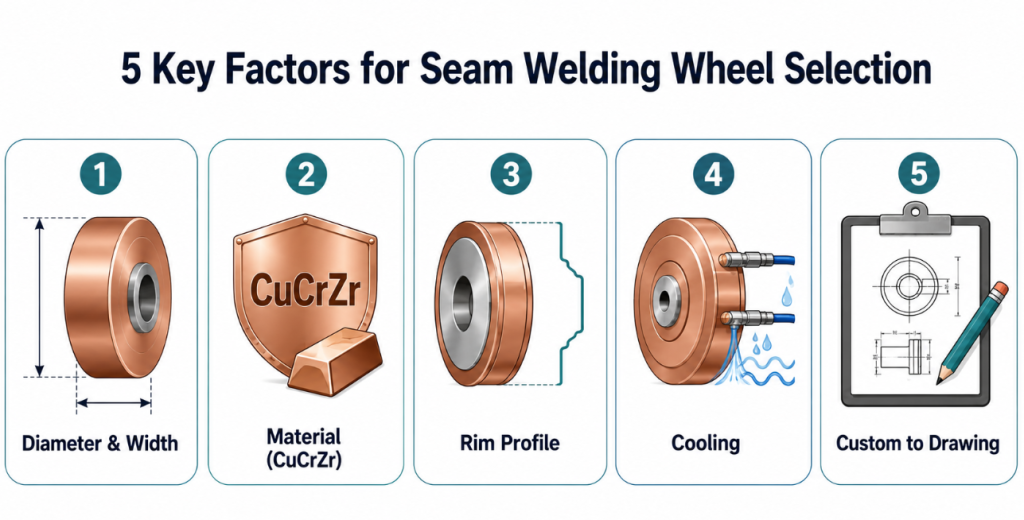
Wheel selection comes down to five specifications, each tied to the duty above.
Wheel diameter and width matched to the application. The wheel’s diameter and width have to suit the machine, the joint, and the access the part allows — diameter affects how the wheel approaches the work and how much rim circumference shares the wear; width relates to the seam and the contact. These are dictated by your welder and your part, and they’re the starting point of any wheel specification.
Diameter deserves a moment more, because it works on both geometry and life. A larger wheel spreads the same duty over more rim circumference — each point on the rim contacts the work less often per meter of seam, so wear per revolution is lower and reconditioning intervals stretch. But diameter is also constrained from above: the wheel must clear the part, reach into the joint, and fit the machine’s throat and arms, and on contoured parts like tank shells a smaller wheel may be the only one that follows the seam path. Width follows the same logic in the other axis — wide enough to carry the current and force the seam needs, narrow enough to track the joint and clear adjacent features. The right answer is always the largest wheel the machine and part geometry will allow, sized down only where access forces it.
Material — CuCrZr as the workhorse. The same copper-chromium-zirconium alloy that dominates spot electrodes serves seam wheels, and for the same reasons: the balance of conductivity, hardness, and heat resistance that survives resistance-welding duty. Copper-chromium class materials are recognized as the general-purpose electrode choice for production spot and seam welding of most materials — and on a wheel, where heat is constant and the rim must hold its shape through long seams, that hot hardness matters even more than on a cap.
Rim profile and face contour. The rim’s contour — flat, radiused, or profiled to the joint — shapes the contact and the seam. The correct profile puts current and force where the seam needs them; the wrong one, or a worn one, produces an inconsistent seam. Profile is a real specification, not an afterthought, and it’s the dimension maintenance must preserve.
Cooling provisions. Because the wheel works continuously, cooling is not optional — the wheel needs effective cooling to survive constant heating, whether through internal water passages, flood cooling at the rim, or both, depending on the setup. A wheel specified without thought to how it will be cooled is a wheel specified to overheat.
Customization to drawing. Wheels frequently need to match a specific machine and application — bore and mounting dimensions, diameter, width, and profile all particular to the installation. We machine seam wheels to customer drawings for exactly this reason: the wheel has to fit your welder and your joint, and a machinable copper alloy makes made-to-drawing wheels practical.
Table 1 — Seam Welding Wheel Selection Factors
| Factor | What It Determines | Getting It Wrong Means |
|---|---|---|
| Diameter & width | Fit to machine, joint, and access | Wheel doesn’t suit the setup |
| Material (CuCrZr) | Hot hardness, conductivity, life | Soft rim, fast wear, short life |
| Rim profile | Contact, current path, seam shape | Inconsistent seam along its length |
| Cooling provision | Survival under constant heating | Overheating, softening, rapid wear |
| Bore & mounting | Fit to the welder’s shaft | Wheel can’t be installed correctly |
The table doubles as a specification checklist: a wheel inquiry that answers all five rows is one we can quote and machine correctly the first time.
The Problems Seam Wheels Run Into
The wheel’s continuous duty produces a characteristic set of problems — the ones customers bring to us — and each traces to the duty in a recognizable way.
Rim wear and grooving. The dominant wear mode: the rolling rim wears and can groove where it contacts the sheet, losing the profile the seam depends on. Unlike a spot cap, which is dressed frequently in place, a wheel’s profile is typically restored by re-machining (re-turning) the rim back to its correct contour — a periodic reconditioning that returns the worn wheel to service with its geometry restored. A grooved rim isn’t scrap; it’s a wheel due for re-profiling.
Sticking and alloying on galvanized sheet. Coated steels punish seam wheels the same way they punish spot electrodes: zinc alloys with the copper rim, promoting pickup, sticking, and accelerated degradation — and on a wheel, the alloyed band runs around the whole rim. Coated work means accepting faster rim degradation and more frequent reconditioning, and it makes the material and cooling choices more consequential.
Overheating from inadequate cooling. Given the constant heating, insufficient cooling shows up quickly: the rim runs hot, softens, wears and deforms faster, and seam quality drifts. The invisible-cooling-failure logic from our electrode cooling deep dive applies with extra force here — a seam wheel with compromised cooling degrades faster than a spot cap would, because it never gets the between-weld recovery a cap enjoys.
Discontinuous seams and leaks. The defect that matters most on leak-tight work: gaps or weak stretches in a seam that must be continuous. The usual suspects are a worn or grooved rim profile (contact varies along the seam), overheating, and process settings — and because the whole point of the seam is tightness, the fix starts with restoring the wheel’s geometry and cooling before touching parameters, the same fix-the-physical-cause-first logic that applies across resistance welding. A useful diagnostic detail: where the seam fails tells you something. Defects that recur at a fixed spacing along the seam — repeating once per wheel revolution — point squarely at a localized rim problem such as a groove or flat, because the same damaged patch of rim returns to the work each turn. Defects scattered randomly point instead at heat, surface condition, or settings. Reading that pattern before adjusting anything saves the common mistake of tuning current to chase what is actually a damaged rim.
Short wheel life. Usually the sum of the above: soft or wrong material, inadequate cooling, coated sheet, and postponed re-profiling compound into wheels that die early. Water-cooled electrodes and regular inspection and replacement of worn components are the recognized route to longer tool life and consistent welds — on wheels as much as anywhere in resistance welding.
Table 2 — Seam Wheel Problems: Cause and Fix
| Problem | Likely Cause | Fix |
|---|---|---|
| Rim wear / grooving | Normal duty, coated sheet accelerates | Re-machine rim to restore profile |
| Sticking / alloying | Zinc-coated workpiece | Expect faster degradation; recondition sooner |
| Overheating | Inadequate cooling for continuous duty | Verify and restore cooling first |
| Discontinuous seam / leaks | Worn profile, heat, then settings | Restore geometry & cooling, then tune |
| Short wheel life | Compounding of the above | Material + cooling + timely re-profiling |
The fix column repeats a familiar theme: restore the physical state — profile and cooling — before adjusting the process. A tuned parameter can’t compensate for a grooved, overheated rim.
Maintaining Seam Wheels for Consistent Seams
Wheel maintenance is simpler than it might seem, because it reduces to three habits.
Re-profile before the seam tells you to. Rim wear is gradual and the seam degrades with it — waiting for visible seam problems means welding with a degraded profile in the meantime. Periodic re-machining of the rim, scheduled by duty rather than by failure, keeps the profile correct and the seam consistent. Like tip dressing on spot caps, reconditioning done early and regularly costs less than the defects late reconditioning allows.
Keep the cooling honest. Because the wheel’s duty is continuous, cooling deserves regular verification, not assumption — flow, passages, and delivery all matter, and a wheel that runs hot announces it through accelerated wear before it announces it through seam defects. Check cooling on schedule, and check it first whenever wheel life shortens unexpectedly.
Inspect the rim as a routine. A quick regular look at the rim — wear, grooving, alloyed buildup on coated work — catches degradation while it’s still a reconditioning job rather than a replacement. The rim’s condition is the leading indicator for everything downstream: profile, seam quality, and wheel life. Thirty seconds of looking at the rim each shift buys hours of avoided troubleshooting later.
Real Cases: Wheels Matched and Maintained
Case 1 — Wheel machined to drawing. A customer needed seam wheels matched to their specific machine and application — dimensions and profile their standard options didn’t cover. We machined wheels to their drawing, delivering the fit their welder and joint required. Made-to-drawing capability is much of what seam wheel supply is, because installations vary so widely.
Case 2 — Material and cooling improvements extended wheel life. A customer with short wheel life traced the problem to the combination of material and cooling under their continuous duty. Addressing both — the right alloy for the duty and cooling that actually reached the rim — extended wheel life meaningfully. Neither alone would have delivered the result; the continuous duty demands both.
Case 3 — Re-profiling restored seam quality. A customer with seam consistency problems found the cause in a worn, grooved rim profile. Re-machining the rim back to its correct contour restored the contact and the seam. The wheel hadn’t failed — its geometry had drifted, and restoring the geometry restored the weld.
Keep the Wheel True and the Seam Follows
A seam welding wheel does the hardest continuous duty in resistance welding — conducting, pressing, and rolling without rest — and everything about selecting and maintaining it follows from that. Specify the wheel to the application (diameter, width, material, profile, cooling, mounting), expect the duty-driven problems (rim wear, coated-sheet alloying, heat), and maintain by the three habits: re-profile on schedule, verify cooling, inspect the rim. Do that and the wheel holds its geometry — and a wheel that holds its geometry produces the continuous, leak-tight seam the whole process exists for.
If you run seam welding, tell us about your application — the machine, the joint, the sheet and coating, and the wheel dimensions or drawing — and we’ll machine seam wheels matched to your setup, in the material and with the cooling provisions your duty needs. Browse our copper spot welding electrodes range or send your wheel drawing, and let’s keep your seams continuous and your wheels turning.
References
Mechelonic — Barrel Seam Welding: Guide to Leak-Tight Welded Joints: https://mechelonic.com/2025/07/16/barrel-seam-welding-guide-to-leak-tight-welded-joints/
Weld Guru — Resistance Welding Guide (seam welding process, wheel electrodes, RWMA materials): https://weldguru.com/resistance-welding/
Agera Resistance Welding — What Is Seam Welding? Types and Applications: https://resistance-welding.com/what-is-seam-welding/
Share This Article
Latest Articles
October 20, 2026
October 20, 2026
October 20, 2026
October 20, 2026
October 20, 2026
October 20, 2026
October 20, 2026
October 20, 2026