KCF Guide Pins vs Tungsten Electrodes: Different Jobs in Projection Welding

A common point of confusion in projection welding is how KCF guide pins and tungsten electrodes relate to each other — as if you had to choose between them. You don’t, because they do different jobs. Tungsten is an electrode material: it forms the contact point that delivers welding current and force to the joint. KCF is a locating material: it positions the fastener accurately and insulates against stray current. They are not competitors fighting for the same role; they are different parts of the same welding system, each suited to its own task. This article clears up the distinction — what each material is for, why each suits its job, and how they work together in projection welding.
Understanding this matters because choosing the right material starts with understanding the right role. For the broader picture of locating components, see our guide to KCF guide pins; for electrode materials generally, our overview of resistance welding electrode materials covers the conductive side.
Two Different Jobs: Locating vs Conducting
The cleanest way to understand KCF and tungsten is by the job each does in a projection weld.
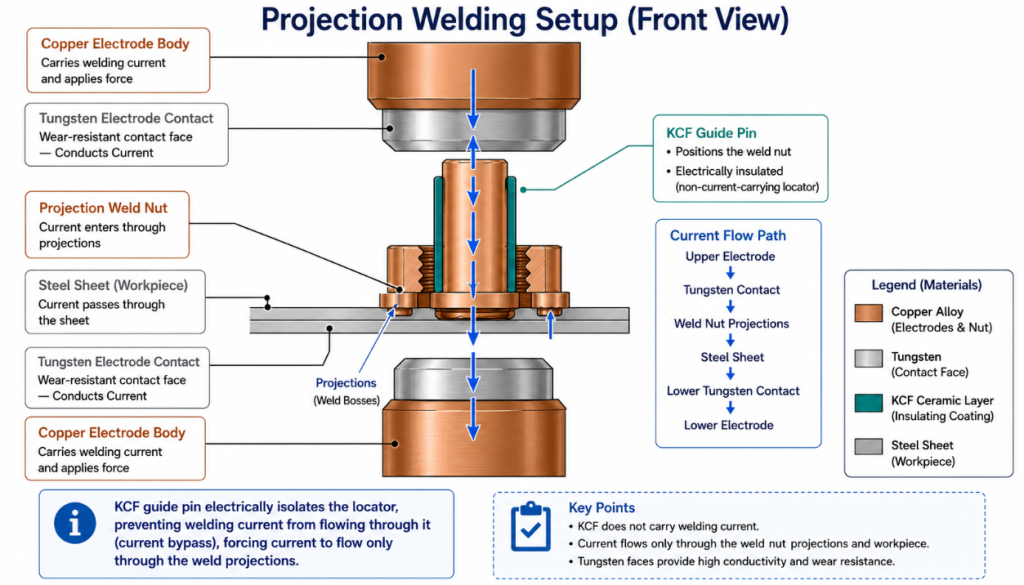
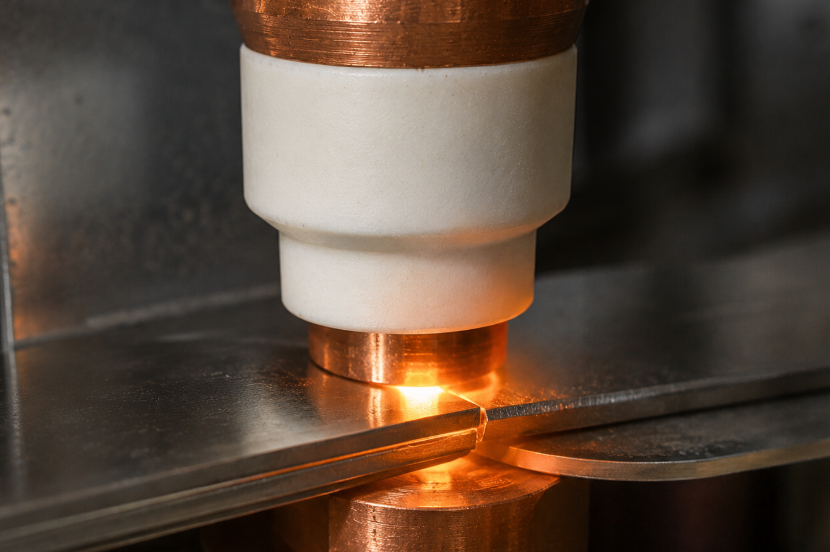
Tungsten’s job: the electrode contact point. Tungsten (and tungsten-copper) serves as electrode material — specifically as the contact face or insert that touches the workpiece and delivers the welding current and force. In projection welding, refractory metals like tungsten are used as electrode inserts and facings, valued because they withstand the heat and pressure at the point where the weld is made. As resistance-welding material references explain, refractory electrode materials such as tungsten and tungsten-copper are used for projection welding inserts where the electrode endures concentrated heat and force. Tungsten’s role is to conduct and endure at the business end of the electrode.
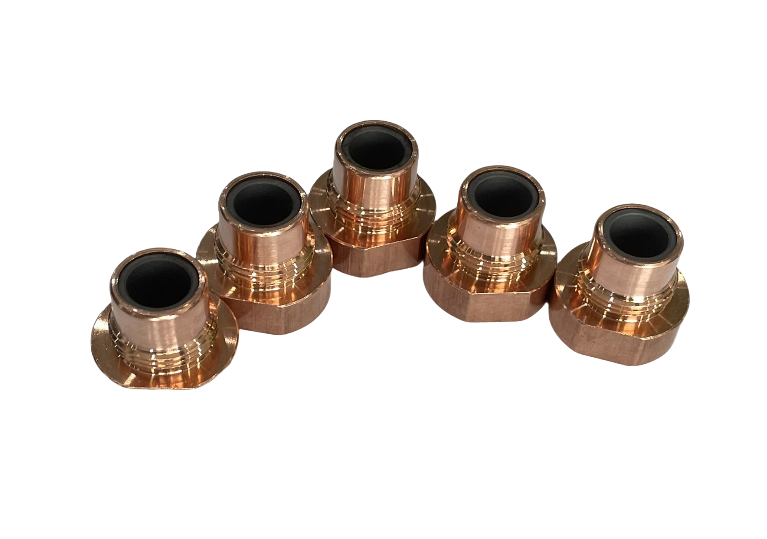
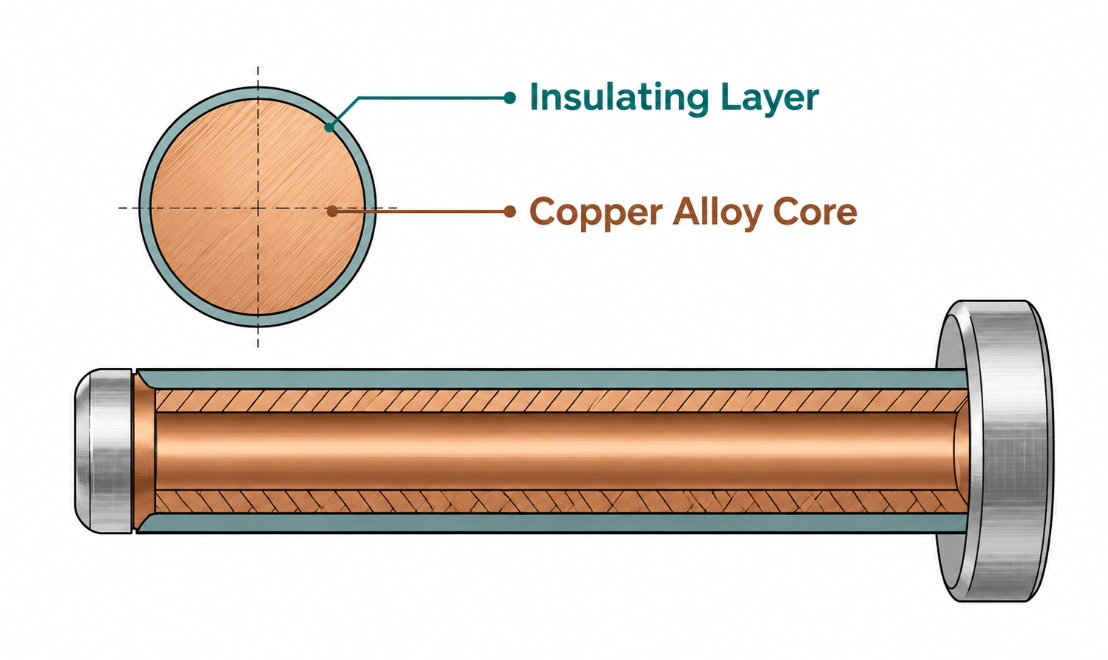
KCF’s job: locating and insulating. KCF, by contrast, is not an electrode at all. Its job is to locate the fastener — position the nut, bolt, or stud accurately for welding — while insulating against stray current. KCF guide pins and sleeves position the part and prevent shunting; they do not carry the welding current to the joint. KCF’s role is to locate and isolate, not to conduct.
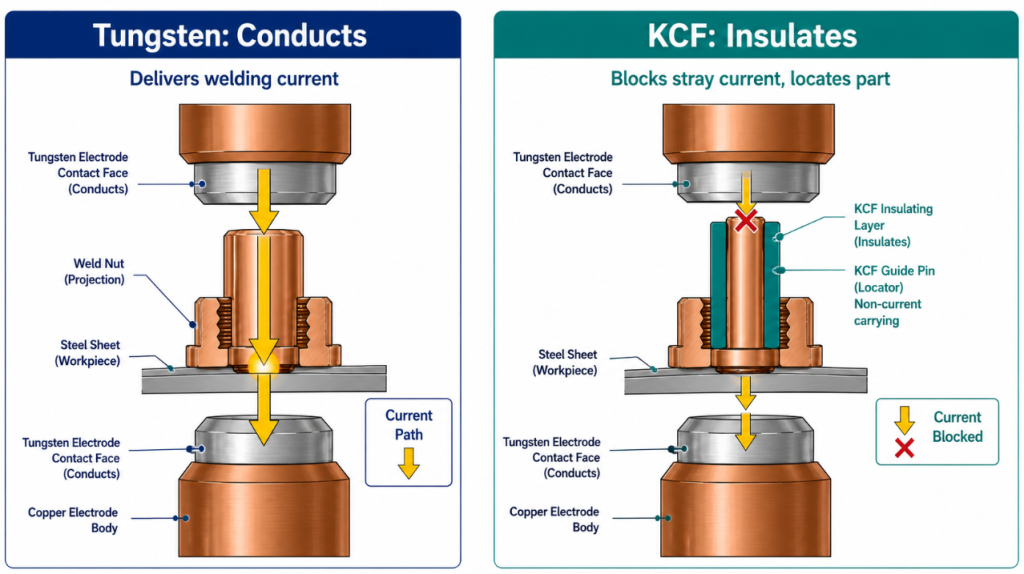
These are fundamentally different functions. One material delivers current (tungsten); the other positions the part and blocks unwanted current (KCF). Framing them as alternatives misunderstands what each is for — they are no more interchangeable than a drill bit and a clamp.
Table 1 — KCF vs Tungsten: Role in Projection Welding
| Aspect | Tungsten (Electrode) | KCF (Locating Part) |
|---|---|---|
| Primary job | Electrode contact point | Locate the fastener |
| Function | Conducts welding current & force | Positions part; insulates |
| Conducts current? | Yes — that’s its purpose | No — it insulates |
| Where it sits | At the electrode contact face | As the locating pin/sleeve |
| Material type | Refractory metal (very high melting point) | Copper-based with insulating layer |
The table makes the division plain: tungsten conducts at the contact, KCF locates and insulates. They occupy different positions in the welding setup and answer different needs.
Why Tungsten Suits the Electrode Job
Tungsten earns its place as an electrode contact material for specific reasons, all tied to surviving the harsh conditions at the weld point.
It withstands high temperature without sticking. Tungsten is a refractory metal with an extremely high melting point, and critically, it does not stick to molten metal at the weld. This anti-stick property at high temperature is exactly what a projection-welding contact point needs, especially for nut and stud welding where sticking is a common problem. Refractory metals like tungsten have very high melting points and do not stick to molten copper, which is why they are used at the contact face — and as electrode manufacturers note, this is what makes tungsten and molybdenum anti-stick tips engineered for nut and stud welding, preventing the build-up and mushrooming that plague softer contacts.
The reason this matters so much for projection and nut welding is that the contact point is where sticking does the most damage. When an electrode sticks to the workpiece, it can tear the weld, transfer material, and degrade both the weld and the electrode — the very problem that drives up consumable costs on a nut-welding line. Tungsten’s refusal to stick at high temperature directly addresses this, which is why it is the material of choice at the contact face precisely where conditions are hottest and sticking is most likely.
It’s hard and wear-resistant. Tungsten is hard and resists wear, helping the electrode contact hold its shape under the repeated mechanical and thermal stress of welding. This hardness suits the demanding contact-point role, where deformation would degrade weld quality.
It handles high-pressure, high-temperature conditions. Tungsten suits applications where both pressure and temperature are high — the severe conditions found at projection-welding output points. Where a copper electrode might deform or degrade, tungsten endures. The resistance-welding industry formally classifies these refractory electrode materials: under the RWMA system, pure tungsten is Class 13 and the tungsten-copper composites are Classes 10 through 12, all used for projection welding electrodes where strength at elevated temperature is required. The higher-tungsten grades are harder and used for heavier-duty projection work — a whole family of refractory materials exists precisely because the electrode contact point demands properties ordinary copper cannot provide.
These properties make tungsten well-suited to the contact point. But note what is not on this list: insulation. Tungsten conducts — it is a metal electrode. It is excellent at delivering current and surviving heat, and it is not meant to insulate. That is KCF’s job.
Why KCF Suits the Locating Job
KCF is built for a completely different role, and its properties suit locating and insulating rather than conducting.
It insulates while it locates. This is KCF’s defining feature and the clearest contrast with tungsten. KCF’s insulating layer lets it position a fastener while preventing welding current from shunting through it. Where tungsten conducts, KCF insulates — that is the fundamental difference in their design. For a locating part, insulation is essential, because a conductive locating part would cause shunting and weak welds.
This insulation requirement is worth dwelling on, because it is the single property that most cleanly separates the two materials’ roles. A locating part sits right next to the weld, often in the path that current could take if it had the chance. If that locating part conducts — as tungsten or any bare metal would — it offers the welding current an alternative route, and current that shunts through the locating part instead of flowing fully through the joint produces a weak, undersized weld. KCF’s insulating layer closes off that route: the part locates the fastener with mechanical precision while remaining electrically invisible to the welding current. This is exactly why you would never use a tungsten-type conductive material as a locating pin, and never use KCF as the conductive contact — the property that makes each material right for its job is precisely the property that makes it wrong for the other’s. Tungsten must conduct; KCF must not.
It locates accurately. KCF guide pins and sleeves position the fastener precisely for welding, with the dimensional accuracy that consistent welds require. This locating precision is the core of the job, and it is a different demand from the current-carrying endurance tungsten provides.
It’s machinable and customizable. KCF, being a copper-based material with an insulating layer, can be machined and customized to a specific fastener — bore, diameter, geometry made to the application. This machinability suits the locating role, where parts often must match a particular fastener.
This is itself a meaningful contrast with refractory electrode materials. Pure tungsten is notoriously hard to machine — it is often shaped by grinding rather than conventional machining, a consequence of the same hardness that makes it endure at the contact point. For an electrode contact, that is an acceptable trade, because the contact geometry is relatively standard. But a locating part frequently has to be made to a customer’s specific fastener — a particular bore for a particular bolt, a custom diameter, an unusual geometry — and here machinability is a real advantage. KCF can be readily machined to a drawing, where a refractory metal would be far harder to customize. So the material that is right for locating is also, conveniently, the material that adapts most easily to the specific fastener a customer needs located — another way the role and the material properties line up.
It’s cost-effective for its role. For the locating-and-insulating job, KCF offers an effective combination of properties without the cost of a refractory metal — appropriate to a part whose role is positioning rather than enduring the contact-point extremes.
Again, note the contrast: KCF insulates, tungsten conducts. KCF’s strengths are in positioning and isolation; tungsten’s are in conduction and high-temperature endurance. Each material’s properties fit its own job.
Table 2 — Matching Material to Job
| Need | Right Material | Why |
|---|---|---|
| Electrode contact point | Tungsten | Refractory, anti-stick, endures heat & pressure |
| Conduct welding current | Tungsten | It’s a conductive electrode metal |
| Locate the fastener | KCF | Accurate positioning, machinable to fit |
| Insulate against shunting | KCF | Insulating layer — tungsten can’t do this |
| High-temperature contact endurance | Tungsten | Very high melting point |
| Positioning + electrical isolation | KCF | Locates and insulates in one part |
Reading the table as a decision guide: the question is never “KCF or tungsten?” in the abstract — it’s “what job am I filling?” The job picks the material, and the two jobs are different.
How They Work Together in a Projection Weld
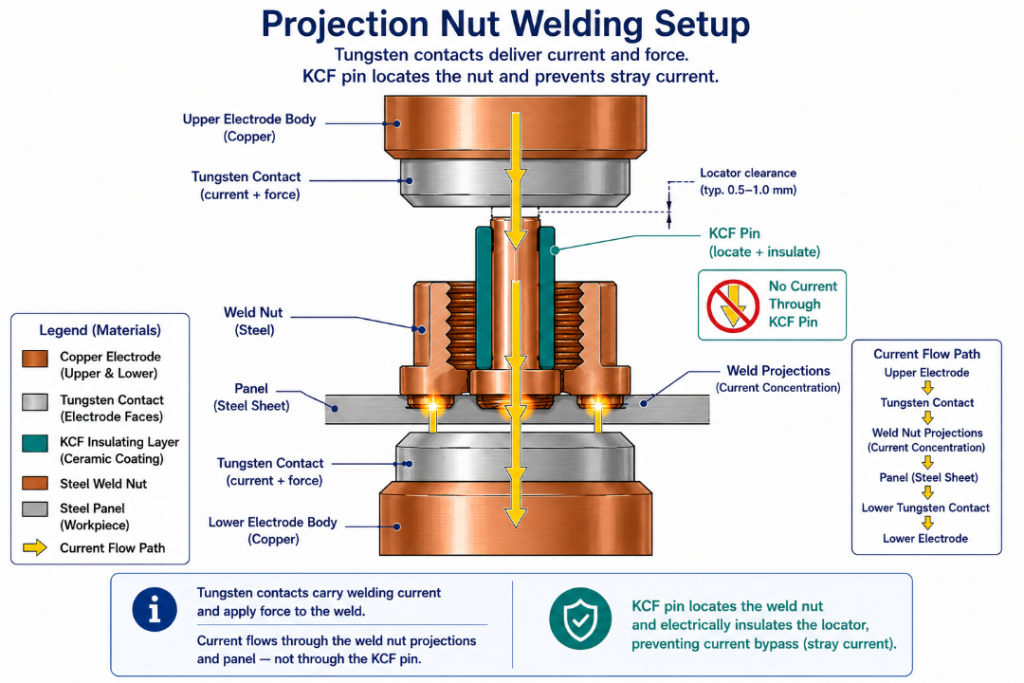
Rather than competing, KCF and tungsten can both appear in the same projection-welding setup, each handling its part. In a typical projection or nut weld, the tungsten (or tungsten-copper) electrode contact delivers the current and force to form the weld, while the KCF guide pin or sleeve locates the fastener and insulates against shunting. One makes the weld; the other makes sure the fastener is in the right place and the current goes where it should.
This complementary relationship is the real answer to “KCF vs tungsten.” They are not rivals; they are teammates. A well-designed setup uses each material for what it does best — tungsten at the conductive contact point, KCF at the locating-and-insulating position. Some applications use both; the materials are selected by role, not chosen one instead of the other.
A concrete way to picture it: imagine a nut being projection-welded to a panel. The nut has to be held in exactly the right position, square and centered over the weld point, and it has to stay electrically isolated so the current does not find a shortcut around the joint — that is the KCF guide pin’s work, locating the nut and insulating it. At the same time, the welding current and force have to be delivered through a contact that can take the heat and not stick to the work — that is the tungsten electrode contact’s work. Both are happening in the same weld, at the same moment, in different places: the KCF pin positions and isolates from within or alongside the fixture, while the tungsten contact delivers current at the electrode face. Neither could do the other’s job. A tungsten pin would shunt current and ruin the weld; a KCF contact would not survive as the conductive electrode face. The weld succeeds because each material is doing exactly the job its properties suit, in the position that job belongs.
Seen this way, the supposed comparison dissolves into a clearer picture: a projection-welding system needs current delivered (tungsten’s job) and fasteners located and isolated (KCF’s job), and the right setup provides both. Understanding which material does which is what lets you specify a system correctly — and it is why a supplier who understands the whole system, not just one part of it, can help you get every piece right rather than forcing one material into a role it was never meant to fill.
The Right Material for the Right Role
The question “KCF guide pins or tungsten electrodes?” has a different answer than it seems to ask, because the two materials do different jobs. Tungsten is the electrode contact material — refractory, anti-stick, built to conduct current and endure heat and pressure at the weld point. KCF is the locating material — accurate, machinable, and crucially insulating, built to position the fastener and prevent shunting. They are not alternatives; they are complementary parts of a projection-welding system, each suited to its own role. The right approach is to use each material where it belongs.
We make KCF guide pins and sleeves — the locating-and-insulating side of that system — and we can help you specify the right locating parts for your projection or nut welding setup. Tell us about your application — your fasteners, your welding setup, and your locating and insulation needs — and we’ll help you get the KCF parts that position accurately and insulate reliably. If your setup also needs refractory electrode contacts, knowing the role each material plays helps you specify both correctly. Browse our KCF guide pins and sleeves range, or send us your application and let us help you with the locating and insulating side of your welding system.
Share This Article
Latest Articles
October 19, 2026
October 19, 2026
October 19, 2026
October 19, 2026
October 19, 2026
October 19, 2026
October 19, 2026
October 19, 2026