Ceramic Pins & Sleeves: Types, Grades, and Specifications

A ceramic pin or sleeve is a precision insulating component — a locating part made entirely of technical ceramic, valued for being a pure insulator that also withstands high temperature and wear. But “ceramic pin” covers a range: different part types (pins, sleeves, tubes), different ceramic grades (varying alumina purity), and different specifications (diameter, length, tolerance, finish). Choosing well means understanding those options and matching them to your application. This guide covers the ceramic locating parts themselves — the types we make, the grades available, the specifications that matter, and how to specify the right part — as a product guide rather than a comparison.
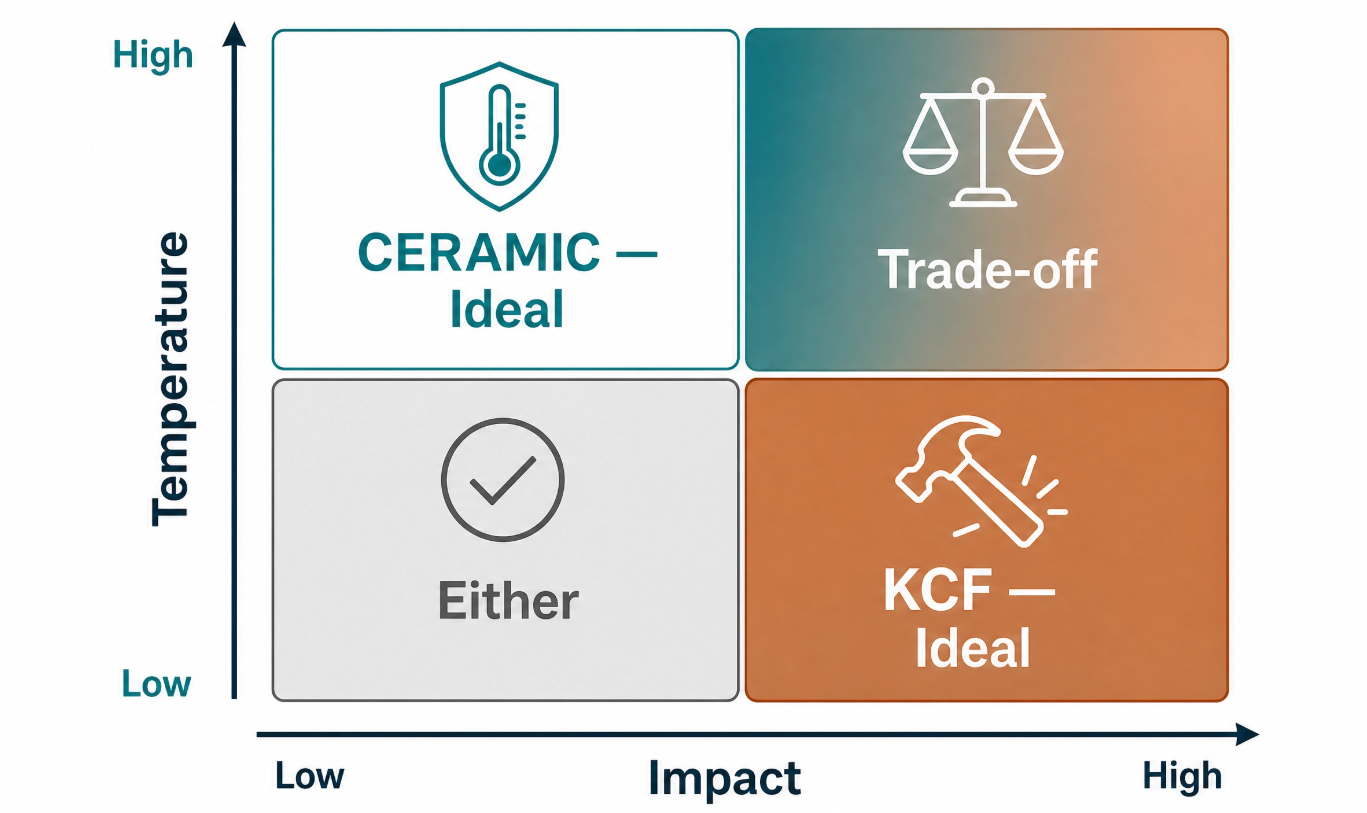
For when to choose ceramic over KCF in the first place, see our guides on when to use ceramic pins and sleeves and high-temperature ceramic pins. This article assumes you’ve already decided on ceramic and focuses on specifying the part itself.
Types of Ceramic Locating Parts
Ceramic locating parts come in several forms, each suited to a role in positioning and insulating. Knowing the types is the starting point for specifying what you need.
Ceramic pins. Solid ceramic locating pins that position a part — a nut, a workpiece — for welding while insulating against current. The pin is the classic locating element: it goes where the part needs to be located, holds that position, and being ceramic, cannot conduct. Pins come in various diameters and lengths to suit the locating job.
The value of a ceramic pin over a metal-cored one comes down to its being insulating throughout — there is no conductive core anywhere in the pin, so it cannot provide a path for welding current under any circumstance. For applications where a solid, absolute insulating locating element is wanted, the ceramic pin delivers exactly that in a simple, robust form. Its diameter is chosen to fit the hole or bore it locates in, and its length to suit how far it must reach and locate; these two dimensions, plus the grade and finish, define most locating pins.
Ceramic sleeves. Ceramic sleeves — tubular parts — that insulate and locate, often surrounding another component to isolate it electrically while positioning it. A sleeve provides insulation around a pin, bolt, or other element, combining location with electrical isolation in a tubular form. Sleeves suit applications where something needs to pass through or sit within an insulating, locating boundary.
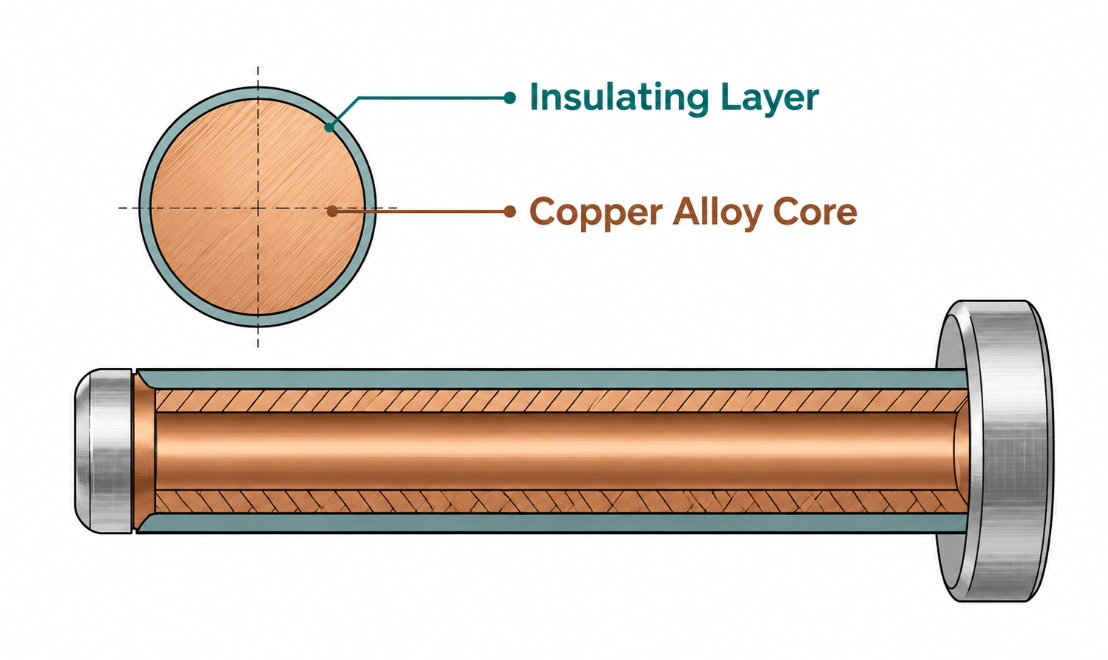
A common role for a ceramic sleeve is to insulate a metal element that must itself remain conductive or strong — the sleeve wraps it in insulation while locating it, so the assembly gets both the metal’s properties inside and the ceramic’s insulation outside. The sleeve’s inner bore is sized to what it surrounds, and its outer dimensions to the hole or fixture it seats in; wall thickness follows from the two, balanced against ceramic’s need for robust sections.
Ceramic tubes and insulating tubes. Ceramic tubes serve as insulating passages or protective insulating elements, isolating what passes through them. Available in single-bore and other configurations, ceramic tubes are a versatile insulating form, and technical-ceramic tubes are supplied in single and multi-bore and closed-end forms for a range of insulating roles.
Various shapes and sizes. Beyond the basic types, ceramic locating parts are made in various shapes and sizes to suit specific applications — the geometry follows the locating job, so a range of dimensions and forms is available.
Custom shapes to drawing. Where a standard type doesn’t fit, ceramic parts can be made to a customer’s drawing. We produce ceramic pins, sleeves, and tubes to specification, because the part has to match the application — and a shape made to your drawing fits where a standard one won’t.
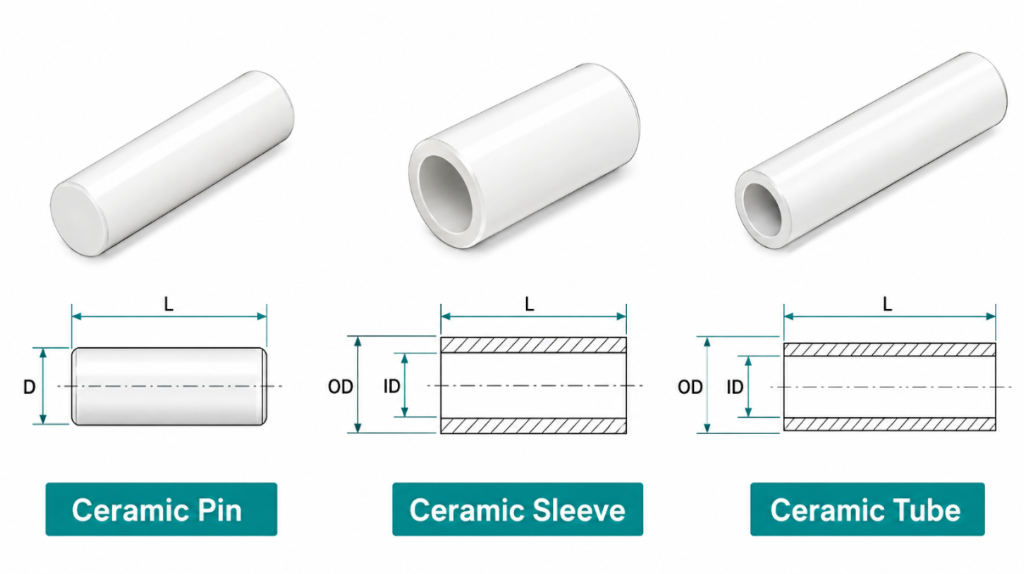
Table 1 — Types of Ceramic Locating Parts
| Type | Form | Role |
|---|---|---|
| Ceramic pin | Solid pin | Locate and insulate a part |
| Ceramic sleeve | Tubular sleeve | Insulate around/locate a component |
| Ceramic tube | Tube (single/multi-bore) | Insulating passage or protection |
| Various shapes | Application-specific | Match the locating geometry |
| Custom to drawing | Made to spec | Fit where standard doesn’t |
The types divide by form and role — solid pins locate, sleeves and tubes insulate around or pass things through. Which you need follows from the locating and insulating job your application requires.
Ceramic Grades: Alumina Purity and Material Choice
The material grade of a ceramic part governs its properties, and understanding grades is key to specifying a part that performs without overpaying. Most technical ceramic locating parts are alumina (aluminum oxide), and alumina comes in grades defined by purity.
Alumina purity grades. Alumina ceramics are classified by their alumina (Al₂O₃) content, and the grade affects the properties. Common grades span from around 95–96% up through 99% and higher, and higher purity generally means improved hardness, insulation, wear resistance, and corrosion resistance — the material properties strengthen with purity. Industry practice divides them roughly: 95–96% alumina for general wear and electrical insulation, and 99%+ for higher-demand applications needing extreme insulation, corrosion resistance, or the highest performance.
Matching the grade to the application — don’t over-specify. Here’s the practical wisdom that saves money: higher purity costs more and isn’t always needed. The honest guidance from ceramic specialists is to match the grade to the application rather than reflexively buying the highest purity — general-purpose grades suit general applications, and over-specifying purity means paying too much for performance the application doesn’t require. For many welding locating parts, a general-purpose alumina grade does the job; the higher grades are for applications that specifically need their extra properties.
Selecting material to your requirement. Because the right grade depends on the application — its temperature, wear, insulation, and corrosion demands — the sensible approach is to select the material to the requirement. We can supply alumina in the grade suited to your application, and select material to your requirements, rather than pushing one grade for everything. Tell us what the part faces, and the grade follows.
It’s also worth noting that alumina is not the only technical ceramic — while it’s the workhorse for most locating and insulating parts, particular applications with unusual demands might call for a different engineered ceramic. For the vast majority of welding locating pins and sleeves, an appropriate alumina grade is the right and cost-effective answer, which is why alumina dominates. But because the material should follow the requirement, the option to select a different ceramic for a genuinely special demand is there. The principle is the same throughout: the application defines the material, not the other way around, and specifying what the part actually has to do is what points to the right ceramic and the right grade of it.
Table 2 — Alumina Grades, Roughly
| Grade Range | Character | Typical Fit |
|---|---|---|
| ~95–96% | Cost-effective, good general properties | General wear & insulation — many locating parts |
| ~99% | Higher density, insulation, performance | More demanding applications |
| 99.5%+ | Very high purity, top properties | Extreme insulation/corrosion/precision |
| Other engineered ceramics | Per special requirement | Application-specific needs |
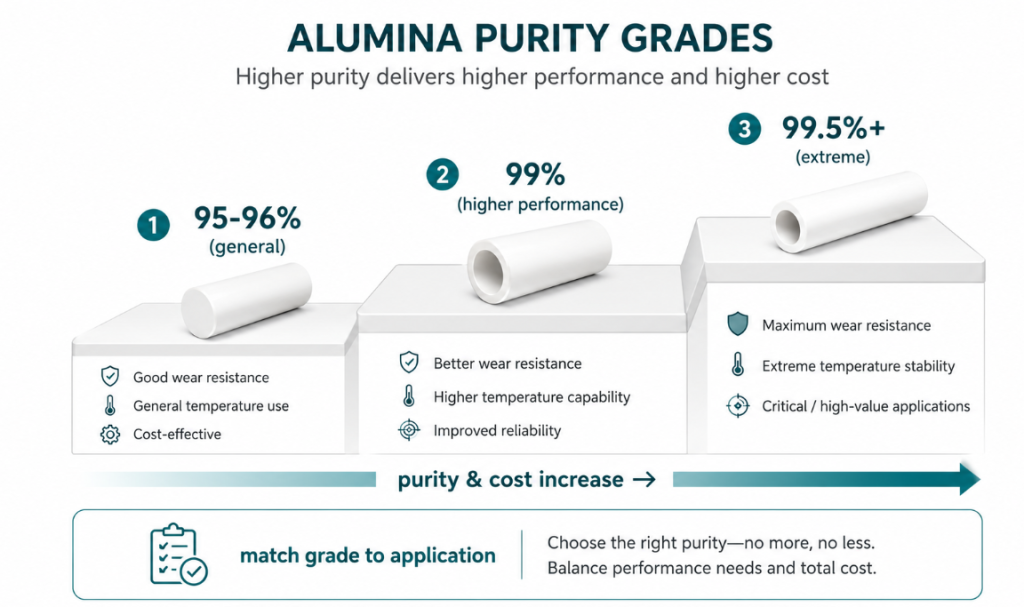
The grades trade cost against performance: more purity buys more, but only matters if the application needs it. Reading down to your application’s real demands — not the maximum available — is how you specify the grade sensibly.
The Specifications That Matter Most
Beyond type and grade, a ceramic locating part is defined by its specifications — the dimensions and quality parameters that make it fit and perform. These are what to nail down when specifying a part.
Diameter and length. The basic dimensions — diameter and length — sized to the locating job. These are the first specifications, set by where and how the part locates.
Matched to the nut or workpiece bore. The part’s dimensions have to match the nut or workpiece it locates — the bore it fits, the hole it passes through, the geometry it positions. A part matched to the specific fastener or hole locates correctly; a mismatch doesn’t. This matching is central to a locating part.
Dimensional tolerance. How tightly the dimensions are held — the tolerance — matters for a locating part, since locating accuracy depends on dimensional precision. Ceramic parts can be ground to tight tolerances after firing, and where accuracy is critical, specifying the tolerance is essential. Tighter tolerances involve more processing, so specify the tolerance the application actually needs.
There’s an important process point behind ceramic tolerances. Ceramic shrinks significantly during firing, so the as-fired dimensions can’t hold the tightest tolerances directly — precision dimensions are achieved by diamond-grinding the fired part to final size. This means a tightly-toleranced ceramic part involves a grinding operation after firing, which is why tolerance is a real cost driver and why it’s worth specifying only as tightly as the locating job requires. For a part where a moderate tolerance suffices, as-sintered or lightly-ground dimensions keep cost down; for a part where locating accuracy is critical, precision grinding delivers it. Stating the tolerance you actually need lets the part be made the most economical way that still performs.
Surface finish. The surface finish — from as-fired through ground to polished — affects how the part fits and functions. Ceramic can be finished to various levels, and the required finish is a specification worth stating, particularly where the part slides or seats against something. An as-fired surface is rougher and cheapest; a ground surface is smoother; a polished surface is smoothest and most involved. Where the ceramic part slides against a mating part, or seats precisely, or needs to minimize friction and wear at a contact, a finer finish helps — but where the surface just needs to insulate and locate, an as-fired or ground finish is fine. As with tolerance, matching the finish to the function avoids paying for smoothness the part doesn’t need.
Made to drawing. All of these come together in a made-to-drawing part: diameter, length, tolerance, and finish specified for the application. We machine ceramic parts to customer drawings, holding the dimensions and finish specified — the way to get a part that fits precisely.
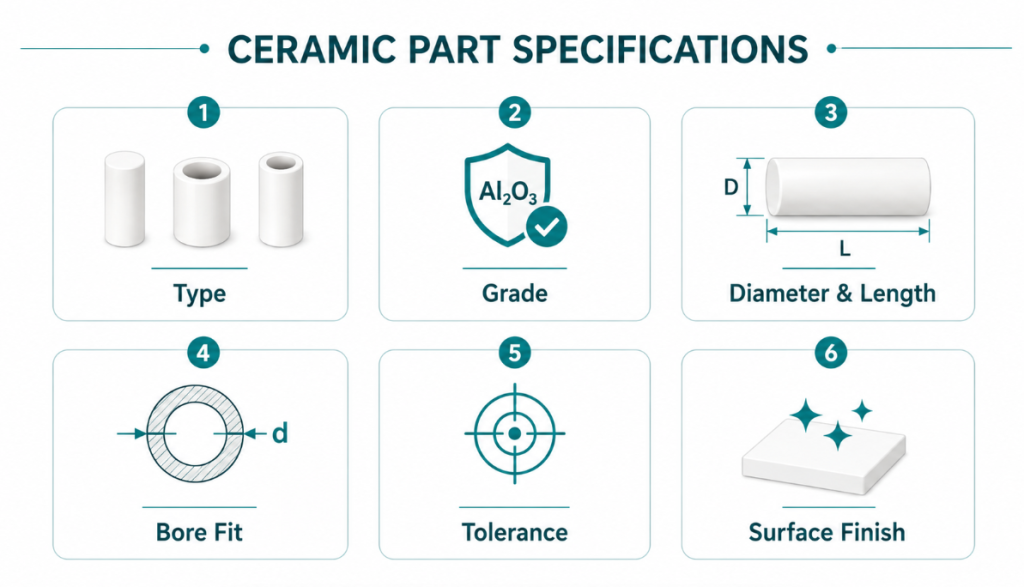
Table 3 — Ceramic Part Specification Checklist
| Specification | What to Determine |
|---|---|
| Type | Pin, sleeve, tube, or custom form |
| Grade | Alumina purity (or other ceramic) to suit the application |
| Diameter & length | Sized to the locating job |
| Bore / fit | Matched to the nut or workpiece |
| Tolerance | As needed for locating accuracy |
| Surface finish | As-fired, ground, or polished as required |
The checklist is the full specification: type and grade set what the part is, dimensions and fit set how it locates, tolerance and finish set how precisely. Answering these specifies a ceramic part completely.
A Note on Ceramic’s Nature When Specifying
Two aspects of ceramic’s nature are worth keeping in mind when specifying, because they affect how the part is made and used. First, ceramic is hard and is precision-finished by grinding after firing — which is how tight tolerances and fine finishes are achieved, and part of why ceramic parts are made to specification rather than casually cut. Second, ceramic is brittle, so designs generally avoid features that concentrate stress and favor robust geometries; this is why, for instance, clamping arrangements are preferred over threading directly into ceramic. Keeping these in mind helps in specifying a ceramic part that is both makeable and durable — a part designed with the material’s nature rather than against it. None of this complicates a straightforward locating pin or sleeve; it simply informs good specification.
Getting the Right Ceramic Part
Two real situations show ceramic part selection in practice.
Custom part to drawing. For a customer needing ceramic locating parts to a specific geometry their standard options didn’t cover, we produced parts to their drawing — the dimensions, form, and fit their application required. Made-to-drawing capability is much of what ceramic part supply is, because locating geometries vary so widely.
Grade matched to the requirement. For a customer whose application had particular demands, selecting the appropriate ceramic grade for those requirements gave the performance needed — the right material for the application, rather than a default. Matching the grade to what the part actually faces is how you get performance without overpaying.
Both reflect this article’s approach: specify the part — type, grade, dimensions — to the application, and the part performs. A ceramic part made to the right specification is one that locates accurately, insulates reliably, and lasts.
Specify the Ceramic Part Your Application Needs
Ceramic pins, sleeves, and tubes are precision insulating locating parts, and specifying one comes down to the type (pin, sleeve, tube, or custom form), the grade (alumina purity matched to the application, without over-specifying), and the specifications (diameter, length, bore fit, tolerance, and finish). Matching each to what your application actually needs — the right form, the right grade, the right dimensions — is what gets you a ceramic part that locates accurately and insulates reliably, made to your drawing where standards don’t fit.
Tell us what you need — the type of part, your application’s demands, and the dimensions or drawing — and we’ll supply ceramic pins, sleeves, or tubes in the grade and specification suited to your application, made to your drawing where needed. Browse our ceramic pins and sleeves range, or send us your part requirements and let’s get you the right ceramic locating parts for your specific application.
References
IQS Directory — Alumina Ceramics: Properties & Uses (purity classification, tolerances, finish): https://www.iqsdirectory.com/articles/ceramic/alumina-ceramic.html
Stanford Advanced Materials — Alumina Ceramic: Common Types and Specifications (grades, specifying, don’t over-specify): https://www.samaterials.com/content/alumina-ceramic-common-types-and-specifications.html
Engineering Ceramic Co. — Precision Machining of Alumina Ceramics (grade selection, tolerances, machining): https://www.engineeringceramicltd.com/news/precision-machining-of-alumina-ceramics-comprehensive-process-control-from-mitigating-brittleness-risks-to-delivering-reliable-components.html
Share This Article
Latest Articles
October 19, 2026
October 19, 2026
October 19, 2026
October 19, 2026
October 19, 2026
October 19, 2026
October 19, 2026
October 19, 2026