When to Use Ceramic Pins & Sleeves in Resistance Welding

Ceramic and KCF are the two main material choices for locating pins and sleeves in resistance welding, and neither is universally “better” — they suit different conditions. Ceramic excels where you need the highest temperature resistance, complete electrical insulation, and corrosion resistance; KCF excels where you need toughness and machinability for fast, high-impact production. This article is about the ceramic side of that choice: where ceramic pins and sleeves are the right call, what genuinely makes them advantageous, and — just as honestly — where their brittleness makes KCF the better option. The goal is to help you match the material to your application, not to push one over the other.
We make both, so we have no stake in steering you wrong — our interest is in you getting a part that performs, which means the right material for your conditions. For the direct material comparison, our piece on ceramic vs KCF guide sleeves sits alongside this one; here the focus is specifically on when ceramic is the material to choose.
What Makes Ceramic Different: A Pure Insulator
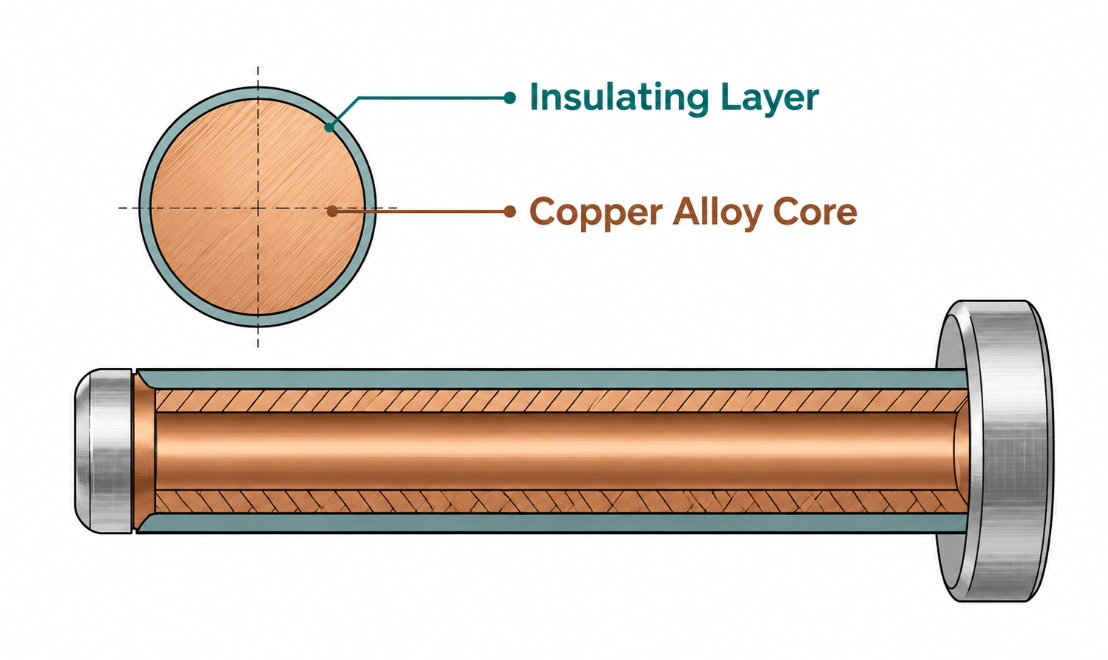
ceramic pure insulator versus KCF copper core with insulating layer cross-section
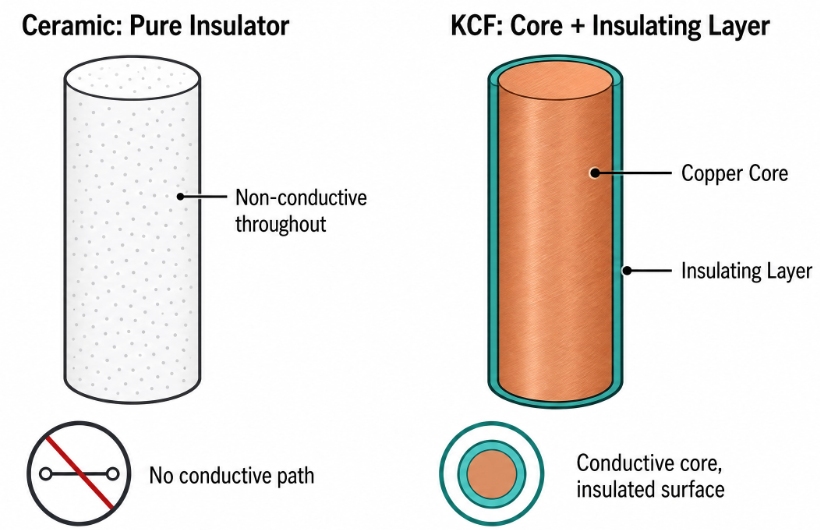
The fundamental thing to understand about a ceramic pin or sleeve is that it is a pure insulator — the entire part is non-conductive, not a conductive core with an insulating layer. This is a categorical difference from KCF, and it drives most of ceramic’s advantages.
Ceramics used for these parts, typically high-purity alumina (aluminum oxide), are among the best electrical insulators available. High-purity alumina’s volume resistivity exceeds 10¹⁴ ohm-centimeters, making it one of the best electrical insulators — and because the whole part is ceramic, there is no insulating layer that could wear through or be damaged to expose a conductive core. The insulation is the material itself, all the way through.
This is the defining ceramic advantage: where a KCF part insulates via a layer over a metal core, a ceramic part simply is insulation. For applications where complete, absolute electrical isolation is the priority, that whole-body insulation is ceramic’s strongest argument.
When Ceramic Is the Right Choice
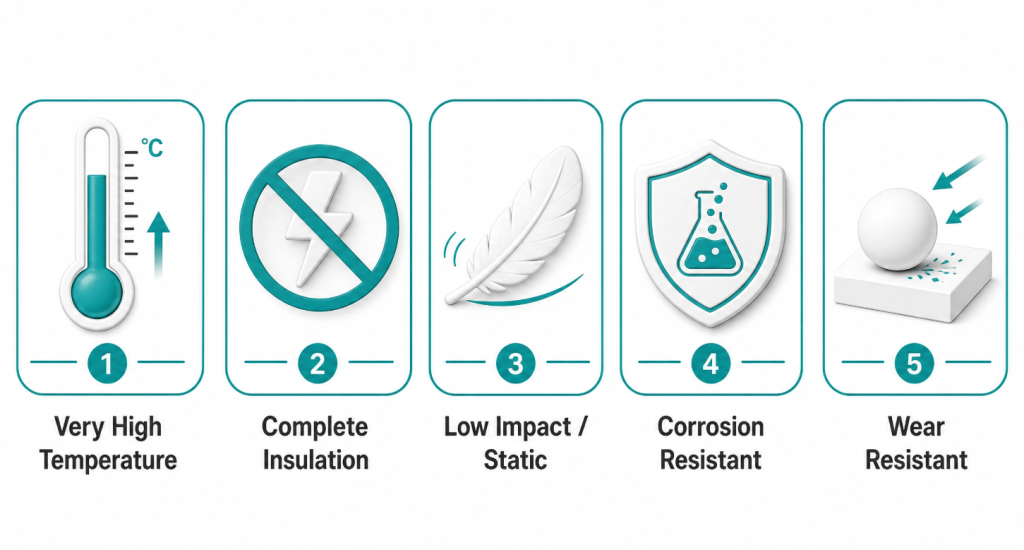
Based on what our customers actually use ceramic for, ceramic pins and sleeves are the right choice in five situations.
When you need complete, absolute insulation. If the application demands total electrical isolation with no possibility of a conductive path, ceramic’s pure-insulator nature is ideal. There is no core to expose, no layer to compromise — the part cannot conduct because it is non-conductive throughout. This is the clearest case for ceramic.
It is worth understanding why this distinction can matter in practice. A KCF part’s insulation is excellent, but it is delivered by a layer over a conductive core — which means that, in principle, severe damage that breached the layer could expose the core. In the vast majority of applications this is not a concern, because the KCF insulating layer is durable and the parts are made to hold up. But for the most insulation-critical applications — where the consequence of any conductive path is unacceptable and the engineer wants the reassurance of a part that physically cannot conduct under any circumstances — ceramic’s whole-body insulation removes the question entirely. The trade-off, as always with ceramic, is brittleness; but where absolute insulation outweighs mechanical robustness, ceramic is the material that delivers it. This is one of the core distinctions our comparison of KCF versus ceramic guide pins examines in more detail.
When temperatures are very high. Ceramic withstands higher temperatures than KCF. Alumina’s melting point is approximately 2,050°C, and it retains structural integrity in conditions that would destroy metals, as documented in references on alumina ceramic properties. For the hottest applications, ceramic’s temperature resistance exceeds what a metal-cored part offers — making it the choice when heat is the dominant challenge.
There is a nuance worth knowing here, because high-temperature performance is not unconditional even for ceramic. Alumina’s mechanical strength does decline somewhat at very elevated temperatures, and its resistance to rapid thermal shock — sudden temperature swings — is moderate rather than exceptional, owing to its thermal expansion characteristics. So ceramic is the right choice for sustained high-temperature conditions, but an application involving violent thermal cycling deserves a conversation about the specific conditions. For the steady high-heat environments most welding-locating applications involve, ceramic’s temperature ceiling, far above what metals tolerate, is a decisive advantage. The point is simply that “high temperature” should be understood as sustained heat resistance, where ceramic genuinely excels.
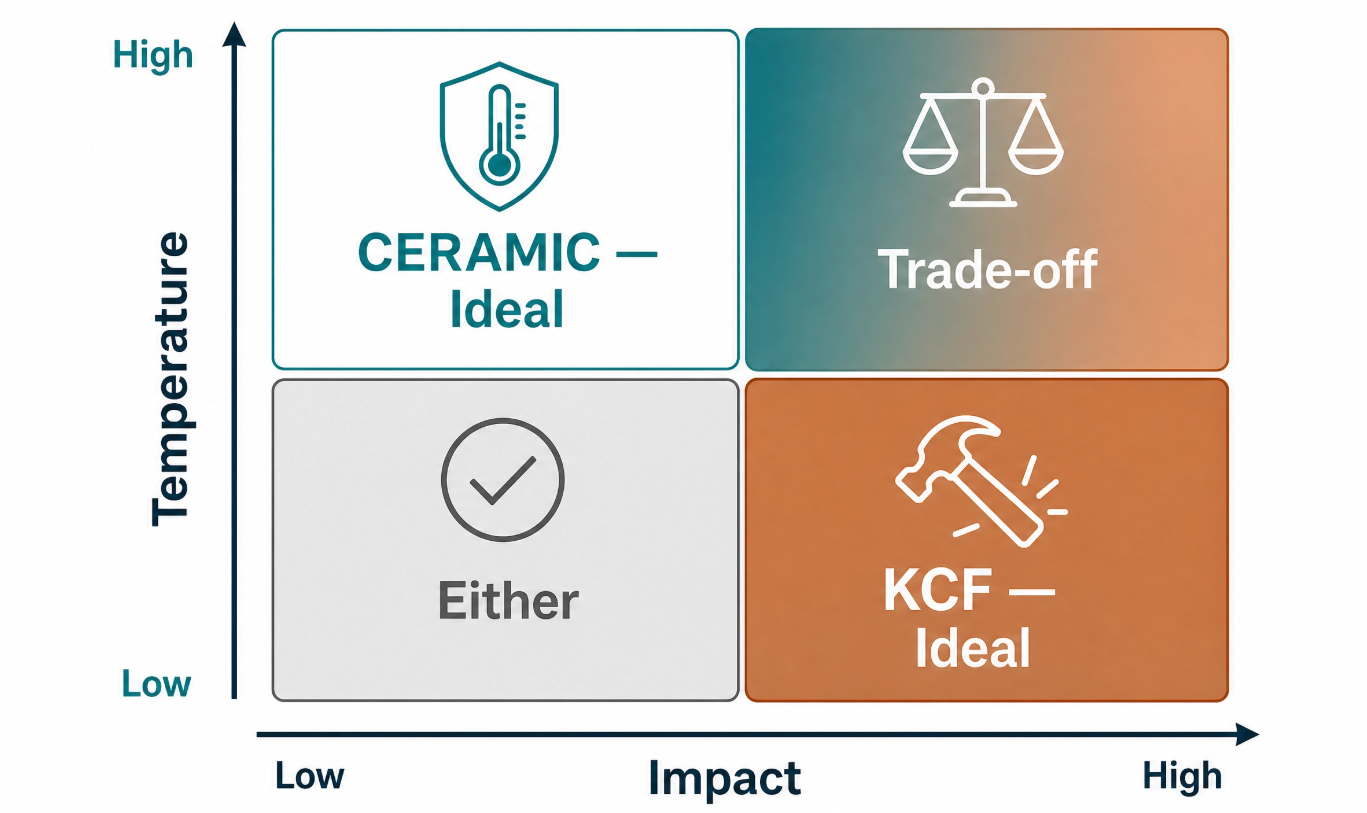
When the application is low-impact or static. This is the crucial qualifier that makes ceramic work. Ceramic’s advantages come with brittleness (more on this below), so ceramic suits applications where the locating part is not subjected to heavy mechanical shock — low-impact positioning, more static setups, situations where the part locates without being hammered. In these gentler mechanical conditions, ceramic’s strengths shine without its weakness being exposed.
When corrosion or a chemically harsh environment is involved. Ceramic is chemically stable and corrosion-resistant, offering good resistance to acids and alkalis even at elevated temperatures. For applications in corrosive or chemically aggressive environments, ceramic’s chemical inertness is a real advantage over metals that might corrode.
When wear resistance is paramount in the right conditions. Alumina is extremely hard and resists abrasion exceptionally well. In applications where abrasive wear is the main concern — and impact is low — ceramic’s hardness gives excellent wear life. The caveat is always the impact condition: ceramic’s wear resistance is an asset specifically where shock loading is not.
Table 1 — When Ceramic Pins & Sleeves Are the Right Fit
| Application Condition | Why Ceramic Suits It |
|---|---|
| Complete insulation required | Pure insulator throughout — no core to expose |
| Very high temperatures | Withstands heat that degrades metals (alumina melts ~2,050°C) |
| Low-impact / static positioning | Brittleness not exposed in gentle mechanical conditions |
| Corrosive / harsh chemical environment | Chemically inert and corrosion-resistant |
| Abrasive wear, low shock | Extreme hardness gives long wear life |
The common thread across the rows: ceramic is the choice when insulation, temperature, or chemical resistance matters most — and mechanical shock is low. That last condition is not a footnote; it is the key to using ceramic successfully.
The Honest Limitations: When KCF Is Better
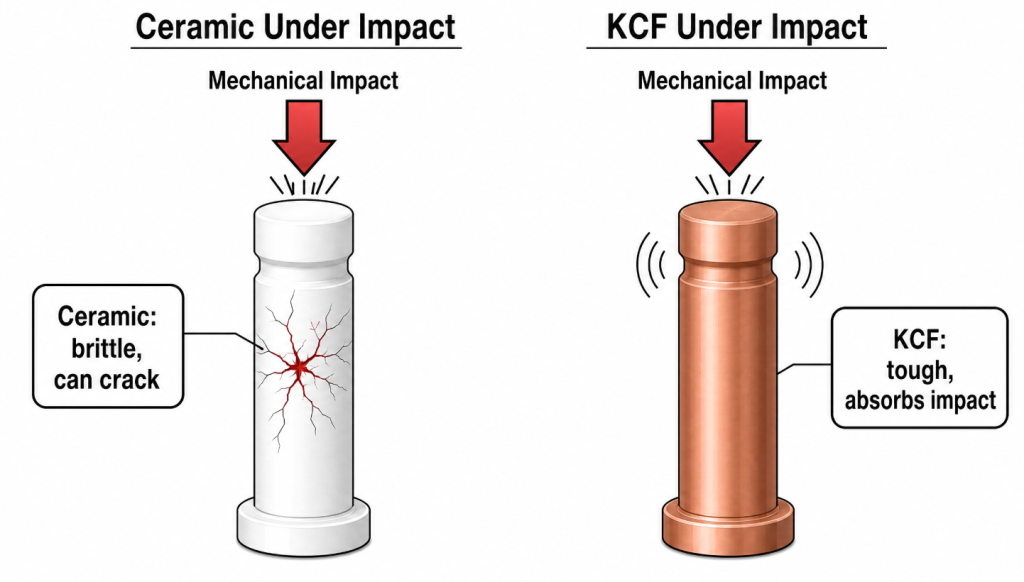
It would be poor advice to present ceramic’s strengths without being equally clear about its limitations — because choosing ceramic for the wrong application leads to failed parts. Ceramic has real disadvantages, and in several common situations KCF is the better choice.
Ceramic is brittle. This is ceramic’s primary limitation, and it is intrinsic to the material. Alumina has low fracture toughness and can crack under sudden impact or tensile stress — its main weakness, the reason engineers choose tougher alternatives for applications involving repeated shock loading. A ceramic part that takes a sharp mechanical hit can fracture where a tough KCF part would simply absorb it. This single property governs most of the decision.
It is worth being precise about what brittleness means in service, because it is not about everyday handling so much as the failure mode. A brittle material does not deform and recover the way a metal does — when it is overstressed, it cracks rather than bends, and that crack can mean sudden, complete failure of the part rather than gradual wear. In a welding-locating context, this matters most under impact: the repeated mechanical shock of a fast line, a fastener slammed into position, or any sharp blow concentrates stress that a brittle part cannot redistribute. The result can be a cracked or shattered locating part, and on a production line a part that fails suddenly is worse than one that wears predictably, because it can stop the line without warning. This is precisely why the impact condition is the single most important question when considering ceramic — not because ceramic is fragile in some general sense (it is extremely hard and durable in compression), but because its specific weakness, low fracture toughness under impact and tension, is exactly the stress a high-impact welding line delivers.
Fast, high-impact production lines favor KCF. Because ceramic is brittle, high-cycle production with mechanical shock is exactly where it struggles. A fast automotive-style line that hammers the locating part thousands of times is hard on a brittle material — this is KCF territory, where impact resistance keeps the part intact at speed. If your line is fast and mechanically aggressive, KCF’s toughness is the deciding factor.
Ceramic can’t be machined and customized like metal. Ceramic’s hardness, an advantage in service, is a limitation in manufacturing: it cannot be machined and customized the way KCF can. Producing ceramic to a specific custom geometry is harder and requires specialized processing, where KCF — being a machinable metal-cored material — can be readily made to a customer’s drawing. If your application needs extensive customization, KCF offers more flexibility.
This manufacturing constraint has a practical consequence for buyers that is easy to overlook. With KCF, adapting a part to your specific fastener, bore, or geometry is a machining operation — relatively straightforward, and something a factory can do to your drawing. With ceramic, the same hardness that makes it wear-resistant in service means it cannot simply be cut and shaped freely; ceramic parts are typically formed and fired to shape, and achieving a custom or unusual geometry is more involved and may require specialized tooling that wears and fractures during processing. The upshot is that ceramic tends to be most practical in standard or simpler geometries, while highly customized or complex shapes lean toward KCF. If your requirement is a standard ceramic pin or sleeve, this is a non-issue; if you need something bespoke, it becomes part of the material decision.
Some sizes and shapes are difficult in ceramic. Following from the machining limitation, certain dimensions and complex shapes are difficult to produce in ceramic. Where a particular geometry is needed that ceramic cannot easily achieve, KCF’s machinability makes it the practical choice.
Ceramic may cost more. Depending on the part and application, ceramic can be more expensive. Where cost is a primary concern and the application does not specifically need ceramic’s unique properties, KCF may be the more economical choice.
Table 2 — Ceramic vs KCF: Matching Material to Application
| Factor | Ceramic Is Better | KCF Is Better |
|---|---|---|
| Electrical insulation | Pure insulator throughout | Insulating layer over core (excellent, but a layer) |
| Maximum temperature | Higher (alumina ~2,050°C) | High, but below ceramic |
| Impact / shock resistance | Poor — brittle, can crack | Tough — absorbs impact |
| Fast high-impact production | Struggles | Excels |
| Machinability / customization | Difficult — specialized processing | Readily machined to drawing |
| Complex / custom geometries | Limited | Flexible |
| Corrosion resistance | Excellent — chemically inert | Good |
| Cost | May be higher | Often more economical |
The two columns make the decision framework concrete: ceramic wins on insulation, temperature, and corrosion; KCF wins on toughness, machinability, and fast-line durability. Reading across to your own conditions tells you which material your application actually calls for.
How to Decide: Ceramic or KCF?
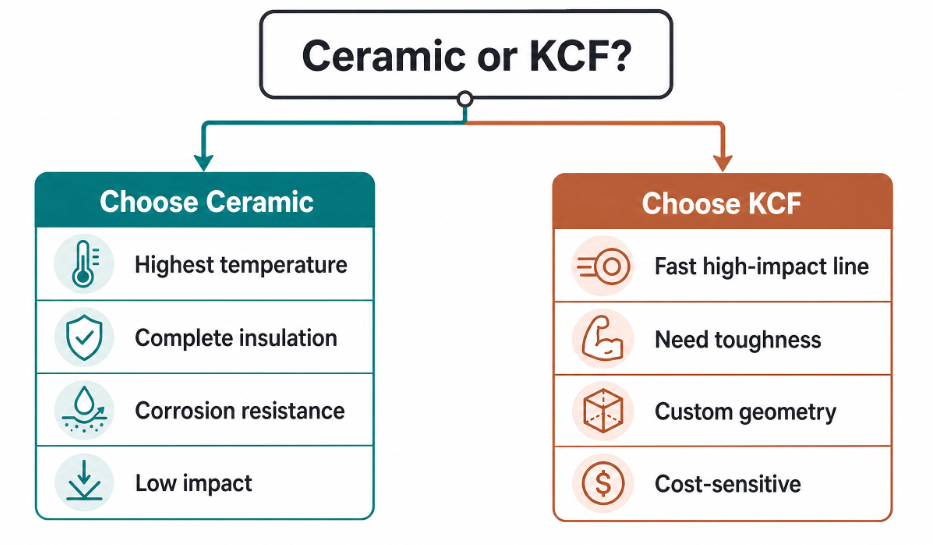
Pulling this into a practical decision: the choice between ceramic and KCF comes down to weighing two clusters of factors against your specific application.
Choose ceramic when your priority is the highest temperature resistance, complete whole-body insulation, or chemical/corrosion resistance — and your application is relatively low-impact, without the heavy mechanical shock that would risk cracking a brittle part. Ceramic is the specialist’s choice for demanding thermal, electrical, and chemical conditions in gentler mechanical settings.
Choose KCF when your application involves fast, high-impact production, needs toughness to survive mechanical shock, requires extensive customization or complex geometries, or is cost-sensitive without a specific need for ceramic’s extreme properties. KCF is the choice for the rough-and-tumble reality of high-volume, high-impact welding lines.
The honest summary is that this is not a question of which material is better, but which is better for your conditions. A high-temperature, low-impact, insulation-critical application may be perfect for ceramic and poorly served by anything else; a fast, hard-hitting automotive line is KCF’s domain and would shatter ceramic. The material has to match the mechanical and thermal reality of your specific line. A supplier who makes both — and who asks about your conditions before recommending — is in a position to guide that choice honestly, rather than fitting your application to whichever material they happen to sell.
Getting the Right Material for Your Application
Ceramic pins and sleeves are an excellent choice for the right conditions — when you need maximum temperature resistance, complete insulation, or corrosion resistance in a low-impact application, ceramic’s pure-insulator nature and thermal stability are hard to beat. Where their brittleness would be exposed by mechanical shock, or where machinability and customization matter, KCF is the better path. Matching the material to your application’s real demands is what gets you a locating part that performs and lasts.
Because we make both ceramic and KCF pins and sleeves, we can help you choose objectively rather than sell you one or the other. Tell us about your application — your temperatures, your impact and cycle conditions, your insulation needs, any chemical exposure, and your customization requirements — and we’ll recommend the material that genuinely fits, ceramic or KCF. Browse our ceramic pins and sleeves range, or send us your application and let us help you get the right material the first time.
Share This Article
Latest Articles
October 19, 2026
October 19, 2026
October 19, 2026
October 19, 2026
October 19, 2026
October 19, 2026
October 19, 2026
October 19, 2026