KCF Material Heat Treatment: Why It Determines Performance

A KCF part’s performance is not set by its chemistry alone — it is set by what heat treatment does to that chemistry. Two parts with identical composition can perform completely differently depending on whether they were properly heat-treated, because heat treatment is what develops the hardness, wear resistance, and dimensional stability that make a KCF locating part work. This article explains why heat treatment matters so much for KCF parts, the metallurgical processes involved, and — for a buyer — how to verify that the heat treatment was actually done right. As with any process built on proprietary know-how, we’ll explain the principles and what they achieve rather than publish specific process parameters, but the principles are what let you understand and verify the property.
For the material fundamentals behind this, our explainer on what KCF alloy is covers the copper-based composition; here we focus on the thermal processing that turns that composition into a performing part.
Why Heat Treatment Determines KCF Performance
Heat treatment is not a finishing touch on a KCF part — it is the step that develops the part’s essential properties. Several performance characteristics depend directly on it.
It determines hardness and wear resistance. The hardness and wear resistance that let a KCF locating part hold its dimensions over a long service life are developed through heat treatment, not inherent in the raw material. A properly heat-treated part has the hardness to resist wear; an inadequately treated one is softer and wears faster, regardless of having the right chemistry. This is the property that most directly affects how long the part lasts.
It affects dimensional stability. Heat treatment influences how stable the part’s dimensions remain in service. This matters enormously for a locating part, whose entire function depends on holding precise dimensions — a dimensionally stable part keeps locating accurately, while one that shifts loses precision. Notably, copper alloys that strengthen through certain heat-treatment mechanisms maintain excellent dimensional stability because the process involves no major crystallographic change, as documented in references on the hardening of copper alloys.
Inadequate heat treatment means insufficient performance. This is the crux for a buyer. A part that was not properly heat-treated will underperform — softer, less wear-resistant, less dimensionally stable — even though it may look identical and test correct on composition. Heat treatment is the invisible difference between a part that performs and one that merely has the right ingredients.
It relates to the insulating layer and overall quality. The thermal processing connects to the integrity of the insulating layer and the part’s overall quality, making heat treatment part of the complete quality picture rather than a standalone mechanical step.
This connection is worth understanding rather than glossing over, because it explains why heat treatment cannot be evaluated in isolation from the rest of the part. A KCF locating part has to do two things at once — locate accurately with the hardness and dimensional stability heat treatment provides, and insulate reliably through its insulating layer. These are not independent: the thermal processing the part undergoes is part of the same manufacturing reality that produces and preserves the insulating layer, so a part made with proper, controlled processing tends to be sound across both dimensions, while a part made carelessly may be compromised in more than one way at once. For a buyer, the practical takeaway is that heat-treatment quality is a useful signal of overall manufacturing discipline: a supplier who controls the demanding, invisible thermal processing carefully is usually a supplier who controls the rest of the part’s quality carefully too. Sloppiness rarely confines itself to one stage.
Batch consistency governs production quality. For volume production, consistent heat treatment across an entire batch is what ensures every part performs reliably. Inconsistent treatment means some parts perform and others don’t — an unpredictability that is poison to a production line.
Table 1 — What KCF Heat Treatment Determines
| Property | Role of Heat Treatment | Consequence If Inadequate |
|---|---|---|
| Hardness | Developed by the treatment | Soft part, fast wear |
| Wear resistance | Developed by the treatment | Loses dimensions quickly |
| Dimensional stability | Influenced by the treatment | Locating accuracy drifts |
| Insulation / overall quality | Connected to thermal processing | Compromised quality |
| Batch consistency | Requires uniform treatment | Unpredictable part-to-part performance |
The pattern is clear: the properties a buyer cares most about — hardness, wear life, dimensional accuracy — are precisely the ones heat treatment develops. A KCF part is a heat-treated product, not just a machined one.
The Metallurgy: How Copper-Alloy Heat Treatment Works
KCF is a copper-based material, and copper alloys of this kind develop their properties through a well-understood family of heat-treatment processes. Understanding the principles — without the proprietary specifics — helps a buyer grasp what’s happening and why it matters.
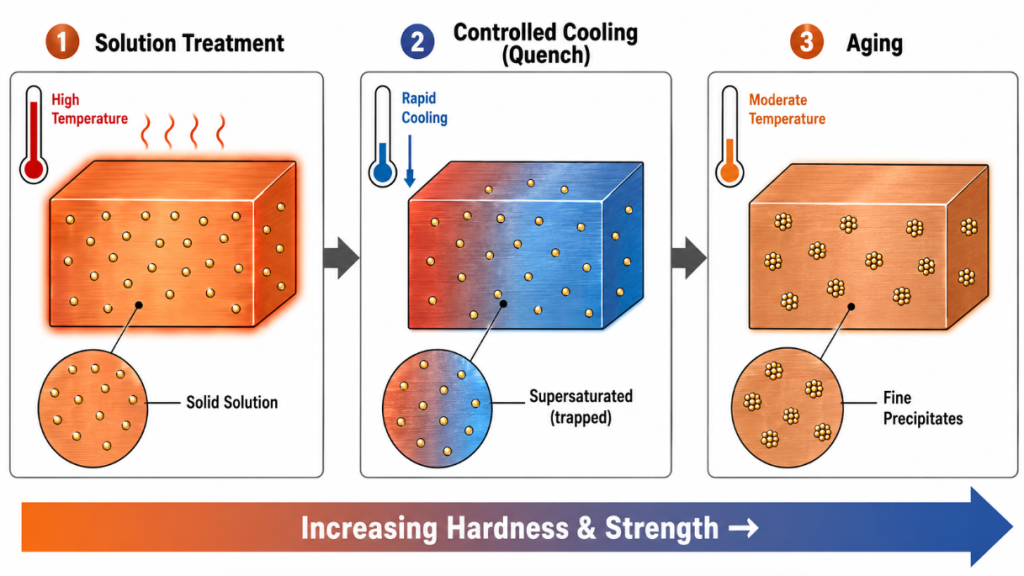
Solution treatment. The first stage heats the alloy to a high temperature at which the alloying elements dissolve into the copper to form a homogeneous solid solution. As metallurgy references describe, this solution treatment heats the alloy above the solvus temperature to dissolve the alloying elements into a single-phase solid solution. This sets the stage by getting the strengthening elements into solution.
Controlled cooling (quenching). The solution-treated alloy is then rapidly cooled, which traps the alloying elements in a supersaturated solid solution — they are held in place rather than separating out. This rapid cooling is what preserves the conditions needed for the strengthening that follows.
Aging (precipitation hardening). The final and crucial stage. The supersaturated material is held at an intermediate temperature, during which the trapped alloying elements precipitate out as extremely fine, dispersed particles throughout the copper matrix. These fine precipitates are the source of the hardness and strength: they impede the movement of dislocations through the metal, which is what makes the material hard and wear-resistant. Copper alloys are specifically hardened through this elevated-temperature treatment, and the strengthening comes from this precipitation. The whole point of aging is to form that fine dispersed precipitate that obstructs deformation.
This two-step nature — solution treatment followed by aging — is what distinguishes heat-treatable copper alloys from ordinary copper. As copper-alloy specialists note, certain copper materials get their high strength, conductivity, and hardness through a combination of cold work and a thermal aging process rather than from cold work alone — meaning the thermal step is not optional polish but the source of much of the part’s capability. Skip or botch the aging, and you have a fundamentally weaker material no matter how good the chemistry.
Annealing and other treatments. Depending on the part and process, annealing and other thermal treatments may also play a role in achieving the right final properties.
The essential insight is that the strength does not come from the alloying elements simply being present — it comes from heat treatment arranging them into fine precipitates that resist deformation. This is why a part with correct chemistry but improper heat treatment fails to perform: the ingredients are there, but the thermal processing that organizes them into a strengthening structure was not done right.
Table 2 — The Copper-Alloy Heat Treatment Stages
| Stage | What Happens | Purpose |
|---|---|---|
| Solution treatment | Heat high; alloying elements dissolve | Get elements into solid solution |
| Controlled cooling / quench | Rapid cool; elements trapped supersaturated | Preserve conditions for strengthening |
| Aging (precipitation) | Hold at intermediate temp; fine precipitates form | Develop hardness via dislocation obstruction |
| Annealing / other | Supplementary thermal processing | Achieve final property balance |
Reading down the stages shows why heat treatment is a sequence, not a single event: each stage sets up the next, and getting any stage wrong undermines the result. This sequential dependence is exactly why heat treatment demands process control.
Why Proper Heat Treatment Is Hard — and Why That Matters to Buyers
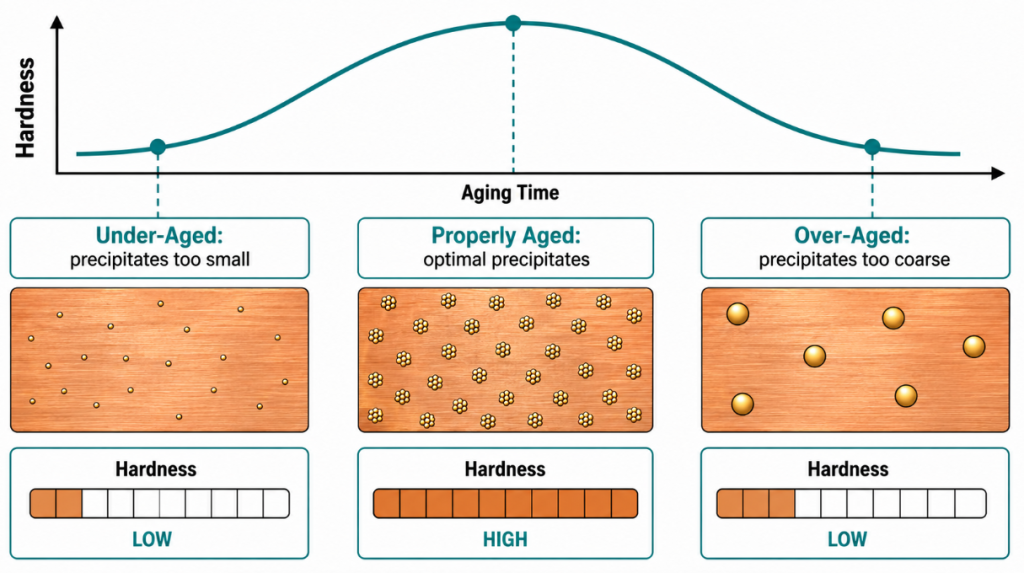
The metallurgy above sounds straightforward, but executing it correctly is demanding, and that difficulty is precisely why heat treatment is a place where part quality is won or lost. Each stage is time- and temperature-sensitive: the precipitation that develops strength depends on holding the right conditions, and getting them wrong produces a poorly performing part rather than a strong one. Too little aging and the precipitates are too small to strengthen effectively; too much and they coarsen and lose their effect. The window matters.
This is the same trap we describe in our comparison of CuCrZr versus pure copper electrodes, where un-aged material with correct chemistry behaves like soft copper. The lesson generalizes to all heat-treated copper parts: chemistry tells you what’s in the material, but heat treatment tells you whether it will perform. A supplier who controls heat treatment carefully produces consistent, performing parts; one who treats it casually — or skips proper aging to save time — ships parts that look right and underperform.
For a buyer, this means heat-treatment quality is invisible at the point of purchase and only reveals itself in service, which is exactly why it should be verified through testing rather than assumed.
How We Control and Document Heat Treatment
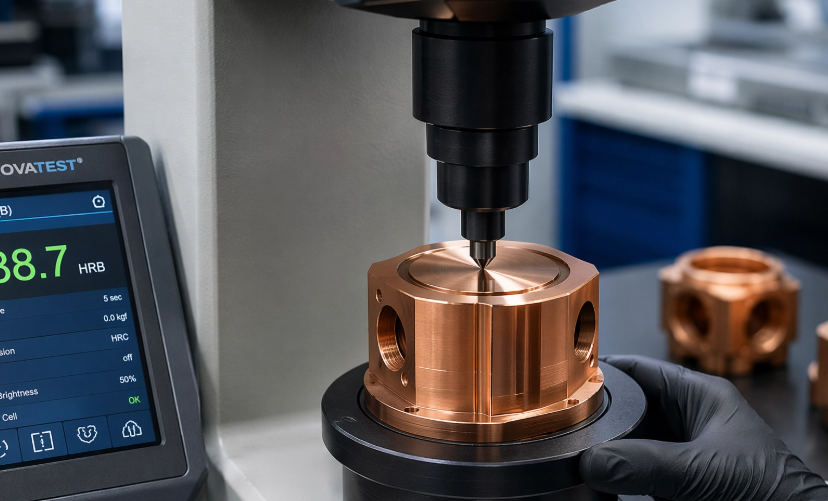
Since heat treatment determines performance, controlling and documenting it is part of how the parts are made. Stated against the standard this article asks you to hold any supplier to, here’s what that involves on our side.
We apply heat treatment to develop the required properties, with the solution-treatment, controlled-cooling, and aging stages carried out to achieve the hardness, wear resistance, and dimensional stability the parts need. Heat treatment is quality-controlled on a per-batch basis, so that performance is consistent across production rather than variable from batch to batch. Our material certification can state the heat-treatment condition of the material — for example, that it has been aged — so the buyer knows the thermal state, not just the chemistry. We provide hardness test reports, which are direct evidence that the heat treatment achieved its purpose: hardness is the measurable outcome of proper treatment. And customers can verify hardness independently with their own testing, confirming the result for themselves.
The principle is the same one we apply across our quality documentation: a property the buyer cannot see directly — here, whether the heat treatment was done right — should be one the buyer can verify through a measurable proxy. For heat treatment, hardness is that proxy.
How to Verify KCF Heat Treatment
Here is the practical part for a buyer: how to confirm the heat treatment was actually done properly, rather than taking it on faith. Because hardness is the measurable outcome of heat treatment, it’s the key to verification.
Request hardness test reports. Hardness is the direct, measurable evidence that heat treatment achieved its goal — a properly aged part reaches its target hardness, an improperly treated one falls short. Asking for hardness data is asking for proof the treatment worked. A supplier who tests hardness can provide it; one who can’t is asking you to trust an unverified process.
Ask for the heat-treatment condition in the material certificate. A material certificate should state not just composition but the heat-treatment condition — whether the material is aged, for instance. This tells you the thermal state of what you’re buying. Composition alone, without the treatment condition, is an incomplete specification for a heat-treated part.
Confirm per-batch quality control. Ask whether heat treatment is controlled and verified per batch. Per-batch control is what ensures consistency; treatment done without batch verification leaves room for the batch-to-batch variation that makes performance unpredictable.
Verify hardness independently. For full confidence, measure hardness yourself with your own equipment, confirming the supplier’s reported values against your own reading. Hardness testing is accessible, and an independent check is the strongest verification — a supplier confident in their heat treatment will welcome it. This is the same principle of independent verification that applies to insulation resistance testing: the property you can measure yourself is the property you can trust.
Table 3 — Verifying KCF Heat Treatment
| Verification Step | What It Confirms | Red Flag If Absent |
|---|---|---|
| Request hardness reports | Treatment achieved target hardness | No data = unverified process |
| Heat-treatment condition on cert | Thermal state of the material | Composition only = incomplete spec |
| Per-batch QC | Consistency across production | No batch control = variability risk |
| Independent hardness check | Claims hold up to your own test | Resistance to it = a concern |
Across the table, the theme is that heat treatment, though invisible in the finished part, is verifiable through hardness — and a supplier worth working with supports that verification at every level. Hardness is the window into whether the thermal processing was done right.
Performance Is Made in the Heat Treatment
A KCF part’s hardness, wear resistance, and dimensional stability — the properties that determine whether it performs and how long it lasts — are developed through heat treatment, not inherent in its chemistry. Solution treatment, controlled cooling, and aging together transform a correct composition into a performing part by forming the fine precipitates that resist deformation. And because the difference between proper and improper heat treatment is invisible in the finished part, it’s a property to verify through hardness testing rather than assume. The part that performs in service is the one whose heat treatment was done right and can be proven so.
If heat-treatment quality matters to your application — and for a locating part’s service life, it does — tell us your requirements, and we can provide hardness test reports, state the heat-treatment condition, and give you the data to verify performance for yourself. Browse our KCF guide pins and sleeves range, or send your application and let’s make sure you’re getting parts whose performance is built in, not just claimed.
Share This Article
Latest Articles
October 20, 2026
October 20, 2026

October 20, 2026
October 20, 2026
October 20, 2026
October 20, 2026
October 20, 2026
October 20, 2026