How Often Should You Dress Electrode Caps?

“How often should we dress?” is one of the most common questions we get, and the honest first answer frustrates people: there is no universal number. A line welding thin galvanized sheet at high speed needs to dress far more often than one welding thick bare steel at a relaxed pace, and a number borrowed from someone else’s line is as likely to hurt you as help. What this article gives you instead is better than a number — it is the method for finding your number, the factors that move it, and the cost of getting it wrong in either direction.
If you need the broader context first, dressing is one of eight levers in our playbook on extending electrode life, and the deformation it corrects — mushrooming — is covered mechanically in our piece on what causes electrode mushrooming. Here we zoom all the way in on the single question of frequency.
What Actually Determines Dressing Frequency
The right dressing interval is set by how fast your specific line degrades a cap’s face, and that rate is driven by a handful of factors. Published practice gives a sense of the range — patented welding methods describe dressing intervals anywhere from every 40 welds up to every 200, commonly landing around every 100 to 140 welds — but that span is wide precisely because the right point within it depends entirely on the variables below. The number is an output of your conditions, not an input you can copy.
Four factors push the interval shorter, and recognizing which apply to you is how you locate your starting point.
Coated steel versus bare steel. This is the biggest single factor. Galvanized and coated sheet punish caps far harder than bare steel, because zinc alloys with the copper face and accelerates degradation. A galvanized line needs to dress markedly more often than a bare-steel line — running both on the same interval guarantees you are either over-dressing the bare steel or under-dressing the galvanized.
Production rate and duty cycle. Higher weld volume and faster cycles deposit heat into the face faster than it can recover, accelerating wear per unit time. A high-throughput line simply reaches the dress-now point sooner than a line running the same parts slowly.
Sheet thickness. Thin-gauge material tends to demand more frequent dressing than thick stock, because of the way heat concentrates at the interface on thin sheet. The thickness you weld shifts the interval.
Electrode material and weld parameters. Softer electrode material mushrooms faster and needs dressing sooner; higher current and force accelerate face degradation and pull the interval shorter. The material and the parameters you run both feed into the rate. This is also why the workpiece grade matters in ways that are not always obvious — for instance, advanced high-strength steels can require lower welding current than mild steel due to their higher bulk resistivity, yet frequent tip dressing remains essential to maintain the electrode tip shape and hold weld quality consistent. The interaction between material, parameters, and dressing frequency is real, and it is why no single factor sets the interval alone.
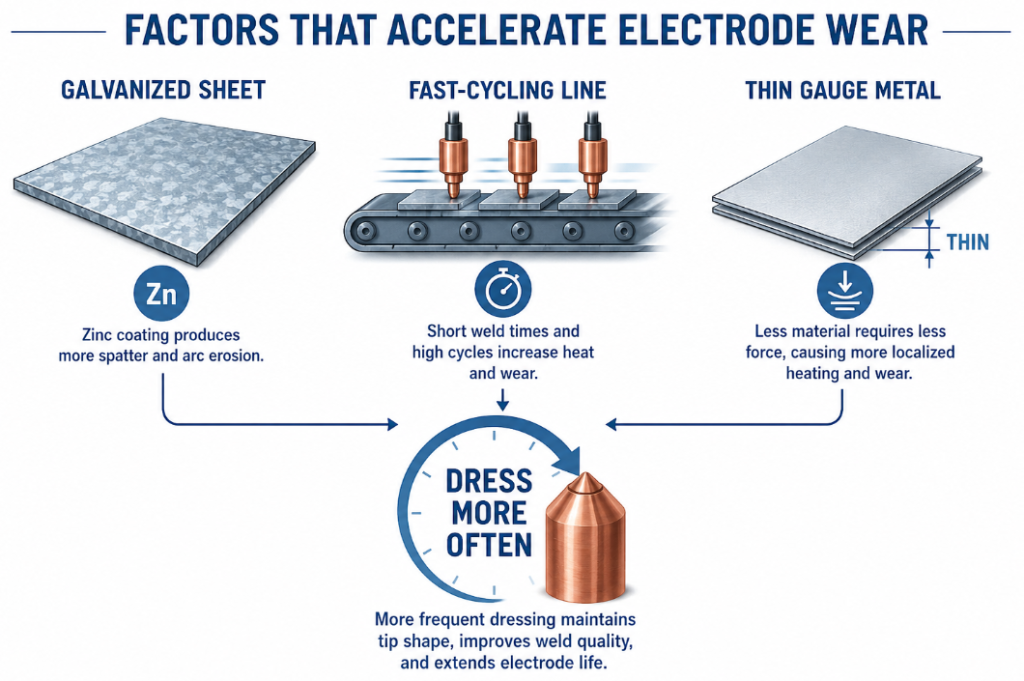
Table 1 — Factors That Shorten the Dressing Interval
| Factor | Direction | Why |
|---|---|---|
| Galvanized / coated sheet | Dress more often | Zinc alloys with copper, accelerates wear |
| High production rate / duty cycle | Dress more often | Heat accumulates faster than recovery |
| Thin-gauge sheet | Dress more often | Heat concentrates at the interface |
| Soft electrode material | Dress more often | Mushrooms faster |
| High current / force | Dress more often | Accelerated face degradation |
Read your own line against this table and you know which way your interval should sit relative to the middle of that 40-to-200 range — but you still need to pin the actual number, which is where weld-count data comes in.
How to Find Your Dressing Interval From Weld Counts
The reliable way to set a dressing interval is not to guess and not to copy, but to let your own line tell you. The principle is simple: identify the weld count at which face geometry has degraded enough to start affecting quality, then set the dressing interval comfortably before that point.
In practice that means watching where weld quality begins to drift as a cap wears — the early signs of the face spreading and current density falling — and noting the weld count when it happens. That count is your degradation threshold; your dressing interval should sit safely below it, with margin, so you dress before quality is ever affected rather than after. This is exactly why logging cap life in weld counts is foundational: without the count, you are dressing on feel, and feel cannot tell you whether you are dressing at weld 80 or weld 180.
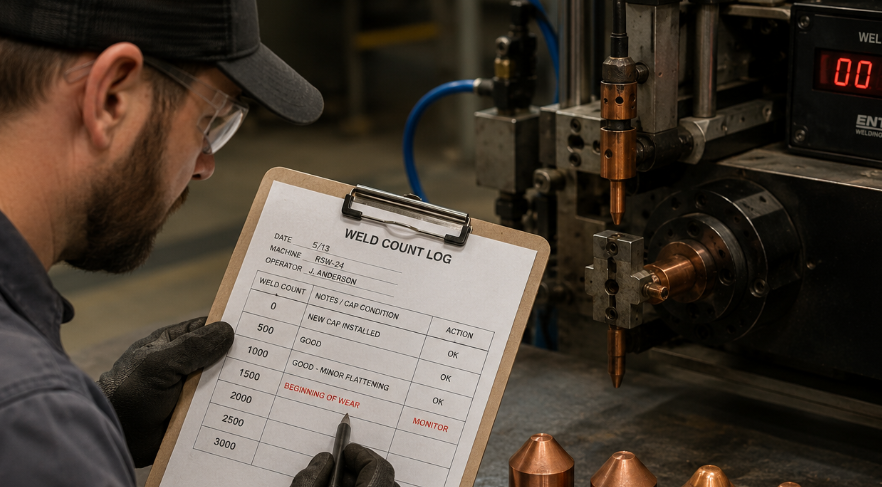
A customer who began recording weld counts was able to find the optimal interval for their specific line this way — not too early, not too late, but pinned to where their own data showed degradation beginning. Before the logging, they had been dressing on an inherited schedule that bore no relationship to how their actual line wore. The number they found was theirs alone, and it was the right one because it came from their conditions rather than someone else’s.
The same logic means the interval is not set once and forgotten. Change the material you weld, the production rate, or the electrode grade, and the degradation threshold moves — so the interval should be revisited whenever the line changes materially.
There is a practical subtlety worth flagging about how you read the degradation point. The face does not fail suddenly at a clean threshold; it drifts, and the question is how much drift you are willing to tolerate before dressing. Set the trigger too conservatively — dress at the very first hint of any change — and you drift toward the over-dressing error, burning copper for marginal benefit. Set it too loosely — wait until welds are visibly suffering — and you are already in the under-dressing zone where the face may not fully recover. The sweet spot is dressing when the face has begun to spread but well before quality is actually compromised, which on most lines means dressing on a count chosen to land in that early-drift window every time. This is why a fixed weld-count interval, calibrated once from observation, beats dressing “when it looks like it needs it” — the eye tends to wait too long, and by the time mushrooming looks obvious, the under-dressing penalties have already begun to accrue.
Dressing Too Often: The Cost of Over-Dressing
It is tempting to think more frequent dressing is always safer — if dressing is good, more must be better. It is not, and over-dressing carries real costs that make “just dress constantly” the wrong answer.
Every dress removes a small amount of copper. Dress far more often than wear requires, and you consume the cap through dressing itself rather than through welding — the dresser becomes the main mechanism eating your electrodes. As industry practice notes plainly, dressing too aggressively or too often, removing more material than necessary, shortens electrode life unnecessarily by consuming usable copper faster than wear alone would. You are trading the cap’s life for a cleanliness it did not need.
The second cost is downtime. Each dress, on many lines, is a brief interruption — and dressing far more often than necessary multiplies those interruptions into a real productivity drag with no quality benefit to show for it. Over-dressing spends both copper and time to solve a problem you did not have.
Dressing Too Seldom: The Cost of Under-Dressing
The opposite error is more common and, on balance, more damaging. Wait too long between dresses and two distinct problems set in.
First, the face degrades past the point of easy recovery. Let mushrooming grow severe and the accumulated deformation may be more than a normal dress can fully remove — the cap has drifted so far that restoring correct geometry takes aggressive removal or simply is not achievable, and quality has already suffered in the meantime. By the time you dress, the damage is done and the cap may be compromised.
Second, on coated steel especially, an alloyed layer accumulates on the face. Leave dressing too long and the brass-like alloyed buildup grows thick enough that a single normal dress cannot clean it off — what regular dressing would have kept in check becomes a problem that resists correction. The under-dressed cap carries a degraded, alloyed face that drags weld quality down until a heavier intervention is forced.
Under-dressing, in short, lets the cap reach a state where dressing can no longer do its job cleanly — which is the whole reason to dress on a schedule rather than waiting for visible severity.
This is worth emphasizing because under-dressing is the more seductive error. Over-dressing announces itself — you notice caps wearing out fast and dressing constantly. Under-dressing hides, because each skipped or delayed dress feels harmless in the moment and the cost arrives later as drifted quality and a face that no longer cleans up. The temptation to stretch the interval is strong on a busy line where every dress is a pause, and it is exactly that temptation the weld-count discipline is designed to resist. A scheduled count does not get tired, does not decide “it can wait one more batch,” and does not misjudge a gradually worsening face as still acceptable. The schedule protects you from the specific human bias — wait and see — that drives most under-dressing.
Table 2 — Over-Dressing vs Under-Dressing
| Dressing Too Often | Dressing Too Seldom | |
|---|---|---|
| Primary cost | Wastes copper; dressing becomes the wear | Face degrades past easy recovery |
| Secondary cost | Unnecessary downtime | Alloyed layer accumulates, resists removal |
| Quality effect | None gained for the cost | Quality drifts before correction |
| The lesson | Don’t dress faster than wear requires | Dress before degradation, not after |
The two columns frame the target: the right interval is the one that dresses often enough to stay ahead of degradation, but no more often than that. Both errors cost you — one in copper and time, the other in quality and recoverability.
Putting It Together: A Practical Approach to Dressing Frequency
Pulling the threads into something you can act on:
Start by placing your line against the factors in Table 1 — coated or bare, fast or slow, thin or thick, soft material or hard, high parameters or moderate. That tells you roughly where in the broad range your interval should sit. Then refine it with your own weld-count data: find where quality begins to drift, and set your interval with margin below that. Dress on that weld-count schedule consistently rather than waiting for visible mushrooming, because waiting is the under-dressing error. And revisit the interval whenever the line changes — new material, new rate, new electrode grade all move the right answer.
One refinement worth building in: if your production rate itself varies — busy shifts versus slow ones, or seasonal swings in throughput — remember that the interval is fundamentally tied to weld count, not to clock time. A cap does not care whether it reached a given weld count in two hours or two days; it has done the same number of welds. Anchoring the schedule to counts rather than to a fixed time interval keeps it correct as your pace changes, whereas a purely time-based schedule (dress every shift, say) silently over-dresses on slow days and under-dresses on busy ones.
Different workpieces on the same shop floor may legitimately need different intervals, and treating them identically is a quiet source of trouble. A customer running both galvanized and bare-steel parts found that differentiating the dressing interval by workpiece — more frequent for the galvanized line, less for the bare steel — improved both cap life and weld quality compared to the single compromise interval they had used before. The galvanized line had been under-dressed and the bare-steel line over-dressed by the one-size schedule; splitting them fixed both at once.
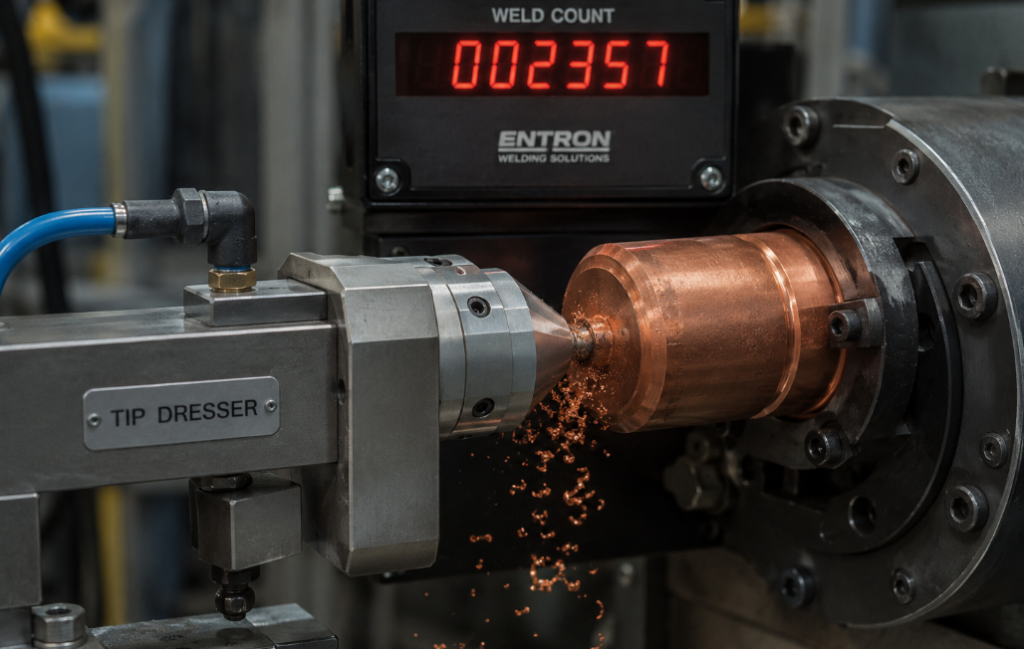
For the equipment that makes consistent dressing practical, our cap tip repair tools cover pneumatic dressers, and the broader question of which dresser suits your line is its own topic. The frequency is only half of good dressing; doing it consistently and correctly is the other half.
Getting Your Dressing Interval Right
The question “how often should you dress electrode caps?” has no borrowed answer, but it has a reliable method: read your line against the factors that drive wear, find your degradation threshold from weld-count data, set the interval with margin below it, and avoid both the copper-wasting error of over-dressing and the quality-wrecking error of under-dressing. The shops that get this right are not following a magic number — they are measuring their own line and respecting what it tells them.
If you want help calibrating, tell us what you weld, your production rate, your electrode material, and how your caps look when quality starts to drift. We can help you reason out where your interval should sit and supply the dressing equipment to hold it — and if the underlying problem turns out to be material or cooling rather than dressing frequency, we will tell you that instead. The goal is the right interval for your line, not more dressing for its own sake.
Share This Article
Latest Articles
October 20, 2026
October 20, 2026
October 20, 2026
October 20, 2026
October 20, 2026

October 20, 2026
October 20, 2026
October 20, 2026