Spot Welding Electrode Caps: Types, Shapes, and How to Choose

An electrode cap is the working end of a spot welding electrode — the replaceable copper tip that presses against the workpiece, carries the current, and forms the weld. It fits onto an electrode adaptor (shank) by a tapered fit, so that when the cap wears out you replace just the cap rather than the whole electrode. That simple idea — a standardized, replaceable, tapered cap — is why electrode caps are the workhorse consumable of resistance spot welding. This guide covers the caps themselves: the face shapes and what each is for, the standards and taper fit that make them interchangeable, the material, and how to choose the right cap for your welding — with a focus on the cap as the product it is.
Everything that happens to a cap in service — wear, mushrooming, dressing, cooling — we’ve covered elsewhere; this article is about selecting the cap in the first place. For the material behind it, see our CuCrZr vs pure copper comparison; for keeping caps in shape once running, how often to dress electrode caps.
What an Electrode Cap Is — and Why It’s Replaceable
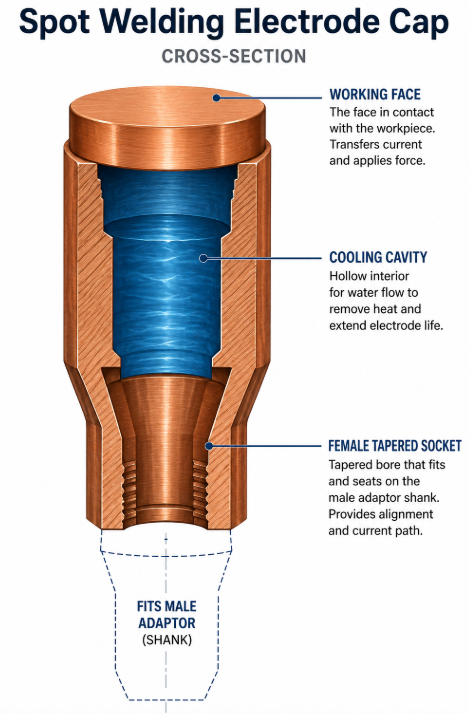
The defining feature of a cap-type electrode is that it separates the wear part from the rest of the electrode. Rather than a single solid electrode integrated with its shank, a cap-type electrode is a detachable cap that fits onto a shank or adaptor — and it’s used this way specifically to reduce cost, since you replace the inexpensive cap as it wears instead of the whole assembly.
The cap has a working face at one end (the part that contacts the sheet and makes the weld) and a tapered socket at the other (which fits onto the matching taper of the electrode adaptor). It’s typically hollow, so cooling water can reach up inside the cap right behind the working face. When the face wears down through use and dressing, the spent cap is pulled off and a fresh one pushed on — a quick change that keeps the line running.
This structure is well-defined in the engineering literature: a cap-type electrode has a tip portion formed in a bottomed, roughly cylindrical shape merging into a cylindrical body, with a cooling medium introduced into the inner cavity inside the tip portion to suppress temperature rise. The working face itself may be convex or concave depending on the shape, and the body carries a nominal diameter that seats into the adaptor. In other words, the cap is a small, precisely-formed part: a shaped working face, a hollow cooled interior, and a tapered mounting — each feature serving the cap’s job of conducting, cooling, and seating.
This replaceability is the whole point. A spot welding line consumes caps steadily; making the cap a cheap, standardized, quick-change part is what keeps that consumption economical and fast. The cap is designed to be replaced, and everything about its form — the taper fit, the standard dimensions — serves that.
Electrode Cap Face Shapes and What Each Is For
The most important thing to specify about a cap — after it fits your machine — is the face shape, because the face is what contacts the work and shapes the weld. Different face shapes suit different applications, and the common ones each have their place. Electrode manufacturers offer a whole family of shapes — pointed nose, dome nose, flat nose, offset, truncated, radius, and more — with the pointed nose often the most common and ideal starting point for general work.
Pointed (conical). A pointed or conical nose, tapering to a defined face. The pointed shape is one of the most common and versatile, and it’s often the default choice for general work — its geometry concentrates the contact and is straightforward to dress.
Domed (radiused). A rounded, radiused face. The dome shape is forgiving of slight misalignment (the rounded face contacts well even if not perfectly square) and distributes force over a curved surface, which suits many general and robotic applications — radius and dome-radius faces are noted as versatile choices for steel and aluminum sheet.
Flat. A flat face. Flat caps put a broad, flat contact on the work, suited to applications needing a flatter mark or specific surface appearance, and where the flat contact matches the joint.
Offset (eccentric). An offset or eccentric face, where the working face is shifted off the cap’s centerline. Offset caps reach into positions a straight cap can’t — around obstructions, into corners, or where access is awkward — putting the face where a centered cap wouldn’t fit.
Truncated cone. A truncated cone (cone frustum) face — a cone with a flat tip. This shape gives a defined face diameter with the strength of a conical body behind it, suiting applications that want a controlled contact area that resists deformation.
Custom face shapes to drawing. Beyond the standard shapes, many applications need a specific face geometry — and caps can be made to a customer’s drawing. We produce cap face shapes to specification, because the face has to match the application, and where a standard shape doesn’t fit, a custom one does.
Table 1 — Electrode Cap Face Shapes
| Face Shape | Character | Typical Use |
|---|---|---|
| Pointed (conical) | Concentrated contact; versatile | General-purpose, common default |
| Domed (radiused) | Forgiving of misalignment; curved contact | General & robotic; steel/aluminum |
| Flat | Broad flat contact | Flatter mark, specific appearance |
| Offset (eccentric) | Face shifted off center | Restricted access, corners |
| Truncated cone | Defined face, strong body | Controlled contact area |
| Custom to drawing | Made to your geometry | Application-specific needs |
The shapes divide by what the face has to do — concentrate or spread contact, reach into a position, control the mark. Choosing the face starts with what your joint and access require, and the table maps the common answers.
Standards and the Taper Fit: Why Caps Are Interchangeable
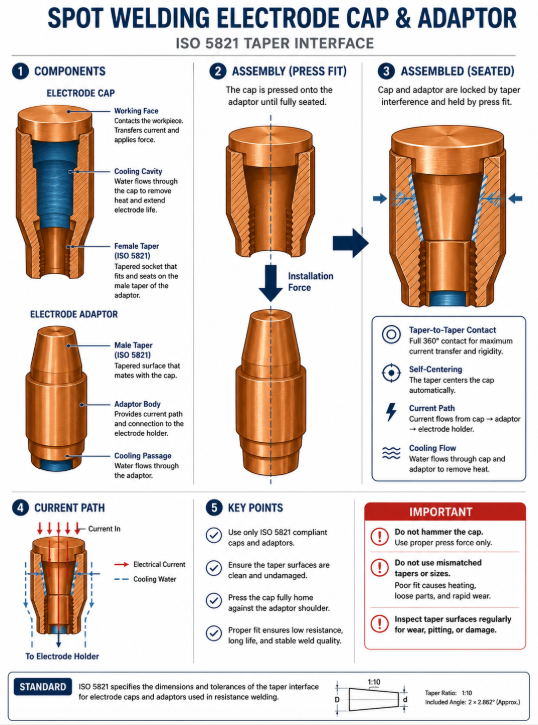
A crucial part of what makes electrode caps practical is standardization — caps and adaptors are dimensioned to standards so they interchange, and the fit between them is a taper. Understanding this is key to specifying caps that fit your machine.
Electrode caps are covered by the international standard ISO 5821 (and its identical German edition DIN EN ISO 5821), which specifies the dimensions and tolerances of spot welding electrode caps, using a female taper to fix the cap to an electrode adaptor. The cap has a female (internal) taper; the adaptor has a matching male taper; pressing them together makes a tight, self-holding, electrically-sound joint. Common cap diameters in the standard include 13, 16, and 20 mm, with taper ratios of 1:10 (and a 1:9.6 variant), and the adaptor tapers are covered by the companion ISO 5183 standards.
The taper fit is elegant: it locates the cap precisely, holds it firmly under the pressing force of welding, conducts current across a large mating surface, and yet releases when you deliberately pull the cap for replacement. This is what allows quick cap changes while keeping a solid connection during welding. Because these dimensions are standardized, caps from the standard range fit standard adaptors — which is what makes caps an interchangeable, widely-available consumable rather than a machine-specific part.
Matching the cap to your machine. In practice, specifying a cap means matching its taper and diameter to your electrode adaptor and machine. A cap has to fit the taper your adaptor uses; get that right and the cap seats correctly, conducts well, and holds. This is why we match caps to the customer’s machine and adaptor — the cap has to fit the taper it seats on, and matching that is fundamental to a cap that works.
The taper fit deserves emphasis because it’s where a surprising number of cap problems originate. A cap and adaptor with mismatched or worn tapers don’t mate over their full surface — and a poor taper contact means the cap can loosen under welding force, conduct current across a reduced area (creating local heating at the interface), or sit slightly off-axis so the face doesn’t meet the work squarely. Each of these degrades welding in ways that look like other problems. So the taper is not a trivial dimension: it is the mechanical and electrical joint between cap and machine, and getting it matched correctly — the right taper ratio, the right diameter, clean mating surfaces — is what lets the cap seat solidly, carry current efficiently, and present its face correctly to the work. A cap that fits its adaptor properly is the starting point for everything the cap does.
Cap Material: CuCrZr and the Right Alloy
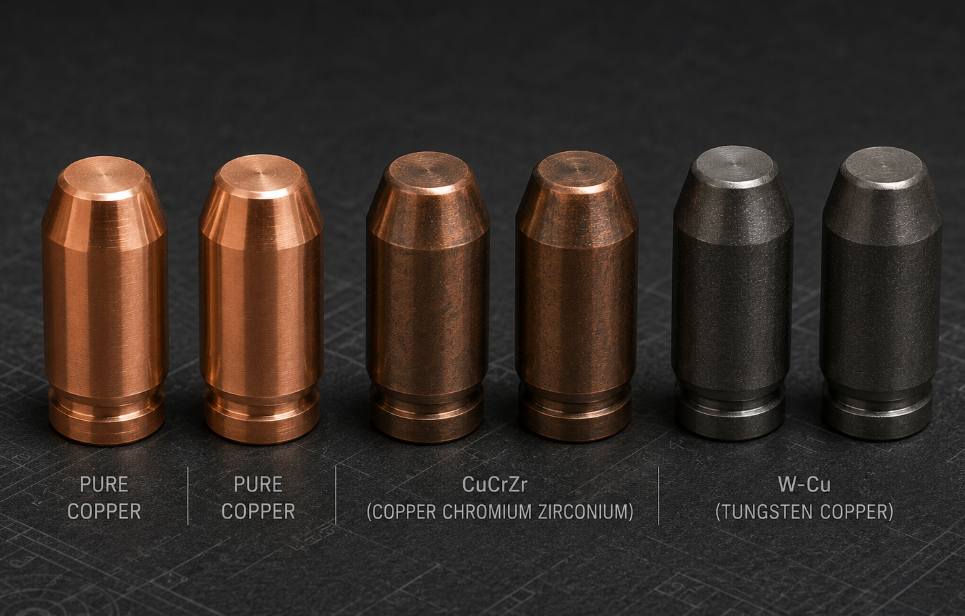
The cap’s material governs how well it conducts and how long it lasts, and for most spot welding the answer is CuCrZr. As the workhorse resistance-welding electrode material, CuCrZr (a copper-chromium-zirconium alloy) offers the combination of electrical and thermal conductivity, hardness, and heat resistance that spot welding caps need — conduct the current efficiently, resist the heat and pressure, and hold the face geometry against wear. Our CuCrZr vs pure copper article covers why this balance suits most steel welding.
The cap material (at least at the working face) needs to excel in thermal conductivity, electrical conductivity, and strength, which is exactly the CuCrZr balance. For most applications CuCrZr caps are the sensible standard; particular applications with unusual demands may call for different alloys, but CuCrZr is the reliable default for the bulk of spot welding.
Table 2 — Electrode Cap Specification Checklist
| Specification | What to Determine |
|---|---|
| Taper & diameter | Match your electrode adaptor / machine |
| Face shape | Suit your joint, access, and appearance |
| Face diameter | Related to weld size and material thickness |
| Material | CuCrZr for most; special alloys if needed |
| Standard vs custom | Standard (ISO 5821) for interchange; custom to drawing if needed |
The checklist is the specification in order: fit the machine first (taper/diameter), then the face (shape/diameter) to the weld, then the material. Answer these and the cap is specified correctly for your line.
How to Choose the Right Electrode Cap
Pulling the specifications together, choosing a cap follows a clear order of priorities.
First, fit the machine. The cap’s taper and diameter must match your electrode adaptor — this is non-negotiable, since a cap that doesn’t fit the taper can’t seat or conduct properly. Start here, from your machine’s adaptor.
Second, choose the face shape for your application. Select the face shape — pointed, domed, flat, offset, truncated, or custom — based on your joint, the access your part allows, and any surface-appearance requirement. The face shape is chosen to suit what you’re welding and how you can reach it.
Third, match face diameter to the weld. The face diameter relates to the weld size needed and the thickness of the material — larger, thicker joints call for a different face diameter than thin, small welds. Match the face to the weld you need.
Fourth, specify the material. CuCrZr for the great majority of work; a special alloy only if your application specifically demands it.
Standardize where you can, customize where you must. Standard caps (to ISO 5821) give you interchangeability, availability, and easy replacement — a real advantage for a consumable. Where your application needs a face shape or geometry the standards don’t cover, a custom cap made to your drawing is the answer. Most lines run standard caps; the option to customize covers the rest.
Getting Caps That Fit Your Welding
Two real situations show cap selection in practice.
Choosing the face shape for the workpiece. For a customer whose welding wasn’t performing as needed, matching the cap face shape to the workpiece and joint improved the result — the right face for that application put the contact and the weld where they needed to be. Selecting the face to suit the work is often what turns marginal welds into good ones.
Matching caps to the machine and adaptor. For a customer needing caps suited to their specific welder, matching the cap’s taper and diameter to their machine’s adaptor gave a correct seat and connection — caps that fit the taper they run. Getting the fit right to the machine is the foundation everything else builds on.
Both cases reflect the article’s logic: fit the machine, then match the face to the work. A cap that fits the adaptor and suits the joint is a cap that welds well.
Choose the Cap That Fits Your Machine and Your Weld
An electrode cap is the replaceable working tip of a spot welding electrode, and choosing one comes down to a clear sequence: fit the taper and diameter to your machine’s adaptor, choose the face shape (pointed, domed, flat, offset, truncated, or custom) to suit your joint and access, match the face diameter to your weld, and specify CuCrZr for most work. Standard caps to ISO 5821 give interchangeability and easy replacement; custom caps to your drawing cover what standards don’t. Get the fit and the face right, and the cap does its job — conducting, pressing, and forming a sound weld, then swapping out cheaply when it’s spent.
Tell us your machine and adaptor (taper and diameter), your workpiece and joint, and the face shape or drawing you need, and we’ll supply CuCrZr spot welding electrode caps — standard or custom — matched to your welding. Browse our copper spot welding electrodes range, or send us your machine and application details and let’s get you caps that fit and weld right.
References
USPTO — Spot welding method (cap-type electrode structure, face shapes, cooling): https://image-ppubs.uspto.gov/dirsearch-public/print/downloadPdf/11772186
Spot Weld, Inc. — Electrode Configurer (cap face shapes and tapers): https://spotweldinc.com/products/electrode-configurer/
ISO 5821:2009 — Resistance welding, Spot welding electrode caps (dimensions, taper fit): https://www.iso.org/standard/45871.html
Share This Article
Latest Articles
October 20, 2026
October 20, 2026
October 20, 2026
October 20, 2026
October 20, 2026

October 20, 2026
October 20, 2026
October 20, 2026