CuCrZr vs Pure Copper Electrodes: Conductivity, Hardness & Cost

Our copper electrode line is built around CuCrZr, with pure copper as a deliberate minority — and that ratio is not a preference, it is what the physics of resistance welding hands to any manufacturer who matches material to application honestly. Yet we still field the same question weekly, from new buyers and veteran purchasing managers alike: “Pure copper conducts better, so why is the CuCrZr more expensive and why do you recommend it?” It is a fair question with a precise answer, and the answer explains most of what goes wrong when buyers choose between these two materials on a single spec-sheet number.
This comparison covers what each material actually is, where each genuinely wins, the two purchasing traps that catch buyers — fake CuCrZr and un-aged CuCrZr — and the cost arithmetic that matters more than the quote. Three real cases from our own records are included, one of which involved a composition test that ended a supplier relationship and solved a “process problem” that had resisted months of troubleshooting.
What CuCrZr and Pure Copper Electrodes Actually Are
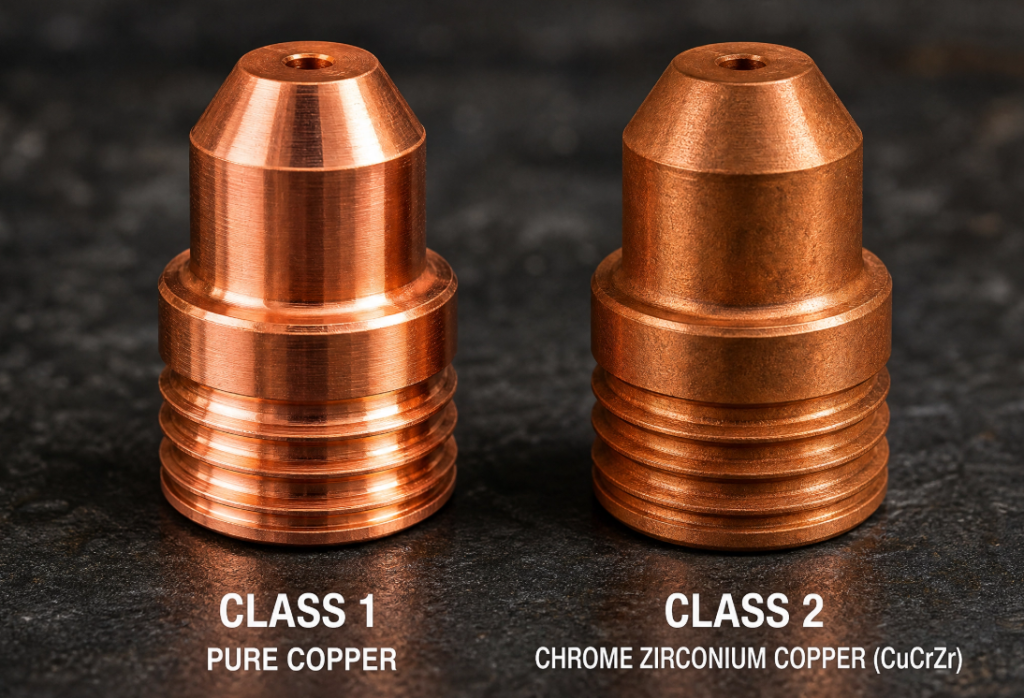
Both materials live inside the RWMA classification system that the resistance welding industry uses to specify electrode alloys. The two relevant classes draw the line cleanly: Group A Class 1 covers high-conductivity materials recommended for welding aluminum and magnesium alloys, while Class 2 covers materials with somewhat lower conductivity but higher mechanical properties — the general-purpose electrode class, which is where CuCr and CuCrZr live, as laid out in patent literature documenting the RWMA class definitions.
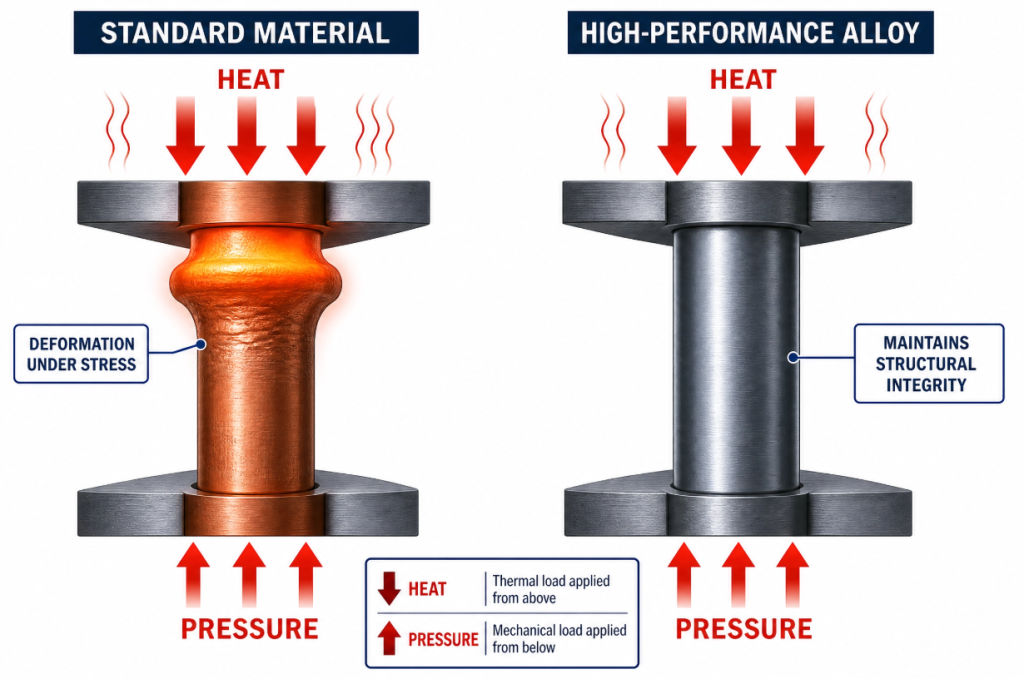
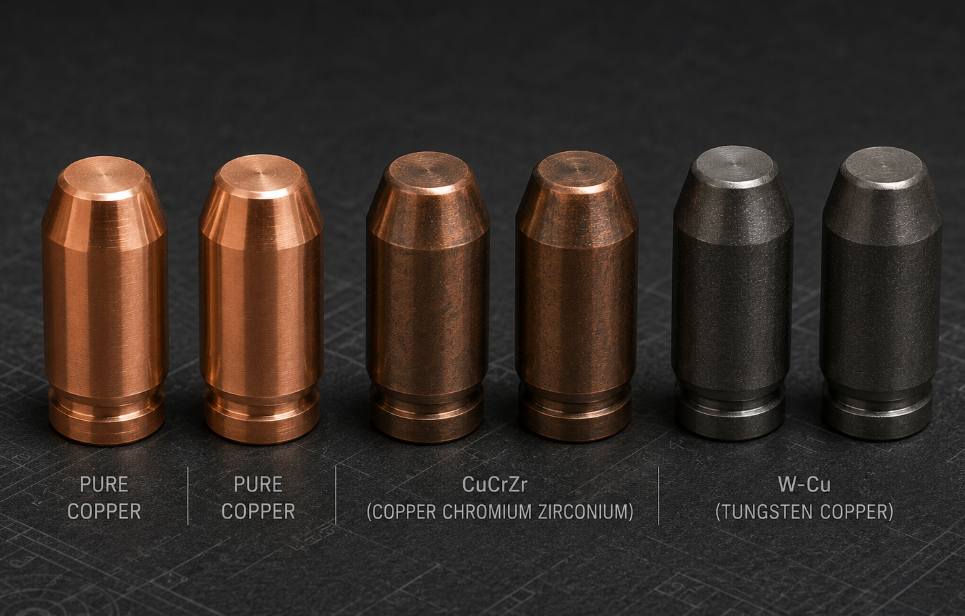
Pure copper (and near-pure grades like oxygen-free copper) is the conductivity champion — up to around 97% IACS or higher. Current flows through it with minimal resistance, which means minimal self-heating in the electrode body. Its weakness is the flip side of its purity: nothing in the metal resists softening. Heat it, press on it, and it deforms.
A quick aside on IACS, since the rest of the article leans on it: the International Annealed Copper Standard sets soft pure copper at 100%, and every conductor is expressed as a percentage of that benchmark. The number matters here for one practical reason — it lets you read a material certificate at a glance. A bar claiming high-90s conductivity is in pure-copper territory and will behave like it under heat and force; a bar in the high-70s to mid-80s is in alloy territory and should be expected to hold its face on a steel line. When the claimed class and the claimed conductivity contradict each other on the same document, that contradiction is itself the finding.
CuCrZr — chromium zirconium copper — sacrifices a slice of that conductivity to buy mechanical survival. Small additions of chromium and zirconium, activated by an aging heat treatment, form fine precipitates throughout the copper matrix that block deformation. The Copper Development Association notes that hardened chromium coppers retain conductivity around 80% that of pure copper while gaining the strength that lets RWMA Class II electrodes resist compression and mushrooming at operating temperatures and pressures. That trade — roughly a fifth of the conductivity for several times the hot strength — is the entire story of this comparison.
CuCrZr vs Pure Copper: The Head-to-Head Numbers
| Property | Pure Copper (Class 1 type) | CuCrZr (RWMA Class 2) |
|---|---|---|
| Electrical conductivity | ~97%+ IACS — highest | ~75–85% IACS |
| Hardness / strength | Low; very low when hot | High; retained at temperature |
| Softening resistance | Poor — deforms readily when hot | Strong — precipitates resist deformation |
| Strength at ~200 °C | Roughly half that of chromium copper | Retains working strength |
| Mushrooming on steel | Rapid | Slow, manageable with dressing |
| Best-fit workpiece | Aluminum, magnesium, high-conductivity metals | Steel, coated steel, general production |
| Relative unit price | Lower | Higher |
The 200 °C row deserves emphasis because it is where buyers’ intuition fails. Electrode tips on a steel line run hot as a matter of course, and at those working temperatures pure copper’s strength collapses to roughly half that of chromium copper alloys — a gap documented plainly in electrode patent literature comparing the materials. On paper, at room temperature, pure copper looks merely “softer.” On a working electrode at temperature, it behaves like a different, far weaker material.
Why CuCrZr Wins on Steel
Welding steel is a hot business for the electrode. Steel’s electrical resistance is high relative to copper, so the joint generates abundant heat, and the electrode face soaks in it cycle after cycle. What the electrode needs most in that environment is not maximum conductivity — Class 2 conductivity is ample for steel — but the ability to stay hard while hot.
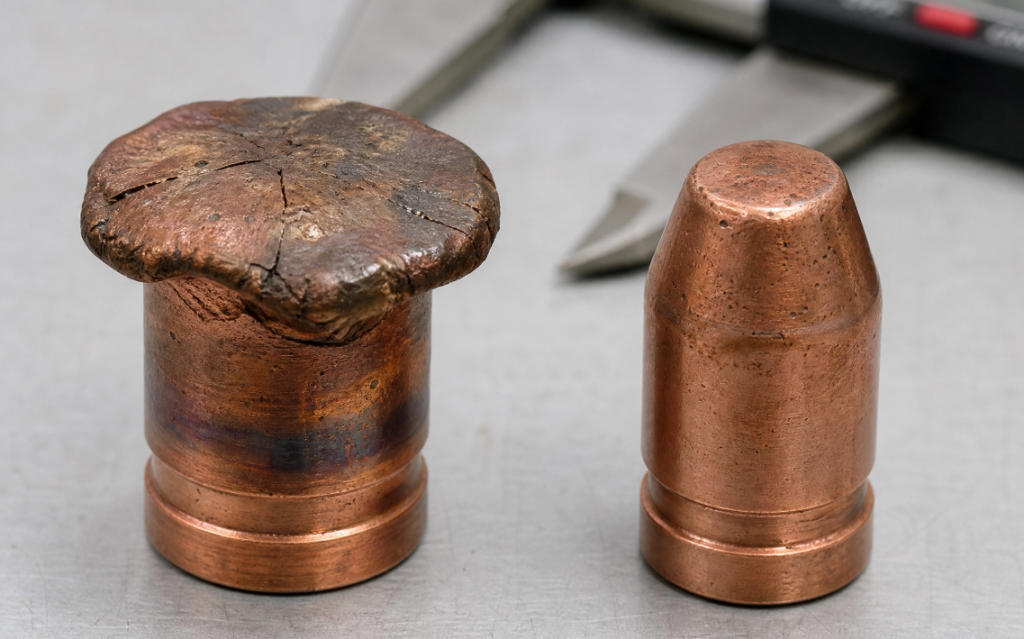
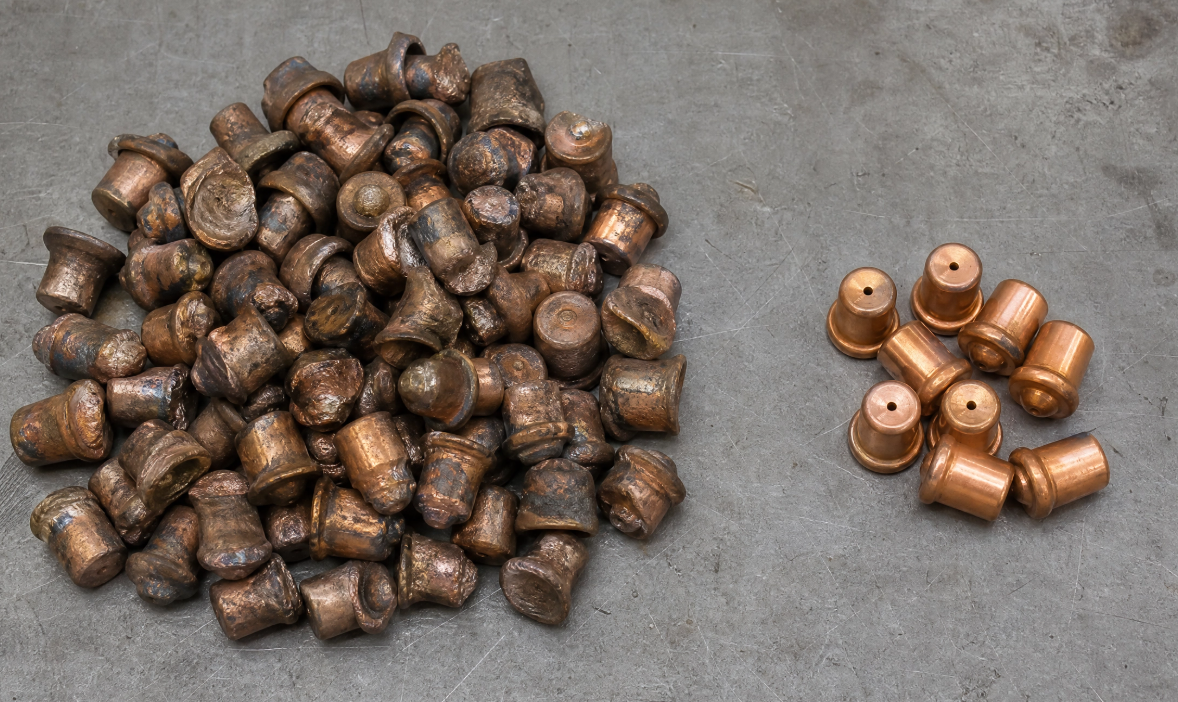
This is where the pure-copper-on-steel mistake plays out, and we have watched it from the supplier side more than once. A buyer chooses pure copper caps for a steel line — sometimes on price, sometimes on the intuition that more conductivity must be better. The caps mushroom at startling speed: the soft face spreads under electrode force, current density falls, someone raises the current, the face runs hotter and spreads faster. The spiral we described in our article on why electrodes wear out too fast plays at double speed because the material has no hot strength to push back.
A real case from our records: a customer running steel sheet came to us burning through soft copper caps at a rate their consumable budget could not survive. The caps were mushrooming within a fraction of a normal service interval. We supplied properly aged CuCrZr caps in the same geometry — no other change to the line — and electrode life improved by multiples, not percentages. The customer had not been buying cheap caps; they had been buying the wrong material for steel, and the unit price they saved was repaid many times over in replacement frequency and downtime.
The conductivity CuCrZr “gives up” is, on steel, not a loss at all. The joint needs resistance to generate weld heat; the electrode’s job is to deliver current, apply force, and survive. Class 2 delivers all three.
It is worth spelling out the precipitation mechanism in plain terms, because it explains why the alloy holds where pure metal yields. In soft copper, the atoms sit in a relatively uniform lattice; when heat loosens that lattice and force pushes on it, planes of atoms slide past each other easily, and the face spreads. In the aged alloy, billions of microscopic chromium and zirconium particles sit dispersed through the lattice like gravel in the path of those sliding planes. Each particle is an obstacle a dislocation must climb over or cut through, and at electrode working temperatures the obstacles hold. The result is a material that conducts nearly as well as copper — the matrix is still copper — but resists the slow plastic flow that turns a precise face into a mushroom. The aging treatment is what creates that gravel; the chemistry merely supplies the ingredients. That is the metallurgical reason both purchasing traps below exist: chemistry without aging gives you ingredients without obstacles, and no chemistry at all gives you neither.
Where Pure Copper Electrodes Genuinely Win
An honest comparison requires the other column, and pure copper has real territory — our own product mix includes it for exactly these uses.
Welding aluminum and high-conductivity alloys. Aluminum flips the thermal logic. The workpiece itself conducts so well that generating weld heat is the challenge, and every bit of resistance in the circuit matters. Class 1 high-conductivity materials are the recommended choice for aluminum and magnesium precisely because the application demands maximum current delivery with minimum electrode-side losses. A real case: a customer struggling with inconsistent aluminum welds had been running Class 2 caps because that was what their steel lines used. Switching the aluminum stations to high-conductivity electrodes improved nugget consistency immediately — the same logic as the steel case, mirrored. Matching material to workpiece runs in both directions.
The aluminum case repays a closer look, because it shows how a sensible-sounding standardization decision becomes a quiet quality problem. The plant had standardized on one cap material across all stations — a defensible-looking move for inventory simplicity — without registering that one cell welded a fundamentally different metal. On aluminum, the lower-conductivity caps were leaving less margin in the weld window: heat generation depended more heavily on parameters being exactly right, so normal variation that a steel joint would absorb showed up as inconsistent nuggets. Nobody connected the inconsistency to the cap material for months, because the caps were “good caps” — and they were, on the lines they were designed for. The general lesson: standardize consumables across stations that do the same job, never across stations that merely look the same.
Specialized seam welding wheel applications. Certain seam welding setups benefit from the conductivity and thermal behavior of purer copper grades, and we supply wheels accordingly when the application calls for it. Seam welding’s continuous rolling contact distributes heat and force differently than spot welding’s point contact, which shifts the material trade-off enough that the purer grade earns its place in specific wheel applications — a judgment made per application rather than by default.
Customer specification and standardization. Some buyers specify pure copper by drawing or by long-standing practice. Where the specification is deliberate and the application suits it, that is a legitimate reason; where it is habit inherited from a line that once welded different material, it is worth revisiting — politely, with the table above in hand, and ideally with a short logged trial that lets the numbers make the argument instead of the supplier.
What pure copper does not win is general steel production. If your workpiece is steel and nobody can articulate why the caps are pure copper, the material is costing you money every shift, and the cost compounds silently with every cap change.
The Aging Heat Treatment Trap: Un-Aged CuCrZr
Here is a failure mode subtler than fake material, and one many buyers have never heard of: genuine CuCrZr that was never properly aged. CuCrZr earns its hot strength through precipitation hardening — a controlled aging heat treatment that brings the chromium and zirconium out of solution as fine strengthening particles. Skip or botch that treatment and the chemistry is correct but the microstructure is not: the bar tests right on a composition report and still behaves like soft copper at the tip, because the precipitates that resist deformation were never formed.
This matters for buyers in two ways. First, it explains a confusing failure pattern: caps that pass composition verification yet mushroom like pure copper. If you ever see that combination, ask about the heat treatment condition, not the chemistry. Second, it means a composition certificate alone does not fully verify a CuCrZr electrode — the material’s condition (solution treated and aged) is part of the specification. A manufacturer who controls its own heat treatment, or buys certified aged stock, can state that condition plainly. We make a point of doing so, because we have seen un-aged bar circulating in the market priced as the real thing.
How does un-aged bar end up in the supply chain at all? Usually not through deliberate fraud but through shortcuts and ignorance compounding. The alloy is supplied in different conditions — solution treated, aged, or various intermediate states — and somewhere between the mill, a stockist, and a small machining shop, the condition gets lost from the paperwork or was never understood to matter. A workshop that machines caps from whatever bar arrived, without verifying or performing the aging step, produces parts that are chemically honest and mechanically wrong. The buyer downstream has no chance of catching this from the certificate. The practical defenses are simple to state: buy from a maker who can name the condition of the bar and the treatment it received, and if a batch behaves soft despite correct chemistry, a hardness test — far cheaper than composition analysis — will expose the condition problem in minutes, because aged and un-aged material sit far apart on a hardness scale even when their chemistry is identical.
The Fake CuCrZr Trap: When the Label Lies
The blunter version of the same fraud is material substitution — plain or low-grade copper sold under the CuCrZr name. The economics invite it: the alloy commands a premium, the substitution is invisible to the eye, and the failure arrives weeks after payment. We covered how to vet against this in our supplier selection checklist, and this is the product category where that vetting earns its keep.
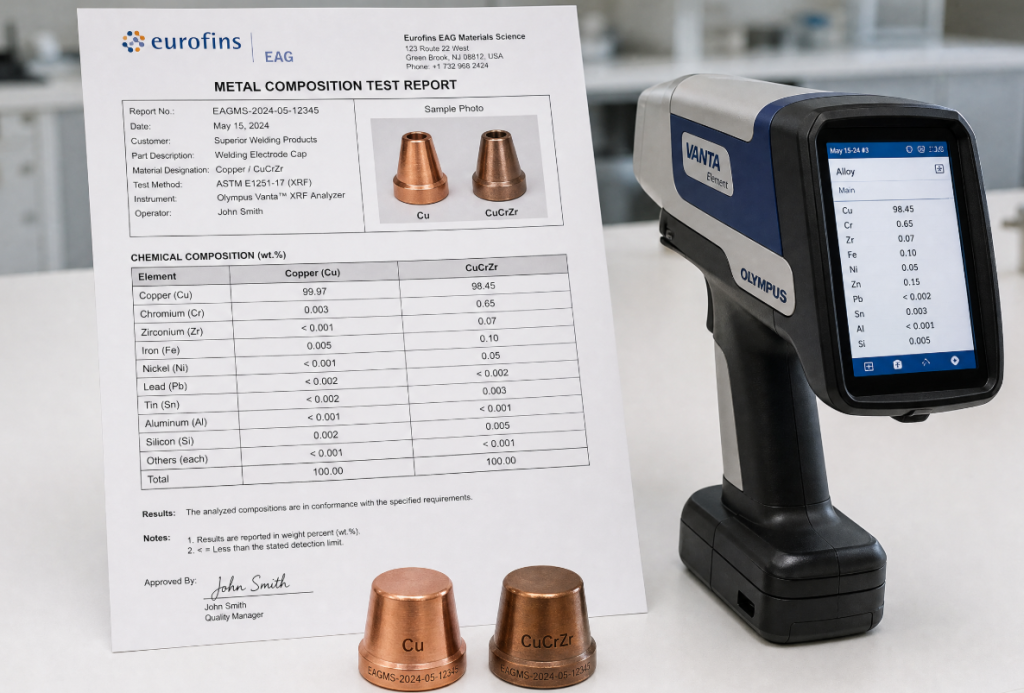
A real case from our records: a prospective customer brought us caps from their existing source that were failing far too fast, suspecting a process problem. We had the material composition tested alongside our own CuCrZr. The result was unambiguous — the “CuCrZr” caps showed essentially none of the specified alloying content. They were ordinary copper wearing a premium label. The composition report settled in one page what months of process troubleshooting could not, the customer changed suppliers, and their “process problem” disappeared with the fake material. The lesson generalizes: when electrode life defies process explanations, test the material. The test is cheap; the months of misdiagnosis are not.
What made this case instructive was how long the fraud survived scrutiny. The customer was not careless — they had reviewed parameters, checked cooling, retrained operators, and adjusted dressing schedules, each intervention producing a brief illusion of improvement before the failures resumed. Every investigation assumed the material was what the invoice said, because questioning that felt like an accusation. The composition test reframed it: verification is not an accusation, it is bookkeeping. Honest sellers pass it without friction, and the single page it produces either closes the question forever or answers it instantly. Either outcome beats another month of chasing a process ghost.
CuCrZr vs Pure Copper Cost: Unit Price vs Cost Per Weld
The price gap between the two materials tempts a simple conclusion — pure copper is cheaper — that survives exactly until the first service-life
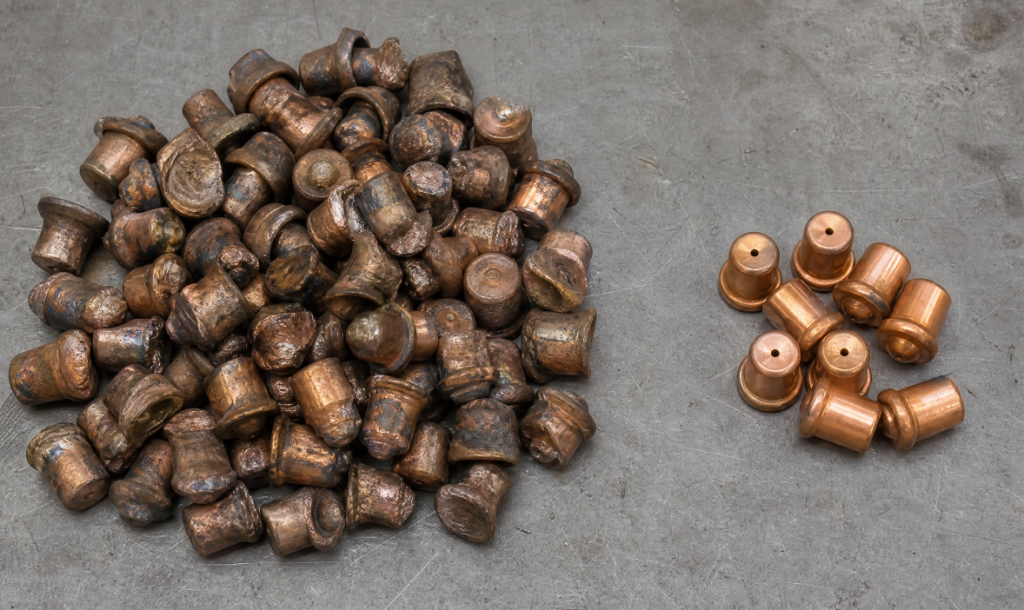
comparison on steel.
| Cost Factor | Pure Copper on Steel | CuCrZr on Steel |
|---|---|---|
| Unit price per cap | Lower | Higher |
| Caps consumed per 10,000 welds | Many — rapid mushrooming | Few — slow face growth |
| Dressing frequency | Constant | Scheduled, moderate |
| Unplanned downtime from cap changes | Frequent | Rare |
| Effective cost per weld | High | Low |
On steel, the cheaper cap is the more expensive consumable, often by a wide margin, once replacement frequency and downtime enter the arithmetic. On aluminum, the table flips in pure copper’s favor — not on price, but because the right material makes welds the wrong one cannot make consistently. In both directions the principle holds: the material matched to the workpiece is the cheap one, whatever the unit prices say.
For buyers who need to make this case internally — to a purchasing department scoring quotes on unit price — the persuasive number is consumption over a fixed production volume, because it converts material behavior into a line item. Take your monthly weld count, divide by realistic cap life for each material on your workpiece, multiply by unit price, and add an honest estimate for the downtime each unplanned cap change costs. On a steel line, that simple spreadsheet almost always shows the premium alloy paying for itself within the first month, with everything after that as savings. The exercise has a second benefit: it forces the cap-life numbers onto paper, and once a line starts logging cap life to feed the spreadsheet, every other consumable decision — dressing intervals, supplier trials, parameter changes — inherits real data to stand on.
How to Choose Between CuCrZr and Pure Copper: A Short Path
- What do you weld? Steel or coated steel → CuCrZr. Aluminum or magnesium → high-conductivity Class 1 type. Mixed lines → match per station, not per plant.
- Verify the alloy. Composition report with the goods — and for CuCrZr specifically, confirm the aged heat-treatment condition, not just the chemistry on paper.
- Sanity-check the price. A CuCrZr quote far below the market cluster is telling you about the metallurgy, not your negotiating skill.
- Trial against your incumbent. Same gun, same parameters, logged weld counts. The material that belongs on your line will prove it in numbers within weeks.
A fifth, optional step for mixed plants: walk the floor with the table above and audit what each station actually runs versus what it welds. In our experience this ten-minute audit surprises someone at most plants — a cap material inherited from a discontinued product line, an aluminum cell running steel-line caps, a “temporary” substitution that became permanent years ago. The mismatches hide in plain sight precisely because caps all look alike from a meter away.
Final Thoughts on CuCrZr vs Pure Copper
The CuCrZr versus pure copper question has a clean answer once it is asked correctly. The question is not “which material is better” — it is “what does my workpiece demand from the electrode?” Steel demands hot strength, and the aged alloy’s microstructure supplies it; aluminum demands conductivity, and pure copper supplies that. The expensive mistakes in this category are not really material choices at all — they are mismatches: soft copper fighting steel, Class 2 starving an aluminum joint, un-aged bar impersonating aged bar, and plain copper impersonating the alloy entirely. Every one of those mismatches is preventable with the table above and a single verification habit.
If you are specifying caps, shanks, or seam wheels now, tell us what you weld, your current material, and what your caps look like when they die. From those three details we can usually tell you whether you have a material mismatch, a quality problem, or a process issue — and quote the right alloy in the right condition either way. Browse our copper spot welding electrodes range, or send the details and start from a diagnosis instead of a catalog page. Either path ends the same place: an electrode whose metallurgy matches the metal it has to weld, which is the only version of “the right electrode” that survives contact with a production line.
Share This Article
Latest Articles
October 20, 2026
October 20, 2026
October 20, 2026
October 20, 2026
October 20, 2026
October 20, 2026
October 20, 2026
October 20, 2026