7 Reasons Your Spot Welding Electrodes Wear Out Too Fast

“Your electrodes don’t last.” We hear this complaint regularly from welding shops and production engineers — sometimes about a competitor’s product, sometimes, frankly, aimed squarely at us before we investigate the actual line. And here is what years of tracing these complaints back to root causes has taught our factory: in the large majority of cases, the electrode itself is not the problem. Something in the process is killing it early, and swapping brands without fixing that something just produces the same short life with a different logo on the box.
This article walks through the seven causes of premature electrode wear we actually find when we investigate, roughly in the order we find them. For each one, you will get the symptom to look for, the mechanism behind it, and the fix. Several are illustrated with real cases from our own customers — including ones where the “bad electrode” turned out to be a blocked cooling line or a dressing schedule nobody was following. If your caps are dying in hundreds of welds instead of thousands, the culprit is almost certainly on this list.
Why Electrode Wear Diagnosis Matters Before You Switch Brands
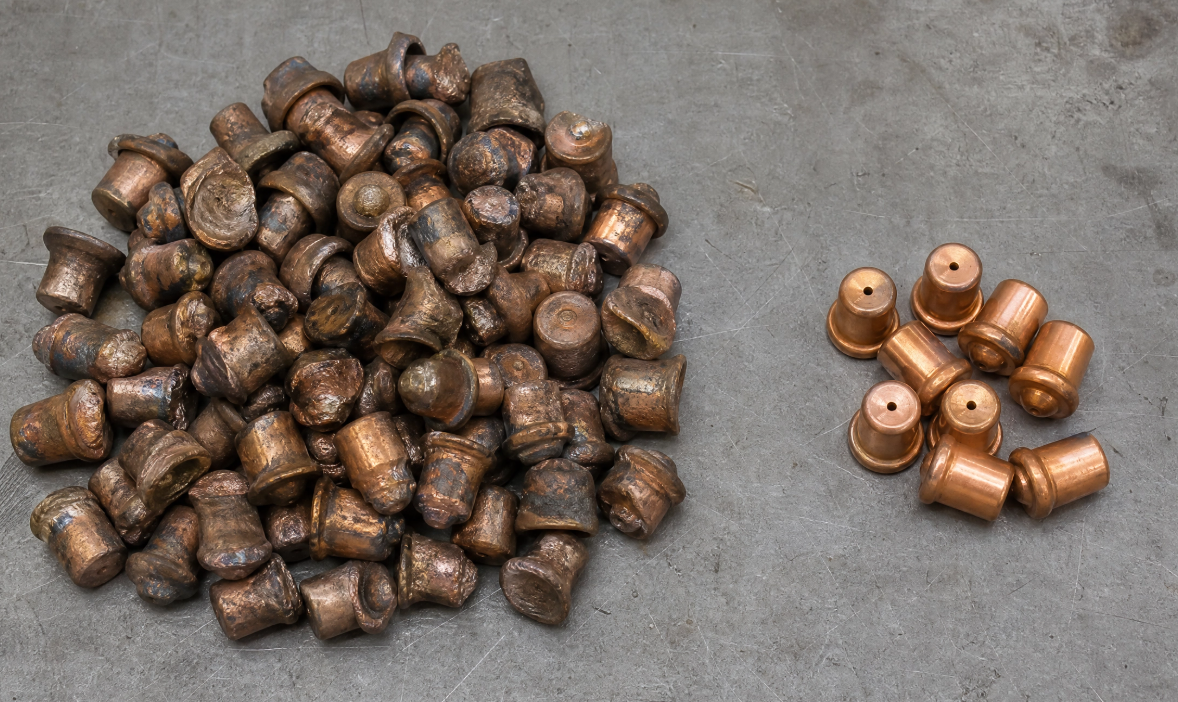
Premature electrode wear is expensive twice over: once in consumable cost, and again — usually far more — in downtime, weld quality drift, and inspection burden. But the most expensive response is misdiagnosis. A shop convinced it has a material problem will cycle through suppliers for months while the true cause, often a process issue, keeps grinding away. Before changing anything, look at how the electrodes are failing. Mushroomed faces, brassy discoloration, heat-blued shanks, and craters each point to different culprits, and the seven sections below map those symptoms to causes.
One honest note up front: cheap, substandard electrodes genuinely are one of the seven causes — we see them often. But they are one of seven, not the default explanation. The diagnostic mindset is what saves money.
Reason 1: Insufficient Cooling Water Flow Accelerates Electrode Wear
This is one of the most common root causes we confirm, and the most invisible. A spot welding electrode is designed to dump heat into cooling water flowing through its internal passage. When flow is inadequate — a kinked hose, a partially blocked passage, scale buildup, a cooling tube set too far from the tip’s internal cavity — tip temperature climbs with every weld. Hot copper softens. Soft copper deforms under electrode force, the face grows, current density drops, someone turns the current up to compensate, and the electrode now runs even hotter. The spiral ends with caps that mushroom in a fraction of their rated life.
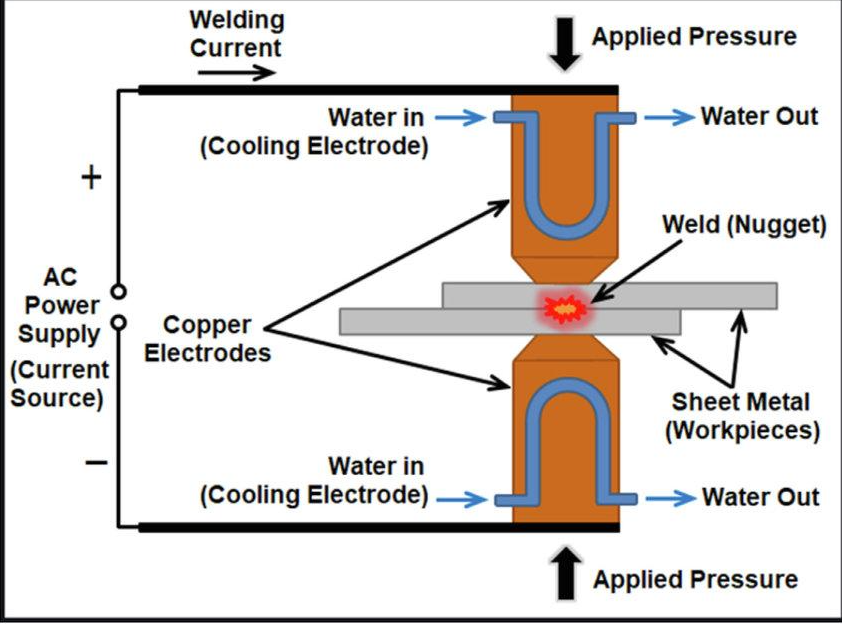
Symptoms: heat discoloration (blue/purple) on the cap or shank, rapid mushrooming, water that exits barely warm or barely flows.
The fix: verify actual flow rate at each gun, not just at the pump; check that internal cooling tubes are cut to the correct length and positioned close to the tip cavity; descale or replace blocked lines.
A real case from our records: a customer complained our caps were failing at a fraction of expected life on one specific gun while identical caps on neighboring guns ran fine. That asymmetry was the clue. Inspection found the cooling circuit on the problem gun nearly blocked. After the water line was cleared, electrode life on that gun recovered to match the others — same electrodes, several times the life. The lesson: when one station eats electrodes faster than its twins, suspect water before metal.
Reason 2: Welding Galvanized or Coated Sheet Causes Brass Alloying and Electrode Wear
If you weld galvanized steel — and most of our automotive and appliance customers do — zinc is attacking your electrodes chemically on every single weld. Zinc melts far below welding temperature, and molten zinc has a strong affinity for copper. It alloys with the electrode face to form a layer of brass, which is softer and more electrically resistive than the parent copper. The brass layer grows, deforms, extrudes, and picks up material, degrading both the electrode and the weld. Research on zinc-coated steels confirms that electrode wear is significantly more aggressive than on uncoated sheet precisely because of this brass formation on the electrode tip face.
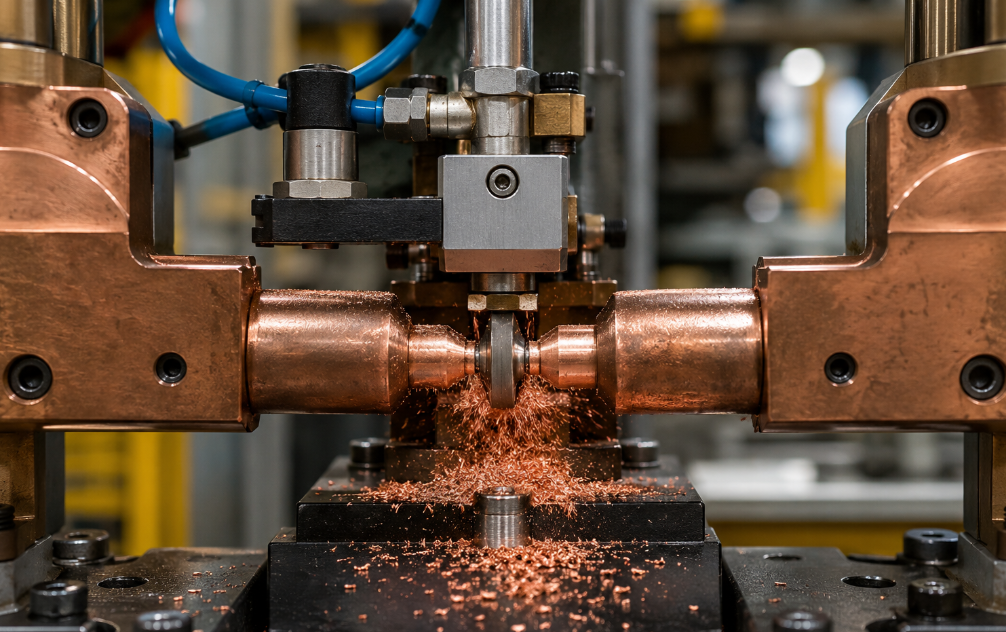
Symptoms: yellowish, brassy discoloration on the cap face; material pickup; electrode sticking to the panel; faster face growth than the same caps show on bare steel.
The fix: you cannot eliminate zinc alloying — it is chemistry — but you can manage it: dress more frequently on galvanized lines than bare-steel schedules suggest, keep cooling at full effectiveness so the brass layer stays thin, and accept that coated sheet simply consumes caps faster. Plan the consumable budget around that reality instead of fighting it.
Bare cold-rolled and hot-rolled steel, by contrast, is the gentlest material on caps — if your electrodes wear out fast on uncoated sheet, look hard at the other six reasons, because the material is not the explanation.
It is also worth knowing that not all zinc coatings punish caps equally. Hot-dip galvanized sheet carries free zinc that readily melts and alloys with copper, while galvannealed coatings are a zinc-iron alloy with little free zinc, which changes how the face degrades. Electro-galvanized sheet behaves differently again, with a thinner and more uniform layer. If your plant runs several coated grades, do not expect one dressing interval to suit them all — the heaviest free-zinc coating on the schedule should set the dressing pace, or better, each grade should earn its own interval from logged cap life.
Reason 3: Late or Incorrect Tip Dressing Shortens Electrode Life
Tip dressing exists to restore face geometry before deformation becomes self-accelerating. Two failure patterns show up constantly in our investigations: dressing too late, and dressing wrong.
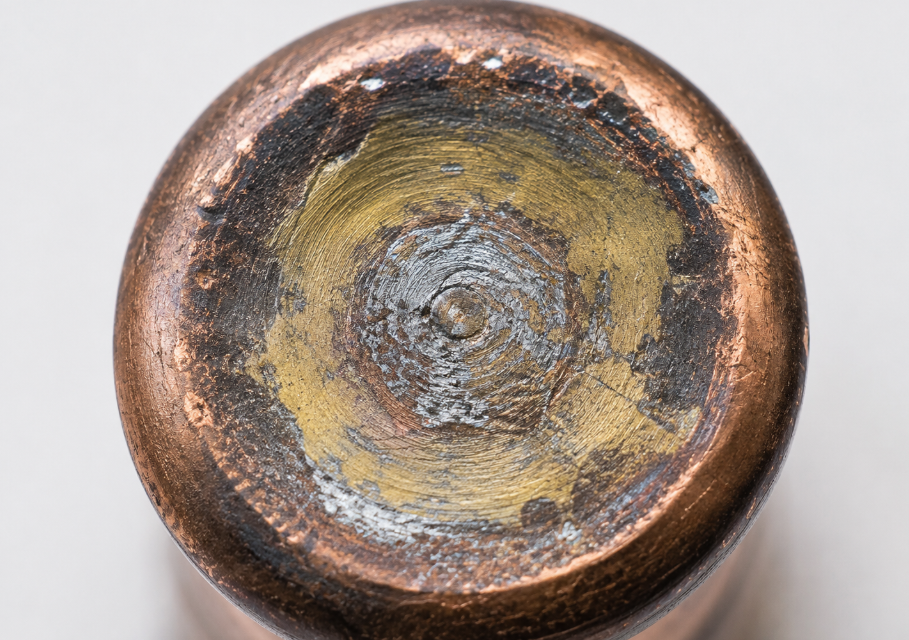
Dressing too late lets the face grow past the point of easy recovery. Once the contact area has expanded well beyond spec, current density has already fallen, heat input has already risen, and the cap has accumulated deep alloyed and deformed material that a light dress cannot remove. Dressing wrong — freehand filing, wrong cutter profile, excessive removal per dress — either fails to restore proper geometry or eats the cap so fast that dressing itself becomes the main consumption mechanism.
Symptoms: weld quality that degrades in a sawtooth pattern (good after dress, bad before); caps that look polished but mis-shaped; dressing intervals set by habit rather than weld count.
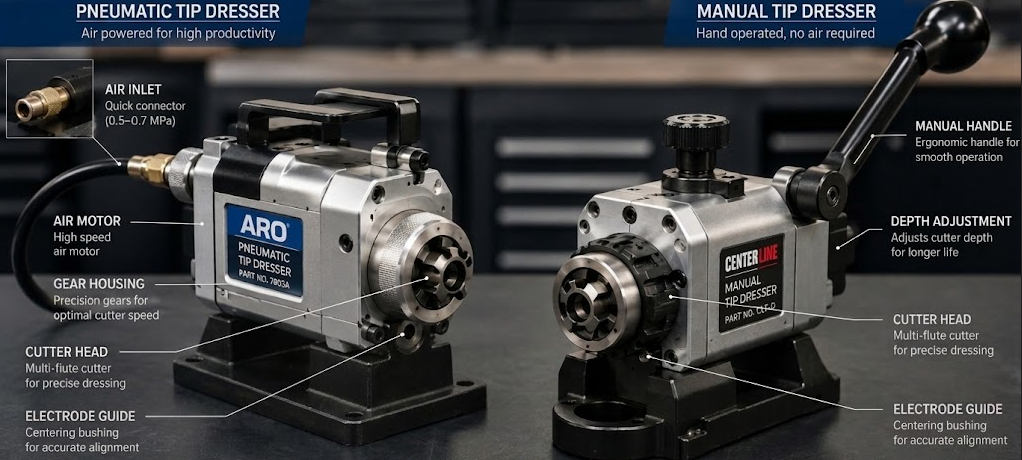
The fix: dress on a schedule tied to weld count, not to visible damage; use a proper dresser with the correct cutter profile for your cap geometry rather than hand methods; remove the minimum material that restores the face.
A real case from our records: a customer running manual, irregular dressing switched to a pneumatic dresser on a fixed weld-count interval. No other change — same electrodes, same parameters, same panels. Electrode life improved markedly, and weld quality complaints from their downstream assembly dropped at the same time. The electrodes had never been the issue; the maintenance habit was.
Reason 4: Substandard Electrode Material Wears Out Prematurely
Now the cause that actually is about the electrode. The market is full of cheap caps and shanks sold as “Class 2” that are not honest CuCrZr — wrong alloy ratios, poor heat treatment, even plain copper passed off as chromium zirconium copper. Genuine CuCrZr earns its place through a precise balance of conductivity, softening resistance, and hardness, and the American Welding Society’s guidance on electrode materials explains why Class 2 alloys are the standard choice for most steel spot welding. A bar that skipped proper alloying or aging heat treatment softens at lower temperature, mushrooms early, and erodes fast — and you cannot see any of that by looking at a shiny new cap.
Symptoms: new caps from a low-price source dying much faster than the previous brand under identical process conditions; rapid mushrooming even with verified good cooling; inconsistent life cap-to-cap within the same batch.
The fix: buy from a source that can state the alloy designation and back it up; be suspicious of prices dramatically below market for “the same” material — in copper alloys, a dramatically lower price almost always means different metallurgy, not a better deal.
A real case from our records: a customer came to us after a stretch of bargain-priced caps that mushroomed within a few hundred welds. Switching to our CuCrZr caps with no process changes, their electrode life multiplied. We do not pretend our caps defy physics — they simply are the alloy they claim to be, properly heat treated, and the comparison made the difference visible.
Reason 5: Excessive Welding Current and Poor Parameters Drive Electrode Wear
Every electrode has a thermal budget. Current set higher than the joint needs, weld time longer than necessary, or insufficient electrode force (which raises contact resistance and interface heat) all spend that budget faster. Excess current is especially destructive because heating scales with the square of current — a modest increase in amps is a large increase in tip heat. Expulsion (weld splash) is the visible flag: metal violently ejected from the joint means energy input beyond what the nugget can absorb, and that same excess energy is cooking your caps.
Symptoms: frequent expulsion; caps eroding centrally (cratering) rather than just mushrooming; parameters that were “turned up to fix cold welds” and never reviewed.
The fix: establish parameters from a proper weld schedule for your stack-up rather than inherited settings; treat persistent expulsion as a parameter alarm, not a cosmetic nuisance; when welds run cold, check face condition and cooling before reaching for the current knob — turning up amps to compensate for a mushroomed face is the classic vicious cycle.
That vicious cycle deserves spelling out, because it quietly destroys caps on lines everywhere. It begins innocently: weld quality drifts because the cap face has grown, an operator raises the current to bring nugget size back, and quality recovers — for a while. But the extra current heats the cap more, the face grows faster, quality drifts again, and the current goes up again. Each turn of the knob treats the symptom and feeds the disease. By the time the cap is finally changed, the machine is running far above the parameters the joint actually requires, and the next cap inherits those settings and dies even faster than the first. Breaking the cycle is simple but requires discipline: when quality drifts, the first response is dress or replace the cap and verify cooling — and only adjust current from a freshly dressed, properly cooled baseline. Shops that adopt this one rule often see consumable usage fall without touching anything else.
Reason 6: Electrode Misalignment and Skewed Force Cause Uneven Electrode Wear
Honesty requires a note here: in our own investigation records this cause appears less often than the five above — but when it appears, it is unmistakable, and other shops’ experience suggests it deserves its place on the list. When upper and lower electrodes are not coaxial, or the gun arms deflect under force, contact pressure concentrates on one edge of the face. That edge overheats and deforms first, the face wears into a slope, and current density becomes uneven, degrading both cap life and nugget quality.
Symptoms: asymmetric wear — one side of the face mushroomed or eroded while the other looks fresh; elliptical instead of round wear patterns; visible arm deflection on large guns at force.
The fix: check electrode alignment at installation and after any gun maintenance; inspect carbon-paper or pressure-film impressions for off-center contact; on aging guns, verify arms are not bending under force.
Reason 7: Cycle Rates Too Fast for Heat Recovery Increase Electrode Wear
The final reason is duty cycle. Each weld deposits heat into the cap; the interval between welds is when cooling water removes it. Push the cycle rate high enough and heat extraction cannot keep pace, so tip temperature ratchets upward weld after weld until the copper runs continuously soft. Like Reason 6, this shows up less frequently in our own case log than the top five — most of our customers’ lines respect their thermal limits — but on high-speed lines chasing output, it is worth ruling out.
Symptoms: electrode life that drops noticeably after a line speed increase; caps fine on slow shifts and dying on fast ones; heat discoloration despite verified good water flow.
The fix: if a speed increase preceded the wear increase, the math is telling you something — either restore the interval, upgrade cooling capacity, or accept and budget for the shorter cap life that the higher output costs.
Electrode Wear Causes at a Glance
| # | Cause | Telltale Symptom | Primary Fix |
|---|---|---|---|
| 1 | Insufficient cooling water | Heat discoloration, fast mushrooming | Verify flow at each gun, clear blockages |
| 2 | Galvanized / coated sheet alloying | Brassy face, sticking, pickup | More frequent dressing, full cooling |
| 3 | Late or incorrect dressing | Sawtooth quality, deformed faces | Weld-count dressing schedule, proper dresser |
| 4 | Substandard electrode material | Fast failure under good conditions | Verified CuCrZr from an honest source |
| 5 | Excess current / poor parameters | Expulsion, cratering | Proper weld schedule, treat expulsion as alarm |
| 6 | Misalignment / skewed force | Asymmetric, sloped wear | Alignment checks, pressure-film impressions |
| 7 | Cycle rate beyond heat recovery | Life drops after speed increase | Restore interval or upgrade cooling |
How the Material You Weld Changes Electrode Wear
Because our electrode customers span bare steel, galvanized sheet, stainless, and aluminum, here is how the workpiece itself shifts the wear picture — useful context before you judge whether your cap life is actually abnormal.
| Material Welded | Dominant Wear Mechanism | What to Expect |
|---|---|---|
| Bare cold/hot-rolled steel | Plain thermal-mechanical wear | Longest cap life; baseline case |
| Galvanized steel | Zinc–copper brass alloying | Markedly shorter life; dress more often |
| Stainless steel | High resistance → high interface heat | Higher force and heat stress on caps |
| Aluminum / Al alloys | Oxide pickup, sticking, rapid fouling | Shortest practical life; frequent dressing essential |
If you moved from bare steel to galvanized or aluminum and cap life fell, that part of the change is physics, not a defect. The seven reasons above explain wear beyond what your material legitimately costs.
A related point for purchasing: when comparing your cap consumption against another plant’s, make sure the materials match before drawing conclusions. We regularly see buyers alarmed that a sister factory “gets twice the life from the same caps,” only to find the sister plant welds bare steel while they weld hot-dip galvanized. The comparison was never apples to apples. Benchmark against your own logged history on your own material mix — that baseline is the only one that can honestly tell you whether something has changed.
A Practical Sequence for Fixing Premature Electrode Wear
When a customer brings us a wear complaint, our investigation runs in this order, and it works as a self-diagnostic too:
- Look at the failed caps. Brassy face → coating alloying. Blue shank → cooling. Slope → alignment. Crater + expulsion history → parameters.
- Check water flow at the problem gun and compare against a healthy one. Asymmetry between identical stations is the fastest clue in this whole article.
- Audit the dressing schedule — interval, method, cutter condition — against weld counts, not habit.
- Review parameters for inherited settings and compensation creep (“we turned it up last year and it stayed up”).
- Only then question the electrode material — and if you do suspect it, test a verified batch under unchanged conditions so the comparison means something.
Our standing advice to every electrode customer is the same three habits: log electrode life in weld counts so changes become visible data rather than impressions; lock in genuine CuCrZr with properly maintained cooling; and pair the caps with a real dressing program on a fixed interval. Shops that adopt all three rarely come back with wear complaints — and when they do, the logs usually identify the culprit in minutes.
The logging habit deserves a closer look, because it is the cheapest of the three and the one most shops skip. Without weld-count records, every judgment about cap life is an impression — “they seem to die faster lately” — and impressions cannot distinguish a 15% decline from a 50% one, or pin the change to the week the line speed went up versus the month the new water pump went in. The log does not need software: a clipboard at each station recording the date, gun number, and counter reading at every cap change is enough. Within a few weeks you have per-gun life figures, and the patterns this article describes start jumping off the page. Gun 4 consistently shorter than its twins? Check its water. Whole line dropped after a material changeover? That is the coating. Life collapsed right after a new box of bargain caps? Now you can prove it instead of suspecting it. Every diagnostic in this article becomes ten times sharper the moment it is fed real numbers, and the numbers cost five seconds per cap change to collect.
Final Thoughts on Stopping Premature Electrode Wear
Electrodes are consumables, but “consumable” does not mean “disposable on a random schedule.” A cap that dies early is almost always carrying a message about cooling, coating chemistry, maintenance, metallurgy, parameters, alignment, or duty cycle — the seven reasons above. Read the message before replacing the messenger.
If your line is eating caps and the cause is not obvious, send us photos of several failed electrodes along with your material, weld counts, and dressing routine. Failed caps are remarkably talkative once you know their language, and diagnosing them costs nothing. Whether the answer turns out to be our product or your process, you will know what is actually going on — and that knowledge is worth more than another box of caps.
And if the diagnosis does point to the consumables themselves, insist on the same evidence standard you would apply to your own process: a verified alloy designation, a controlled side-by-side trial on one gun, and logged weld counts for both batches. Good electrodes survive that test comfortably. The ones that cannot survive it were the problem all along.
Share This Article
Latest Articles
October 20, 2026
October 20, 2026
October 20, 2026
October 20, 2026
October 20, 2026
October 20, 2026
October 20, 2026
October 20, 2026